There was a period in the early 1990s during Kevin Keegan’s first, electrifying spell as Newcastle United manager when he and assistant Terry McDermott would turn up at St James’ Park at 10.30 on Saturday mornings for 3pm kick-offs.
The pair would inspect the pitch, assess the level of watering and chat to the groundsman. St James’ was open then at both ends, vulnerable to the wind and rain blowing down the Tyne Valley. Keegan and McDermott were European Cup winners. Looking around, Keegan said it was “more like a bus shelter than a football stadium.”
But, as Keegan’s impact upon Newcastle — the club and the city — rose, the dilapidated ground changed, too. As it shed its old skin, St James’ became a visible focal point on the modern skyline. It still is.
“We watched the stadium develop week by week,” Keegan said in his 1997 autobiography, “and it became a symbol of all we achieved.”
On Sunday — enclosed, impressive, unique — 52,000-capacity St James’ Park will be full and beating. It will hear Keegan’s name sung like never before, which is saying something.
Because Keegan is loved — loved — in this place and the emotion has been expressed vocally often. This will be louder, though. Newcastle’s opposition, Liverpool, will join the vociferous appreciation and the towering noise will match the stands Keegan built. It’s a get-there-early occasion. No one will mistake it for a bus shelter.
Kevin Keegan died 33 days ago, aged 75. The news was unexpected, even if Keegan had alerted the Geordie public to his stage four cancer at the end of May.
He did so at an event at the Tyne Theatre, less than half a mile from St James’. The mere fact, 44 years after his Newcastle debut, Keegan was again speaking at a local venue offered another illustration, if needed, of the deep impression he made on the club and its followers. The affection was mutual, profound, honest.
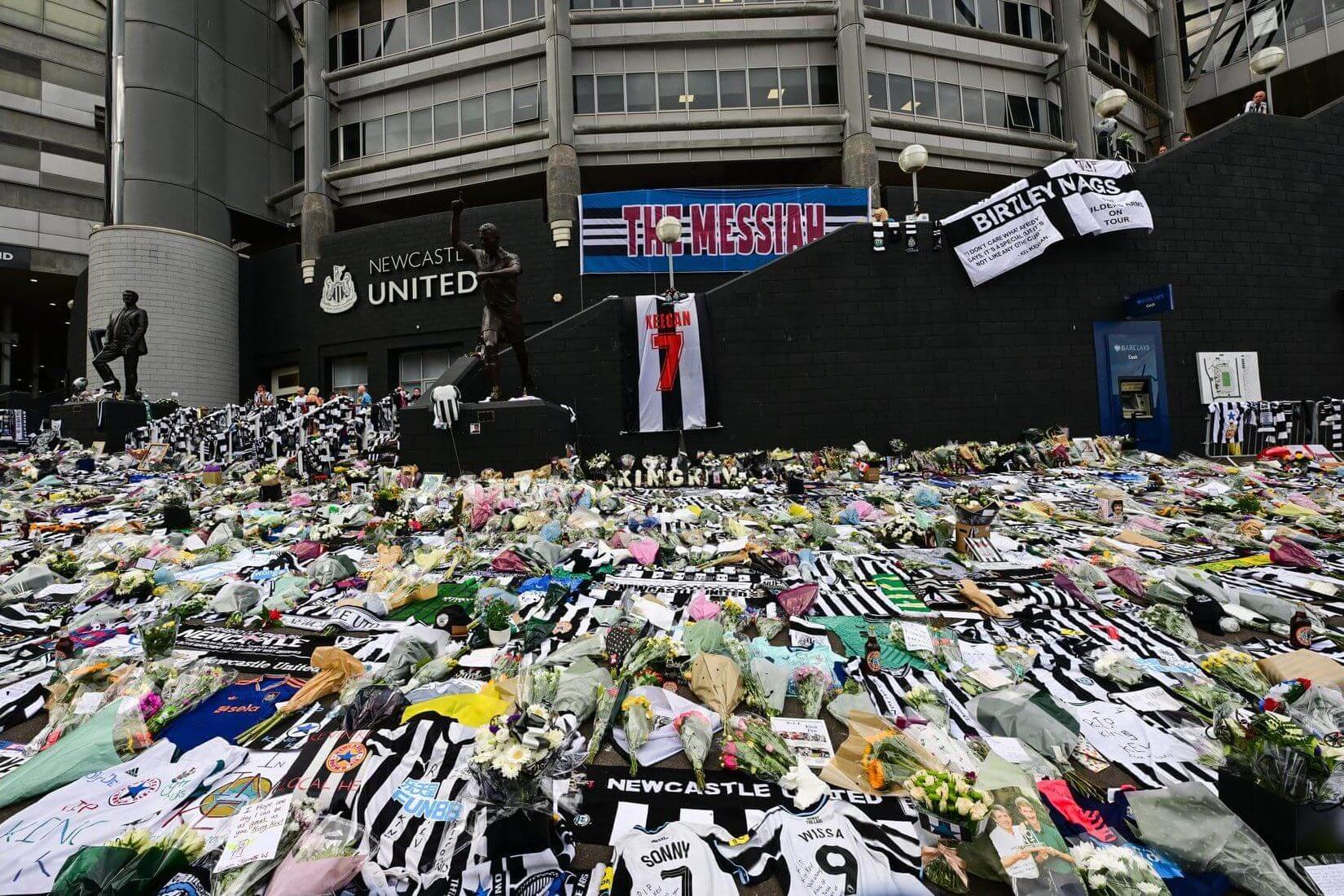
Keegan’s cancer revelation was a shock, but nothing compared to the walloping force of the news of his death. Tyneside, rocked onto its heels, head swimming in grief, did the only thing it thought it could and made for the stadium. In a sport beset by increasing corporate choreography, what followed was spontaneous, sincere, human: flowers, shirts, scarves, flags and much else were laid by an endless stream of fans quietly shuffling up the Gallowgate hill. Day after day.
Tributes outside St James’ Park to former player and manager Kevin Keegan (Newcastle United FC)
This response — full-hearted, full-throttle, fullalove — was a vivid example of Keeganism itself, as this corner of England knows and understands it.
Keegan would have been unsurprised. As he wrote of Tyneside’s strength of feeling towards him: “Eventually I taught myself to anticipate it by imagining the most extreme reaction in any given set of circumstances — and that was what always occurred.”
If not reeling to quite the same extent, Liverpool, the club and the city, were also suffering. They first felt Keegan as a young, vital force, seemingly from nowhere — Scunthorpe United — infusing his new team with ferocious energy and under-rated talent. Those memories of Keegan chasing, Keegan scoring, Keegan leading 1970s Liverpool across England and Europe to trophy upon trophy were clattered by 2026 reports of his illness and death.
Once some form of steadiness was regained, however, Merseyside remembered. Redmen started to count: three League titles, one FA Cup, two UEFA Cups and the European Cup. All won in the space of six seasons with Keegan, as nominated by Liverpool’s legendary manager Bill Shankly himself, the essential presence.
Would the Liverpool of today be as totemic without the 1970s? No. Would the Liverpool of the 1970s have been what it was without Kevin Keegan? No.
Liverpool had not won a trophy, any trophy, for six seasons, when Keegan arrived. His first season, 1971-72, was barren, but he was only 20 turning 21. Shankly was rebuilding. The next season Keegan was joint top scorer as Liverpool were champions of England for the first time in seven years and also seized the club’s historic first European trophy. In his autobiography, Shankly called Keegan “the inspiration of the new team”.

Kevin Keegan in action against Everton in 1977 (Tony Duffy/Allsport/Getty Images)
A decade later, Keegan the catalyst, now 31, twice winner of the Ballon D’Or and still — just — captain of England, turned up at Newcastle United. The club had finished ninth in the old Second Division, today’s Championship. Heads were scratched.
In Newcastle’s last home game of season 1981-82, the attendance was 9,400. When Keegan made his debut in the opening game of 1982-83, the attendance was 36,500. In the local newspaper, the Evening Chronicle, John Gibson wrote bringing Keegan to Tyneside was “like opening your own bank”.
Keegan stayed two seasons and lifted Newcastle to promotion. Yet even that achievement paled when compared to his intoxicating return in February 1992 as manager. Newcastle were back in the Second Division and thinking about a first-ever drop to the Third. They were second-bottom after a 5-2 loss at Oxford United spelled the end for Ossie Ardiles.
So initially Keegan came back as a firefighter. His first game was won 3-0 against Bristol City. Newcastle stayed up. Then the catalyst resumed: Newcastle won the opening 11 league games of the next season and surged to promotion. St James’ Park, literally, began its transformation.

Keegan and coach Terry McDermott ahead of their first game in charge of Newcastle United, against Bristol City, in February 1992 (Mike Hewitt/Getty Images)
And now to Sunday. In the first match of Premier League 2026-27, a beautifully sad coincidence brings Newcastle United and Liverpool together on the grass Keegan once scrutinised with Shanklyesque zeal.
At least until kick-off, club rivalry will be set aside; there will be northern English empathy. Keegan once remarked he played in port cities — Liverpool, Newcastle, Hamburg, Southampton — and a restless figure did not like to overstay a welcome.
At St James’ Park, though, he is permanent. It would not exist as it does without him.
Kevin Keegan’s first day in Liverpool has gone down in Red folklore. So, too, his last.
The first was at Anfield in May 1971, when he sat on a bin outside the stadium sporting a new red kipper tie, ready to sign as he awaited the busy Shankly. Keegan’s last was in May 1977, the European Cup final in Rome, when he ran Borussia Monchengladbach to distraction. On both occasions, Keegan came away a winner.
It could have been different. In September 1968, aged 17, Keegan played for Scunthorpe at the Old Show Ground in a League Cup tie against Arsenal. Arsenal won 6-1, but Keegan impressed to the extent Arsenal asked if they could take him on a forthcoming tour with their youth team. Scunthorpe, eyeing a transfer fee, agreed.
Regulations intervened and, by the season’s end, Arsenal’s interest in Keegan had disappeared. “I couldn’t understand it,” Scunthorpe manager Ron Ashman told the Daily Mirror at the time.
Perhaps it made Ashman all the more determined to drive Keegan from Scunthorpe to Anfield that day in 1971. Not that Keegan needed much persuading. “Liverpool was a dream,” he wrote. He had visited as a schoolboy “to look at the place where the Beatles came from and where the ships came in from all over the globe”. He moved to digs in Lilley Road, a mile or so south of Anfield, and when Derek Hodgson penned his 1978 history of the club, chapter nine was titled ‘The Boy on the Dustbin’.
It’s a beguiling, innocent image. Then Keegan asked Shankly for £50 a week and caught a glimpse of Ashman looking, well, ashen. Both knew Keegan was on £25 a week at Scunthorpe.
Shankly accepted the boldness, Ashman sighed and football had its first example of many of Keegan’s awareness of his financial worth. Liverpool’s squad gave him the nickname ‘Andy McDaft’ — furious energy, wild flares, permed hair — and he had a romantic heart when it came to attacking football. But Keegan had a hard head when it came to personal economics.

Keegan emerges from the players’ tunnel for his Liverpool debut in 1971 (Liverpool FC via Getty Images)
Unnamed in the match programme for the first game of the 1971-72 season, against Nottingham Forest, Keegan made Shankly’s team sheet at No 7 nonetheless. He scored after 12 minutes and never looked back. A first England cap came a year later and a first league title in 1973. Liverpool’s ‘drought’ was over.
As an indication of where the club saw itself, Shankly noted this was Liverpool’s eighth league title, equalling Arsenal’s record. Rivalling Arsenal was seen as significant.
But with Keegan irrepressible and the team a developing force, Liverpool were champions twice more, in 1975-76 and 1976-77. It was this period when the club was established as the most powerful in England and Europe. Arsenal and others were left breathless. By the time Arsenal won their ninth title, in 1989, Liverpool were on to number 17.
A few weeks after that league triumph in 1973, Liverpool won the UEFA Cup, today’s Europa League. Keegan scored twice in the first leg against Monchengladbach, who would be the same opponents in the 1977 European Cup final.
In ’73 the second leg was lost, but Liverpool won 3-2 on aggregate and gripped a landmark European trophy. Such is the club’s European pedigree, it is difficult in 2026 to conceive a time when Liverpool had no such reputation. But there was that time and Keegan was crucial in ending it. As it stands, the 1973 UEFA Cup was the first of nine European trophies to go to Anfield. The first four were won with Keegan at No 7.

Keegan and Liverpool’s captain Emlyn Hughes celebrate their FA Cup final victory over Newcastle in 1974 (AP Photo/BIPNA/Robert Dear)
In the August 1973 edition of Rothmans Football Yearbook, the Old Testament of British football, it described Keegan as “the new hero”, “ebullient”, “wasp-like”.
He became more than that — 1970s pop-star handsome, chirpy and successful. After Shankly’s 1974 retirement Keegan was the face of Liverpool. He captained England one month after his 25th birthday and was soon a national character. In June 1976 Real Madrid offered Liverpool £700,000 for him. Commercially, he was magnetic. As team-mate Phil Thompson wrote in the Daily Telegraph, “Kevin Keegan was Liverpool’s first global star, helping transform my beloved club into a superpower.”
Yet to the consternation of Thompson and others, a recent fan poll of Liverpool’s top 100 players had Keegan at 14. Maybe voters were too young, Thompson thought.
Or maybe it was Keegan’s Anfield departure, announced at the beginning of season 1976-77 by him and market-conscious, which forever skewed opinion. He left for Hamburg in the Bundesliga at the end of that season having secured Liverpool’s first European Cup/Champions League trophy. Shankly’s successor, the understated Bob Paisley, described Keegan’s individual performance as “his finest game for Liverpool in his last match for the club”.

Keegan fires off a volley against Queen Park Rangers back in 1974 (AP Photo/Smith, File)
Keegan came second in the 1977 Ballon D’Or vote, even though he received 11 first preference votes from the 25 countries involved, as opposed to seven for winner Allan Simonsen — of Monchengladbach. Keegan would have been Liverpool’s first European Footballer of the Year, 24 years before Michael Owen claimed the honour.
Keegan won the award the next two years at Hamburg. As he breezily revealed, he had joined them for an annual salary of 400,000 Deutschmarks (the currency then), quadrupling his wages at Anfield.
The transfer fee was £500,000, a British record. And with £440,000 of that sum, Paisley drove to Celtic in person and signed Kenny Dalglish. For the second time in six years, Keegan was Liverpool’s catalyst.
Given what Dalglish did in Keegan’s No 7 Liverpool shirt, given that Dalglish followed Keegan as manager at Newcastle, given the scale of the two personalities, there has always been a comparison between Kevin Keegan and Kenny Dalglish.
Keegan took his flamboyant Newcastle United side to Anfield in April 1996 and lost what is considered the most mesmerising game in Premier League history 4-3. One year later Dalglish returned to Anfield with Keegan’s Newcastle team and lost 4-3. It was uncanny.
But in terms of what Keegan came to mean to Newcastle, as a city as well as a football club, a better comparison might be with Shankly. Shankly is the start of modern Liverpool; Keegan is the start of modern Newcastle United. In each other the two men saw a reflection of themselves. Keegan said it would be “silly” to say it was love at first sight, “but it was something like that.”
Shankly, remarkably, played against perhaps the only historic Newcastle figure comparable to Keegan the player, Hughie Gallacher. Shankly said Gallacher, small and dynamic — like someone who would succeed him as Newcastle striker — “could beat half a dozen men by throwing dummies.” That was one reason to admire Gallacher. Another was because he was “strong-willed”.
Gallacher had an aura. Shankly saw it in Keegan and vice versa.

Liverpool manager Bill Shankly with Keegan at Anfield (Peter Robinson/EMPICS via Getty Images)
Shankly’s first decision as Liverpool manager in 1959, when they were in the Second Division, was to spend £3,000 on new equipment to water the Anfield pitch. Keegan’s first decision at Newcastle as manager in 1992 was to fumigate the depressing training ground. Shankly made foundational signings in Ron Yeats and Ian St John. Keegan did the same with Brian Kilcline and Robert Lee.
Just as the old First Division was happening somewhere else when Shankly arrived at Anfield, the new Premier League was occurring somewhere else when Keegan returned to St James’. His exit in 1984 as a player had been as dramatic as it was from Anfield seven years earlier. It again involved Liverpool, the guests at Keegan’s testimonial.
He left from a helicopter in the middle of the pitch, everyone looking up, including Dalglish, as Keegan dropped his No 7 shirt from the air. St James’ was his theatre.
The funds raised were for Newcastle United’s transfer budget. But the money spent did not keep them in the top flight for long and when Keegan returned in 1992 the club required salvaging.
We should resist nostalgia about Keegan’s Newcastle connection — he negotiated 15 per cent of increased gate money on top of his basic salary when he joined as a player. There was good money for him as a manager, though twice he showed he was prepared to walk away from it. He did not lack willpower.
His entrepreneurial spirit was offset, however, by a family link to Newcastle United and north-east England via his father Joseph. Like Shankly’s family, Keegan’s were coal miners. He was born in south Yorkshire due to Joe Keegan looking for work. Joe spoke with a Geordie accent and his favourite word, according to his son, was “champion”. It’s a very common, everyday Geordie reply to the question of how you are doing.
Sentiment was not the overriding factor in Keegan’s utterly out-of-the-blue decision to sign for Newcastle in 1982, but it was a consideration. When he stepped back and surveyed the club, he saw what Shankly saw at Liverpool — “potential”, a word both used. Keegan’s Geordie roots informed his perception.

Keegan signs autographs after playing for Newcastle at Blackburn in 1982 (Bildbyran/Sipa USA)(Sipa via AP Images)
In August 1992, having kept Newcastle afloat and gained the necessary boardroom authority from chairman Sir John Hall, in his first programme notes of the season, against Southend United, Keegan said of the notion of consolidation: “Forget that.”
Instead the only acceptable outcome was promotion to the Premier League. Keegan knew it would bring pressure but he said he had a long relationship with that. “And frankly I love it,” he wrote. “When the pressure is on it means something is happening. And what will happen at this club is we are on the way up.”
His belief was that soon Newcastle United would be “bigger and more exciting than Liverpool”.
This was different. No one had spoken or acted this way for decades and the city felt it. One year after Keegan’s 1984 helicopter farewell, St James’ hosted another superstar — Bruce Springsteen. He donated $20,000 to the wives of striking miners. Newcastle and the north east was about to be rendered post-industrial, talked down, a place of managed decline. There was no lively Quayside then, no regeneration.
At the club, the three most gifted players — Chris Waddle, Peter Beardsley and Paul Gascoigne — were sold to Tottenham Hotspur (1985), Liverpool (1987) and Tottenham (1988).
Keegan stood against this drift, this lessening. He would bring footballers to the north east, not export them.

Newcastle fans hold a flag of Keegan prior to the FA Cup third-round match against Bournemouth in January (Annabel Lee-Ellis/Getty Images)
The novelist Jonathan Tulloch met Keegan in the 1990s and Tulloch’s assessment is worth revisiting: “He means a lot to the area because he understood that for them football was about self-esteem.
“Basically one of the oldest parts of the industrialised world was in decline and football represented the last flower of that old sense of co-operation and community. Keegan might not have articulated it that way but he certainly understood it. That’s why the name Keegan represents something.”
What he represented at Newcastle in the early to mid-1990s was ambition and leadership. He was ‘King Kev’.
Four years to the week after inheriting the mess of a 5-2 defeat at Oxford, Keegan’s latest signing Faustino Asprilla made his debut at Middlesbrough. Newcastle won 2-1 and were nine points clear of Manchester United — with a game in hand — at the top of the Premier League. In just four years, Keegan had spurred a disintegrating club into a united entity known for its energy and style, cherished as the ‘Entertainers’. Four years.
Thousands would turn up just to watch training. There was sheer joy — Warren Barton once instructed Keegan to perform press-ups on the touchline during a game at St James’ for calling a throw-in the wrong way. It was squad policy, a small punishment for an error. Keegan did it. The players were roaring with laughter.

Keegan salutes the Newcastle support at St James’ Park in 1996 (Clive Brunskill/Allsport/Getty Images)
Ultimately Keegan’s team fell short, but this was no failure. Think of where it began, where it ended and what came between. It was unforgettable, and it had a broader catalytic effect on the new Premier League.
It can sound like cod-sociology, measuring an intangible such as the impact one individual can have on a place. But to be in the city in those years, to be in the bars of Percy Street after a televised Newcastle away game and witness the immediate silence when Keegan appeared on screen post-match, was to experience something beyond fandom, beyond football, something deeper.
Plus, Keegan came back. He was always coming back, even in May.
It is why ‘King’ graffiti has sprouted up in Newcastle. It is why Sunday afternoon will be moving, special; why all four sides of an unmistakable stadium will be together in acclaim. Liverpool fans helicopter-high in a Leazes End unrecognisable from Keegan’s bus shelter. It is why amid all the tributes flowing at St James’, one shirt laid carefully on the ground had written across it: ‘Thanks for making this city believe again.’