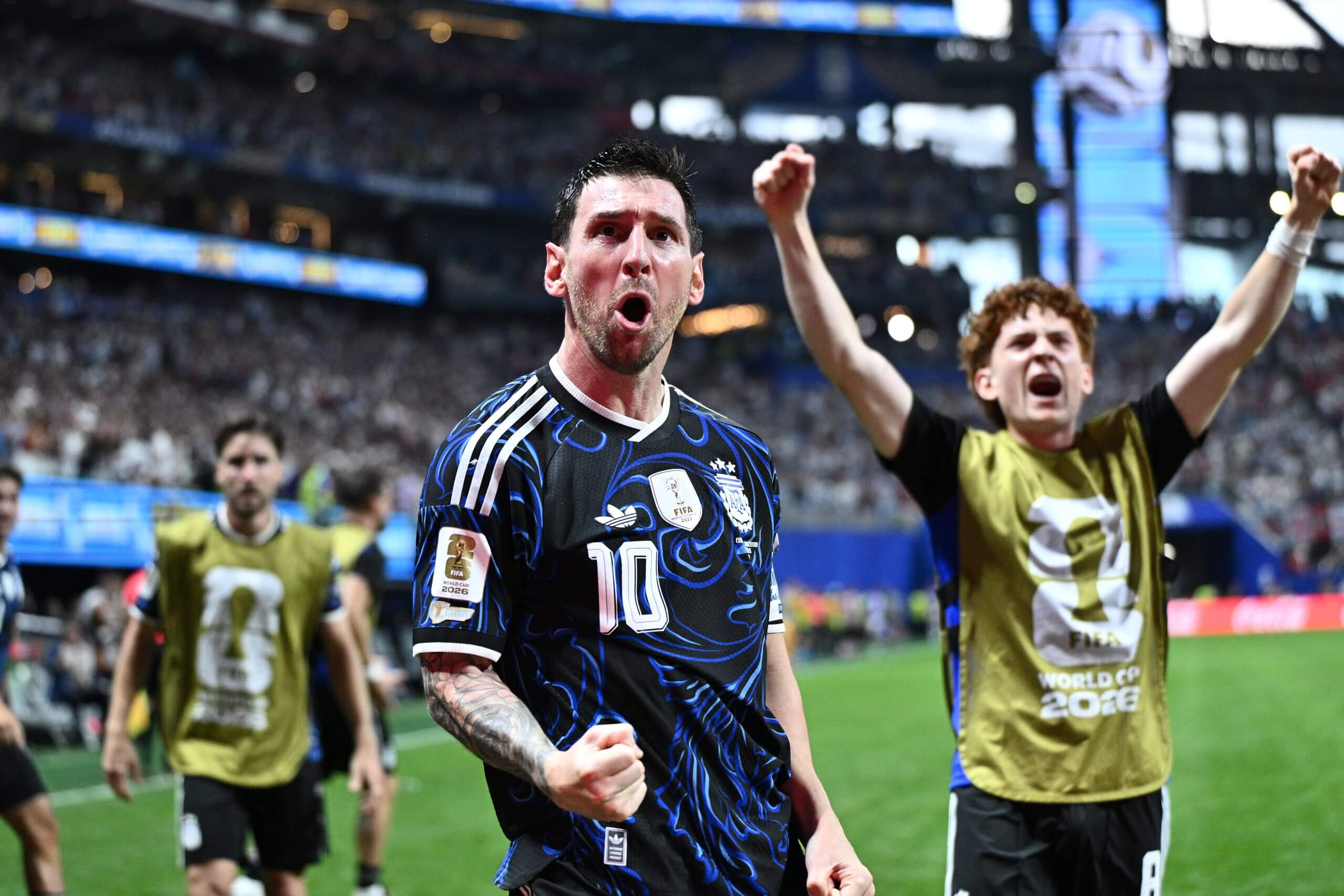
For the past two decades, watching Lionel Messi has been a joy, a privilege and a source of near-constant wonder. There are good footballers, there are great footballers and then there is Messi, who plays as if he has been sent here from another dimension, a superior life form inside the 5ft 7in frame of a normal guy from Rosario, Argentina.
At the dizzy peak of his powers at Barcelona, spanning all the way from the late 2000s to the early 2020s, he took the breath away almost every time he played. In the blink of an eye, he went from mesmerising to killer mode. He didn’t just score goals at a prodigious rate. He created, caused havoc and performed in a way that left even the most cynical press-box veterans in thrall.
Watching Messi at this World Cup — and indeed the previous one, given how little we knew at the time — has felt different. You are not just watching in awe of his other-worldly talent. You are watching in disbelief that he is still doing it, albeit perhaps more sporadically, at the age of 35 in Qatar in 2022 and at the age of 39 now, and knowing, in the knockout stages, that each time might be the last you see him play on the sport’s biggest stage.
Beyond that, there is the knowledge that every game, every performance, every dramatic intervention on Argentina’s behalf, is embellishing a sporting legacy that already seemed complete. Among those who have long felt Pele’s or Diego Maradona’s legacies unsurpassable — perhaps even for a small minority of those who insist the Argentina captain is not the greatest of the modern era — Messi is challenging deeply entrenched beliefs.
Sunday’s final against Spain will be Messi’s last game on the World Cup stage. He has made that clear — even if he said the same thing in 2022 and for a long time afterwards, reflecting that leading Argentina to glory at his fifth attempt, fulfilling his life’s ambition, “closed a circle” and represented the perfect ending.
This time it really will be the end. That song Argentina’s players and fans have been singing, which features a well-documented line about wanting to win the World Cup “por las Malvinas” (for the Falkland Islands, the subject of a decades-long dispute with the UK), also contains a line about wanting to do it “por la ultima de Leo” (for Leo’s last one).
Messi has appeared far more emotional at this World Cup (Getty Images)
He might yet continue as far as the Copa America in 2028, also to be held in the United States, but the 2030 World Cup looks beyond even his remarkable powers of endurance. For the vast majority of sports fans across the world, those who are not minded to tune in to follow his exploits for Inter Miami in Major League Soccer, this could, realistically, be the last time they see Messi play.
At times over the past five weeks, it is as if that realisation has dawned on him in the closing stages of games. For long periods he has been quiet until, at 2-0 down against Egypt in the round of 16 and trailing England 1-0 in the semi-final, a raging intensity has taken hold of him. As his former Barcelona team-mate Thierry Henry put it, in the Fox studio: “You do not (want to) wake up the beast. You look at his eyes, and he switches. When he goes into that mood, it’s very difficult to stop him. He starts to take the ball and dribble past almost everybody to try to change the game.”
The danger is that, if Argentina find themselves trailing once again in Sunday’s final, their opponents will be far less accommodating than Egypt and particularly England were. England’s response to taking the lead against Argentina in Wednesday’s semi-final in Atlanta was to retreat further and further until Messi’s inevitable impact, setting up goals for Enzo Fernandez and Lautaro Martinez. By contrast, Spain’s response to going 1-0 up against tournament favourites France 24 hours earlier was to double down and dominate the game until they scored a second.
Since a stuttering start with a draw against Cape Verde, Spain have looked the most complete, most cohesive team of this tournament. Argentina have played in bursts, frequently drawing on their never-say-die spirit as well as Messi’s brilliance. Bookmakers’ odds, data-based predictive models and indeed the majority of Athletic readers in our predictions hub lean towards a Spanish victory at MetLife Stadium.
That said, France were favourites in the last final and Argentina beat them, albeit by the finest of margins, recovering from the shock of Kylian Mbappe’s hat-trick before holding their nerve to win the penalty shootout.
In 2022, there was much focus on the symbolism of a meeting between Messi and Mbappe, seemingly the heir to the Argentinian’s throne. Mbappe is a wonderful player, as he has demonstrated for France during this World Cup, but Messi has remained pre-eminent, even while playing his club football in Florida. Now thoughts turn to whether tomorrow’s final might see the torch passed to Spain’s 19-year-old phenomenon Lamine Yamal, which would be all the more poignant given the extraordinary circumstances of their only previous meeting.
In these situations, the narratives can be so seductive. But in Messi’s case, his status and his legacy are surely by now so secure that he has nothing left to prove.
The same feeling took hold in the build-up to the 2022 World Cup final. The notion that Argentina had to win it in order to secure his position on the pantheon of all-time greats, elevating him to the level of Pele and Maradona, was appealing but ultimately facile. Had Argentina lost that penalty shootout, rather than won it, would it really have caused Messi’s career to be seen in a less favourable light?
It probably would, but it shouldn’t. Before that World Cup final in Qatar, he had played 1,002 games at senior level for club and country. In that time, he had changed our perception of what elite performance in football looks like. The idea that his legacy should hinge on the outcome of one game — let alone a game settled on a penalty shootout — was the 1,003rd game of his career for club and country. His greatness had already been proved over and over.
The same applies now. Sunday’s final will be the 1,196th game of his career. It makes little sense to suggest that his legacy hinges on whether or not, at the age of 39, he is able to lead Argentina to a second world title.
But that word “lead” is significant because, for years, leadership was the one thing Messi was perceived to lack. His talent was extreme, but his introverted personality seemed at times to inhibit him on the World Cup stage, where the burden of trying to deliver glory for his country — as Maradona did so memorably in 1986 — weighed so heavily on his shoulders. Maradona himself remarked after Argentina’s defeat by Chile in the 2016 Copa America final that Messi had “no personality” and lacked the “character” to be a leader.

Messi has a devoted following among Argentina’s players (Elsa/Getty Images)
In 2016, Messi was faced with a dilemma: fight or flight. His instinctive reaction, tearful after losing another final, was to throw in the towel, to announce his career with Argentina was over at the age of 29, to focus on his club career, which by comparison brought him so much joy and so little anxiety by comparison.
But then he listened to his heart, listened to the advice of his nearest and dearest, and pledged to carry on trying to bring Argentina’s success. He reevaluated his role as a captain and a leader and made it his greatest obsession. He finally won his first senior trophy with Argentina at the Copa America in 2021. Since then, they have won the Finalissima (one-off match between the champions of Europe and the Americas), the World Cup in 2022 and the Copa America again in 2024 and now he has the opportunity to win his second World Cup and Argentina’s fourth.
In some ways, watching this late-career Messi has become just as compelling an experience as watching the one who recorded a quite absurd 91 goals and 22 assists for Barcelona and Argentina in 2012. Not as reliably, breathtakingly, constantly brilliant — you would not expect that of a 39-year-old — but perhaps slightly more human, more relatable, more conscious of his own (notional) fallibility and of how time is now so precious, particularly in those moments when Argentina’s ambitions have been hanging by a thread.
He knows his time as a footballer is running out. He knows his powers have to be used more selectively these days. There have been times at this World Cup, even until the closing stages of the semi-final against England, when it has felt as if his endeavours over the previous might just have caught up with him. Watching him has become a more intense, more dramatic experience, perhaps less about appreciating his incredible talent and more about marvelling at his ability to conjure up one more piece of magic when the stakes are so high and when time — not just on the scoreboard but on his body clock — appears to be catching up with him.
He is astonishing: the prolific goalscorer who is also a selfless creator; the virtuoso who brings out the best in every team-mate; the quiet, unassuming guy who is transformed with a ball at his feet; the teenage wonderkid who is illuminating the World Cup more brightly than ever in his 40th year.
Now, as ever, he leaves his audience in thrall.