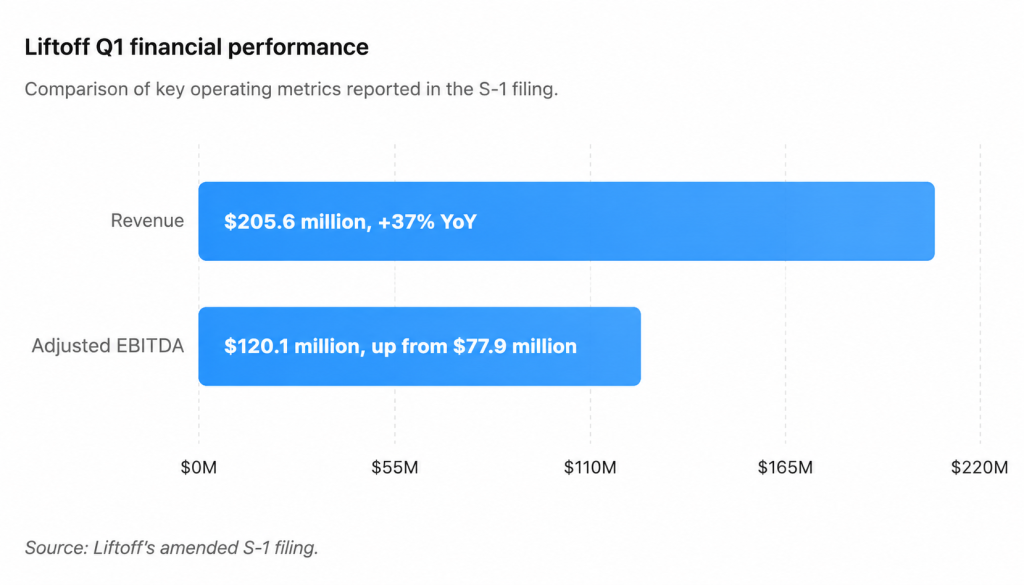
On the morning Liftoff Mobile finally hit the public markets and raised $437 million, CEO Jeremy Bondy sat down with Digiday to explain why the company, backed by a private equity firm Blackstone, decided to make its initial public offering now and how he intends to thrive as a Nasdaq-listed entity.
Earlier this year, Liftoff walked away from a hotly received roadshow after markets suffered their “SaaS-apocalypse” wobble, sending investors scrambling to triage their portfolios rather than back new listings.
Since then, Liftoff has notched a “tenth consecutive quarter of growth,” markets have stabilized, and investors have started to regain confidence, with Bondy arguing that now is the window the company has been waiting for — even if the June raise was short of its initial ambitions.
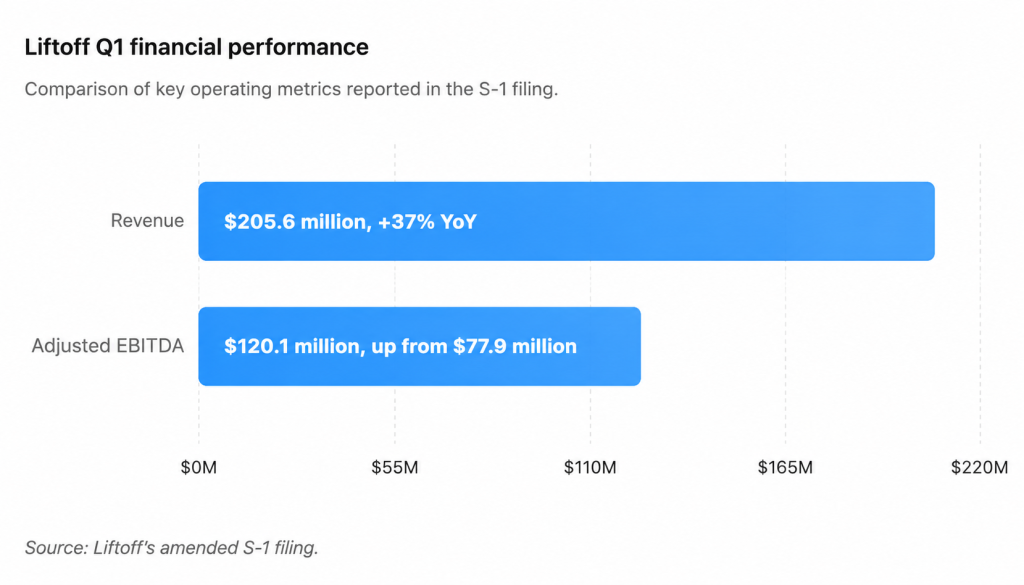
In conversatiaon with Digiday, Bondy framed the firm as a pure-play, AI-driven performance engine for the app economy, distinct from both “traditional ad-tech incumbents” and Big Tech, stressing the Blackstone-backed outfit’s role in the “highly fragmented ecosystem of 4 million apps” in helping them acquire and monetize users, with the outfit’s neural net–based recommendation engine Cortex at the core of its monetization efforts.
Why Liftoff came back to market
While market observers may view Liftoff’s aborted February IPO attempt as a sign of hesitation, Bondy characterized the decision as a response to unusually volatile conditions rather than any change in investor appetite for the company.
“There was a ton of investor enthusiasm in February, and the launch to the road show was really, really strong,” Bondy said. However, he explained, markets deteriorated rapidly during the process, with investors suddenly more concerned about existing holdings than evaluating new listings.
“What you had in the days since the road show launched, and the day that we decided to walk away,” he said, referring to the notorious “SaaS apocalypse” of early-2026. “Any sort of an investor who’s very bullish on the story… is now focused on their portfolio and the health of their portfolio.”
What changed between February and June was not the company, Bondy argued, but the environment around it. Liftoff continued to grow, delivering what he described as a 10th consecutive quarter of expansion since launching Cortex, the company’s neural network-based recommendation engine. “Our thesis, our business really only did get stronger,” he added.
Positioning against ad tech incumbents
Asked where Liftoff fits within the public ad tech landscape, Bondy drew a distinction between companies built around the app economy and those rooted in display advertising, television, or other forms of digital media.
He acknowledged similarities with AppLovin, describing both companies as sharing “a lot in common on neural net technology” and large-scale SDK distribution. However, he argued Liftoff’s focus across the broader app ecosystem sets it apart.
“We work with travel apps like Booking.com to optimize for dollars per night stayed in the hotel, which is very different from games,” Bondy said.
He was more reluctant to compare Liftoff directly with companies such as The Trade Desk, Criteo, or other traditional ad tech platforms, arguing that the economics of the app economy are fundamentally different.
“The in-app economy is unique because you have at this point 4 million independent businesses,” he said, noting, “all these one- and two-person shops all over the world that are trying to figure out how to monetize their app, or how to advertise.”
Per Bondy’s assessment, such fragmentation creates a market dynamic that rewards recommendation engines and automation technologies capable of operating across vastly different environments.
Cortex and the AI story
Much of Bondy’s investment case ultimately comes back to Cortex, which he repeatedly described as the company’s answer to AI. The technology, he said, has fundamentally changed how Liftoff operates.
“We now have 20 times the data in our model that we had prior to Cortex,” Bondy said. “We now can ramp an advertiser’s campaign profitably much, much, much faster — an order of magnitude faster.”
While acknowledging that competitors such as AppLovin and Meta have also embraced neural network architectures, Bondy argued that Liftoff’s advantage lies in the breadth of data generated across the app economy. “We get about $160 billion a year of consumer purchase data directly from our advertisers,” he said, adding that it spans categories including travel, finance, dating, and gaming.
Such a diversity of signals, he argued, improves the quality of recommendations across the platform and strengthens Liftoff’s position as a marketing engine for app developers.
Beyond gaming
Although gaming remains a major part of mobile advertising, Bondy said some of the strongest growth is now coming from elsewhere. In a subsequent email exchange with Digiday, he identified e-commerce as a particularly important area of expansion.
“Consumer behavior is shifting decisively toward in-app purchasing,” Bondy wrote. “Brands that used to think of mobile as a top-of-funnel awareness channel are now treating it as a primary conversion surface.”
The broader implication is that Bondy sees the app economy as still being in the early stages of monetization. Despite Liftoff’s software being embedded in more than 160,000 apps and reaching approximately 1.4 billion daily active users, he argues there remains significant room for growth.
Liftoff’s leadership maintains that the combination of expanding consumer behavior, AI-driven optimization, and continued fragmentation sets the company apart from both traditional ad tech incumbents and Big Tech platforms. Hence Bondy believes investors are ultimately willing to back the company’s return to the public markets.