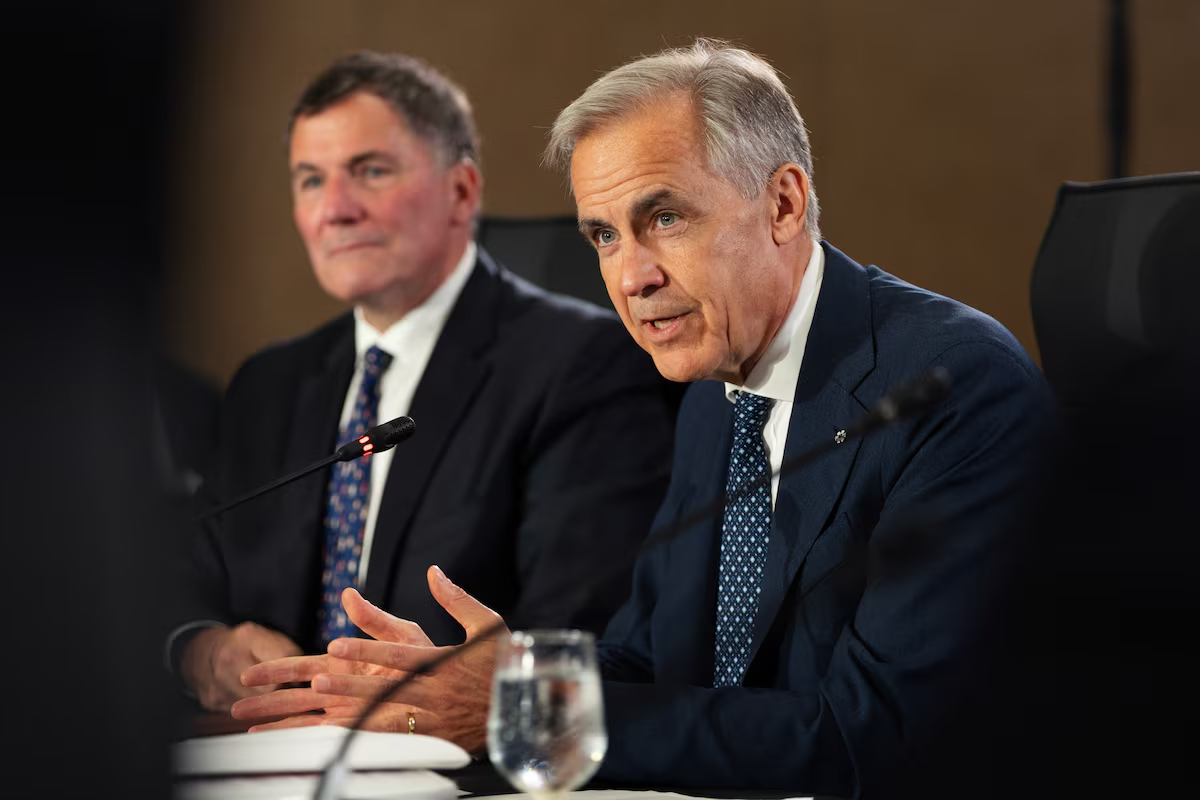
Prime Minister Mark Carney, right, and Canada-U.S. Trade Minister Dominic LeBlanc, left, in Charlottetown on July 23.Darren Calabrese/The Canadian Press
Slow and steady
Re “Lumber, auto tariffs remain sticking points as negotiations with U.S. enter final stretch” (Aug. 17): I generally vote Conservative, probably due to my small-c nature. However, I voted Liberal in the last election due to Mark Carney.
I am so far impressed with his leadership and how he is handling the administration of our southern neighbour. I agree with our government’s strategy of finding other trade partners for a better economic future.
Unfortunately, Mr. Carney now seems to be listening to his political handlers when dealing with the public. He sounds more like a politician than the leader he came in as.
Trade agreements are not overnight negotiations. I trust Mr. Carney’s instincts on how to make this happen. I hope he maintains the course and does not bend to the impatient few.
I also hope our negotiators don’t capitulate for the sake of looking good to shortsighted voters. Chances are, they won’t remember the result in a month or so anyway.
Chris McCabe The Blue Mountains, Ont.
Milking it
Re “The U.S. is right to be sour over dairy quotas” (Editorial, Aug. 14): Asking us to allow more U.S. dairy would be akin to asking us to replace beef tenderloin with hot dogs.
U.S. factory farms overproduce a product loaded with bovine growth hormone. It would not reduce prices for the consumer, because our wonderful grocery stores would likely charge the same money for an inferior product.
So who, exactly, would benefit? Dairy farmers – all farmers, really – do not have careers, it is their lives. Cows don’t take vacation.
Blair Faulkner Truro, N.S.
Supply management may be the antithesis of a free market.
So are the massive taxpayer subsidies received by U.S. dairy farmers.
Lyle Clarke Whitby, Ont.
The argument is that we should modify our dairy tariff-rate quotas not because Donald Trump asked, but because trade treaties should be binding. In other words, we should honour our commitments.
Canada already modified its dairy TRQ administration following the first USMCA dispute. Subsequently, it won the second dispute.
If the rules matter, then so do their interpretations. To give in now would be to undermine the dispute settlement mechanism for which we fought so hard.
It is stronger to simply point out that farmers were compensated for greater access than what was conceded in practice. Nevertheless, we should be careful not to give on anything to Mr. Trump for nothing.
Noah Fry Killam Postdoctoral Fellow, department of political science, Dalhousie University; Halifax
Business case?
Re “The national interest in a new bitumen pipeline must be accommodated” (Editorial, Aug. 13): If a new pipeline was such a good idea, then pipeline companies would be competing for the chance to build it. It is just too risky, then.
Where are the markets? Asian nations are adding renewables to their energy mix and achieving their own versions of “economic sovereignty,” instead of being at the mercy of volatile fossil fuel prices and supply.
Even if one doesn’t buy the argument that fossil fuel production is harmful to our world, this project does not seem to make business sense. Assets could be stranded and taxpayers left on the hook for this folly. In the national interest? I don’t think so.
I believe that investing in the transition to a more liveable world should be our goal. This is something the the Union of British Columbia Indian Chiefs should be able to support.
Cathy Page Calgary
To a halt
Re “Stellantis weighs selling idled plant in Brampton, Ont., union says” (Report on Business, Aug. 15): Stellantis received a $529-million federal grant in 2022, contingent upon keeping production at its facilities in Brampton and Windsor, Ont. It failed to keep up its half of the bargain.
Stellantis should be pressured to pay back the grant plus interest, which should be invested in partnering with a vetted foreign company interested in building the next generation of electric and hybrid vehicles in Canada, for Canadians and for export to markets outside the United States.
Anne Greenwood Toronto
Why not sell the Stellantis plant to BYD? The Chinese electric carmaker would no doubt like to increase its foothold in Canada while employing 3,000 auto workers.
Daniel Hrycyk Baie-D’Urfé, Que.
Bring back
Re “Manitoba opens first supervised drug-use site in Winnipeg after prolonged delay” (Aug. 12): Manitoba’s decision to open the country’s first Indigenous-led supervised consumption services site is evidence-based and courageous. While Ontario has closed all publicly funded SCS sites, it is heartening to hear Manitoba is listening to what experts have said time and again: Harm reduction saves lives.
In Toronto, paramedics saw an increase in opioid overdose calls in early August. With SCS sites closed, this trend will likely continue and lead to more preventable deaths.
While treatment is an important part of the care continuum, harm reduction services offered at SCS sites are life-saving. They include safe needle exchange, overdose prevention in safe environments and access to primary care.
Doug Ford says he wants to support all Ontarians. He should heed the advice of nurses and other health providers by reopening SCS sites across the province.
Wab Kinew is putting support where it is needed. Will Mr. Ford do the same?
Doris Grinspun RN, PhD, O.Ont; CEO, Registered Nurses’ Association of Ontario; Toronto
Shine bright
Re “Zhu Rongji was mythical – and also a man who did the work” (Aug. 17): The Icarus metaphor of “flying too close to the sun” was famously applied to Zhu Rongji by Time magazine in October, 1998.
In a profile titled “China’s missing pieces,” journalist Terry McCarthy wrote about the political resistance Mr. Zhu was facing over his aggressively ambitious economic reforms: “When powerful men fly too close to the sun, two things can happen: They modify their course, or they come crashing down. China’s most daring highflyer, Premier Zhu Rongji, has come very close.”
Mr. Zhu responded in an off-the-cuff speech in Beijing that fall, seated between contributor André Desmarais and then-prime minister Jean Chrétien (I was a diplomat assigned to take notes from a lower table that evening). He humorously said about the Time piece that Mr. Chrétien could see he had no burnt feathers or roast chicken aroma.
There was no reference to the United States in Mr. Zhu’s remarks that night.
Charles Burton Ottawa
………………………………………………………………………………………………………………….
Letters to the Editor should be exclusive to The Globe and Mail. Include your name, address and daytime phone number. Keep letters to 150 words or fewer. Letters may be edited for length and clarity. To submit a letter by e-mail, click here: letters@globeandmail.com