DeepSeek Shakes Markets in 2025
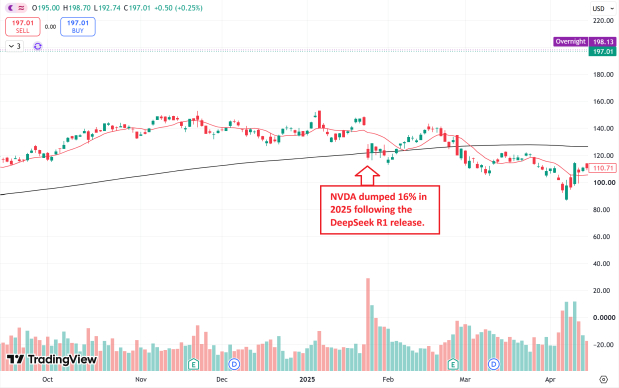
On January 27, 2025, a relatively unknown Chinese-based artificial intelligence company shook up Wall Street. At the time, the AI buildout was in the early innings, and the majority of leading U.S-based technology stocks were at or near all-time highs. However, DeepSeek changed the narrative overnight when it launched its R1 AI model. The company claimed that, unlike leading AI companies like OpenAI and Alphabet (GOOGL), which require hundreds of billions of dollars in hardware, power, and data centers, it was able to build a rival model for a mere $5.6 million. Meanwhile, according to DeepSeek, it was able to bypass U.S. government controls on NVIDIA’s (NVDA) top chips and get similar results using fewer and older GPUs (A100s & H800s).
If DeepSeek’s claims were true, it would mean that hyperscalers like Meta Platforms (META) and Amazon (AMZN) were undercut after spending hundreds of billions of dollars on expensive AI infrastructure. In late January 2025, investors didn’t wait for an answer and instead sold first, and asked questions later. Wall Street would lose roughly $1 trillion in a single day while chip leader NVDA would plunge 17% on massive volume turnover.
Image Source: Zacks Investment Research
DeepSeek Fallout: Cooler Heads Prevailed
After the DeepSeek carnage, AI stocks slumped for a few months before fully recovering their losses (and then some). Below were the reasons for the recovery:
· “Jevons Paradox”: The main reason for the vicious recovery was that investors realized that efficiency does not equal demand. In fact, Jevons Paradox suggests exactly the opposite. That is, when costs come down, consumption explodes.
· CapEX Spending Stayed Steady: Despite the fear reverberating through Wall Street, big tech CEOs continued to commit billions to AI infrastructure, suggesting that they did not view the DeepSeek breakthrough as a reason to stop committing capital. Later, corporate earnings would suggest that the fundamentals of AI companies continued to grow despite the DeepSeek threat.
· Debunking Spending Claims: Following the knee-jerk reaction to DeepSeek, tech experts investigated and found that the $5.6 million in spending suggested by the company was misleading at best. The $5.6 million was instead an iteration on top of pre-existing hardware and multiple years of research and development.
Kimi K3: DeepSeek Déjà vu?
Currently, the Nasdaq 100 Index (QQQ) is having its worst July in over two decades. The reason for the sell-off is that a Beijing-based start-up named Moonshot AI released a flagship named Kimi K3. The open-source model is one of the most efficient AI models ever released, and its performance is said to be near or on par with top U.S AI models. Once again, investors are selling first and asking questions later amid CAPEX ROI anxiety and hardware demand concerns.
Atreides Management’s Gavin S. Baker is one of the top tech investors on Wall Street and worth listening to. In January 2025, Baker was one of the first on Wall Street to suggest that, contrary to popular belief, DeepSeek’s rise would be a buying opportunity and highly bullish for physical infrastructure and hardware providers. He was absolutely correct.
Gavin Baker’s Kimi K3 Take
In his latest comments, Baker argues that Kimi K3 may threaten the dominance of closed-source giants like OpenAI and Anthropic. Nevertheless, Baker notes that Kimi K3 may level the playing field and create healthier economics across the “AI cake.” Meanwhile, Baker’s July 16th social media post was more direct, writing:
“Risk reward seems attractive again. Lots of cheap stocks with durable competitive advantages that are going to crush numbers for the next 6-12 quarters. Time will tell!”
In other words, Baker seems to believe that, just like DeepSeek, the Kimi K3 fear, uncertainty, and doubt will create a buying opportunity.
Bottom Line
Kimi K3 has reignited AI cost fears and has decimated tech stocks. However, the current carnage is eerily similar to the DeepSeek disruption of early 2025.
Beyond Nvidia: AI’s Second Wave Is Here
The AI revolution has already minted millionaires. But the stocks everyone knows about aren’t likely to keep delivering the biggest profits. AI’s second wave is moving from infrastructure to implementation and these companies are at the forefront of this transition, positioned to become what Amazon and Google were to the internet era.
Amazon.com, Inc. (AMZN) : Free Stock Analysis Report
NVIDIA Corporation (NVDA) : Free Stock Analysis Report
Alphabet Inc. (GOOGL) : Free Stock Analysis Report
Meta Platforms, Inc. (META) : Free Stock Analysis Report
This article originally published on Zacks Investment Research (zacks.com).
The views and opinions expressed herein are the views and opinions of the author and do not necessarily reflect those of Nasdaq, Inc.