
Beijing’s intensifying efforts to shape international norms on AI are calibrated to promote itself as a responsible global leader, but they are largely self-serving, aimed at catching up on the technology and exporting China’s illiberal values. Democracies need to get their act together in response.
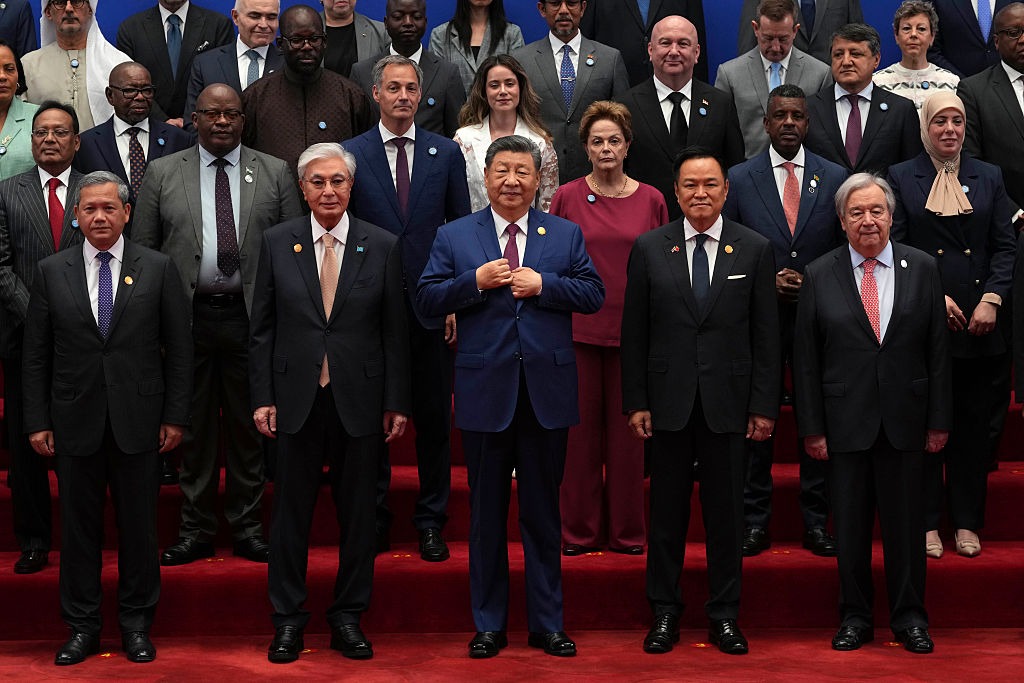
President Xi Jinping delivered a keynote speech at the 2026 World AI Conference and High-Level Meeting on Global AI Governance on 17 July, making the case for the promotion of AI globally ‘for the positive, for good and for humanity’. He called for ‘a people-centered approach’, saying that ‘AI is an important driver for shared prosperity and common security’ that required states to join hands ‘to build a just and equitable system for global AI governance.’
So Xi said all the right words. After all, China has never been short on its rhetoric. At last year’s edition of the conference, Premier Li Qiang made a strong case for global regulations governing AI using language designed to appeal to the Global South.
Noting the vast opportunities and challenges that come from the adoption of new technologies, Xi raised four points on AI development and governance: he promoted openness, collaborating and sharing; recognised the various risks associated with AI adoption and the resultant need for AI always to be under human control; encouraged inclusiveness and the promotion of mutual learning between civilisations; and called for true multilateralism and an important role for the United Nations as well as a consensus-based governance framework in writing new global rules and technical standards.
His emphasis on international cooperation and openness has definite appeal. But it also appears to be somewhat self-serving, as China still depends on others. Henry Gao, a professor of law at Singapore Management University, says that China ‘wants access to global models, talent, chips, research, open-source ecosystems and technical knowledge because that is what it needs at this stage.’ Alexander Evans, former cyber head at Britain’s Foreign and Commonwealth Office and former adviser to then prime minister Boris Johnson, similarly noted that China needed international cooperation because ‘no country has complete vertical control’.
Xi’s opposition to ‘overstretching the national security concept in the field of AI’ is a rather brazen effort to target US restrictions on allowing China to access the United States’ AI technology. This is particularly rich considering Beijing’s own role in securitising crucial assets such as trade, data, finance, markets and access to rare earths – areas where China has deliberately created advantages for itself.
Much of the speech was aimed at the Global South. These nations will appreciate Xi’s call for international cooperation to help them with capacity building to avoid AI capability gaps and bridge existing digital divides. But they should not be fooled: Xi’s efforts are geared towards exporting what it considers responsible norms, rules and standards, which will pay no heed to universal principles such as human or political rights.
Xi has convinced some regional blocs to support China’s vision by saying that, in the next five years, it will assist developing countries ‘with 5,000 opportunities in AI training and seminar programs’ and ‘develop international AI application cooperation centers with the Association of Southeast Asian Nations, the League of Arab States, the African Union, the Community of Latin American and Caribbean States, the Shanghai Cooperation Organization, and BRICS.’ It’s too early to say how this will play out and whether these organisations will endorse the emerging Chinese version of the AI order.
China is already globally exporting its tech, such as 5G network gear, drones, smart cars and renewable-energy equipment. Democracies cannot afford for it to succeed similarly with AI.
In his speech, Xi also announced the establishment of the World AI Cooperation Organization for facilitating international cooperation on AI governance and development. On 16 July, 29 countries – including, Pakistan, Russia, Malaysia and Indonesia – became founding signatories. This is an impressive achievement for China, but its future remains to be seen.
But remember that China’s efforts in global governance of other domains haven’t always borne fruit. China and Russia proposed a draft Treaty on the Prevention of the Placement of Weapons in Outer Space and of the Threat or Use of Force Against Outer Space Objects in 2008 and a revised text was introduced in 2014, but there haven’t been many takers. Even those countries that have argued for legally binding mechanisms did not support the treaty. This may show how China’s AI governance journey could pan out.
While countries should be concerned that without any regulations, AI will do more harm than good, it is also necessary to come up with the right norms and rules. Allowing China, an illiberal, authoritarian and aggressive great power with a penchant for centralisation and hegemony, to determine the rules for AI governance is likely to be dangerous everywhere, including in the Global South. Xi’s speech should sound the tocsin to liberal powers across the world to get their act together. These powers need to collectively strengthen AI governance, including by promoting ethical and responsible use of the technology, before China can write the global AI rulebook.