The East is Read today shares an excerpt from US-China Great Power Competition and The New World Order by JU Jiandong, Chair Professor at Tsinghua University’s PBC School of Finance at Tsinghua University, published by Palgrave Macmillan in 2026.
Ju is a Changjiang Scholar, awarded by the Ministry of Education in China, and the President of the China International Trade Research Group (CTRG). He previously served as a Dean at Shanghai University of Finance and Economics (2014–2017), a resident scholar at the International Monetary Fund (2007–2009), and a tenured professor in the Department of Economics at the University of Oklahoma (1995–2014).

US-China Great Power Competition and The New World Order offers a reader-friendly yet systematic and professional analysis of nearly all key aspects of contemporary great power competition. It creates a theoretical framework for understanding great power rivalry and provides comprehensive, coherent solutions to the most pressing issues in the competition.
Following the outbreak of the U.S.-China trade war in 2018, the author introduced an undergraduate course titled The U.S.-China Trade Disputes and the Re-Architecture of Globalization at Tsinghua University. The course was awarded the National First-Class Undergraduate Course designation by the Chinese Ministry of Education in 2023.
The book draws from the author’s teaching materials, alongside decades of professional research, teaching, and personal experience. It therefore serves as an invaluable reference for anyone seeking to understand how Chinese society has responded to and navigated great power competition.
In this excerpt, Ju argues that technological catch-up cannot be left to market forces alone. His diagnosis is that without sufficient domestic demand, Chinese firms may lack the commercial incentives and revenues needed to keep moving toward the technological frontier.
His policy prescription is therefore to use government intervention to secure a domestic demand for Chinese homegrown technologies. In the smartphone market, for instance, he suggests requiring companies selling phones in China to ensure that at least 30% of their sales use domestically produced Chinese chips, backed where necessary by taxes and subsidies.
The excerpt follows.
Let’s consider the process of upgrading semiconductor technology. This is illustrated in Fig. 10.3. Chip technology has evolved step by step from the 45 nm process to the 32 nm, 28 nm, and 14 nm and today’s 7 nm and 3 nm process. Leading American companies have achieved 3 nm chip technology, while Chinese companies have reached the 14 nm level. The United States is working very hard to block Chinese companies from acquiring technology more advanced than 14 nm.
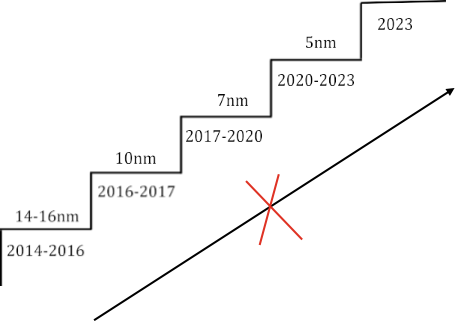
Why can’t Chinese companies catch up to the advanced chip technology by upgrading step by step from the existing 14 nm process technology available domestically to 7 nm process and even 3 nm process technology? The reason is that upgrading from the 14 nm process to the 7 nm process does not simply require a technology breakthrough by Chinese companies, but also requires sufficient market demand to motivate these profit-making companies to develop more advanced chips. Even in the Chinese domestic market, there has been no demand for Chinese-made chips more advanced than 14 nm process. Why? Because demand for high-end chips in China has been met by imports embodying US technology. In this sense, US high-tech companies monopolize China’s domestic high-end chip market, creating an insurmountable hurdle for Chinese high-tech companies to develop their own high-end chips.
US containment of China’s technological progress is not simply a technological blockade, but rather a deliberate effort to create an environment that shunts Chinese and American companies into separate specializations. To be more specific, the intention is to have American companies specialize in more advanced technology and Chinese companies specialize in less advanced tech-nology so that the United States’ dominant position in the high-tech industry is maintained. Therefore, the United States is, in a sense, monopolizing the Chinese market for chips below 14 nm while vigorously blocking Chinese chipmakers from acquiring the technology to make their own high-end chips.
Let’s take smartphone chips as an example. Smartphones are usually built on top of a silicon chipset (chip) that serves as the “brain” of the device. The manufacturing process of a chip is typically specified in nanometers—generally speaking, the smaller the nm size, the smaller the internal components of the chip and the better it is for power efficiency and compactness.
The main smartphones sold in China are from Apple, Honor, Huawei, OPPO, Redmi, Samsung, VIVO, and Xiaomi. Advanced chip technology and production are controlled by companies in the United States and its allies, while lower-end smartphone components are made by Chinese companies. Apple uses the 3 nm Apple A17 chip, while Honor, OPPO, Redmi, Samsung, VIVO, and Xiaomi use the 7 nm Qualcomm Snapdragon chip, both of which are owned by US companies. Therefore, the smartphone market in China is still dominated by American technology. When Huawei dared to challenge US dominance in high-end chip technology, the US government banned the sales of equipment to Huawei and sought to persuade its allies to do the same.
If there is no demand for Chinese-made high-end chips in the smartphone market, how can China catch up in chip technology?
The key to catching up is to create market demand for Chinese-made chips through government intervention. Core technology, no matter how advanced, cannot be 100% dominated by foreign companies. Instead, Chinese government can take measures to ensure that a certain share of the domestic market (e.g., 30%) must be occupied by domestic technology. That essentially constitutes a technology security policy. With such a policy, if there is a foreign embargo, at least 30% of the market could still be served by domestic tech-nologies. Moreover, if about 30% of the domestic market share is served by domestic technology, it can also ensure that domestic technology can substi-tute world advanced technology to a certain extent, thereby preventing undue vulnerability to external pressures.
How should we design a technological catch-up path or technology security policy? Let’s take the mobile phone chip as an example.
First, identify smartphone chip as a national core technology.
Second, the national core technology opposes foreign monopolies. The downstream market demand for chips is mobile phones. Any company selling phones in the Chinese market, whether domestic or foreign, must ensure that at least 30% of the phones they sell in China are equipped with domestically produced Chinese chips. For example, companies such as Apple, Samsung, Huawei, Xiaomi, OPPO, Vivo, and others must ensure that 30% of the total phones they sell in the Chinese market use domestically produced Chinese chips.
Third, for example, let’s assume “XiaoGuo” is a company selling mobile phones in the Chinese market. If the volume of “XiaoGuo” mobile phones using Chinese domestic chips falls below 30% of its total shipment volume, which leads to a total reliance on foreign chip technology, the “XiaoGuo” company poses a risk to Chinese technological security. The Chinese government should impose taxes on this mobile phone company. The tax rate levied is based on the proportion of Chinese domestic chips used in its total shipment of mobile phones. The smaller the proportion, the higher the tax rate.
Fourth, according to this policy, there will be two types of the same brand of mobile phones sold in the Chinese market. One uses imported chips, referred to as “XiaoGuo A,” and the other uses domestically produced chips, referred to as “XiaoGuo B.” When the technology of domestic chips is lower than that of imported chips, the quality of “XiaoGuo B” will be lower than that of “XiaoGuo A,” and the market price of “XiaoGuo B” may even be lower than its production cost. If this happens, the government can provide subsidies to the company to ensure that “XiaoGuo B” has a certain profit margin.
We refer to such a policy as the “International Technology Anti-Trust Policy.” This policy applies to all products recognized as a core technology. Through such an international technology anti-trust policy, it ensures that the market share of domestic produced technology in China reaches 30%. This not only ensures technological security in the Chinese market but also promotes competition for core technology products, preventing a global monopoly on core technology products (such as high-end chips and operating systems).
The “International Technology Anti-Trust Policy” serves as a strategic approach to pave the way for technological catch-up and can serve as a theoretical consideration to prevent China from falling into the “chaser’s trap.” The key for China to form a virtuous“innovation-market” cycle in the context of great power competition lies in its market share. Only by seizing a certain amount of market share and creating a favourable market environment, Chinese enterprises will choose to catch up, innovate, and surpass according to the comparative advantages designed by the government policies.
On August 29, 2023, Huawei introduced its new flagship phone, the Mate 60. The Huawei Mate 60 is equipped with the self-developed Kirin 9000S chip which functions at a level equivalent to the 7 nm process chip. Huawei’s technology breakthrough came after three years of relentless efforts by the United States to contain China’s high-end chip industry.
It should be pointed out that even a prominent company like Huawei will find difficult to change the competitive environment of the chip market through its efforts alone. The innovation-market cycle for Chinese semiconductor companies cannot be automatically realized by the market and must rely on government policies to nurture and create.
In mid-July 2025, the US government reversed a four-month ban to allow Nvidia to resume exporting its H20 AI chip to China—a device deliberately designed to comply with export rules and priced as a lower-tier offering. This shift aligns with our “innovation-market” cycle theory: the United States aims to preserve its own innovation loop, earn revenue, and keep Chinese firms dependent rather than independent of Western-level chip technology.
By supplying the H20 chip, the United States achieves two objectives: it keeps Chinese firms consuming sub-tier hardware instead of investing in costly full-stack R&D, and it retains commercial presence in a crucial overseas market. In turn, United States revenues can be reinvested into advancing its own R&D and market feedback loop. China’s counter is clear: it must institutionalize long-term industrial policies and sustain large-scale investment to avoid the “chaser’s trap.” Without that coordinated commitment, the H20 move will effectively stall China’s drive toward independent AI-chip leadership.
The outcome of technological competition between China and the United States will determine the long-term growth of both countries and the reform of the world order. China has a comparative advantage in disruptive technological innovations, but it needs to strive hard to avoid falling into the “chaser’s trap” in incremental technological innovations. The country that can achieve a virtuous innovation-market cycle will win the technological competition.