Published on
July 21, 2026
By: Antara Mitra

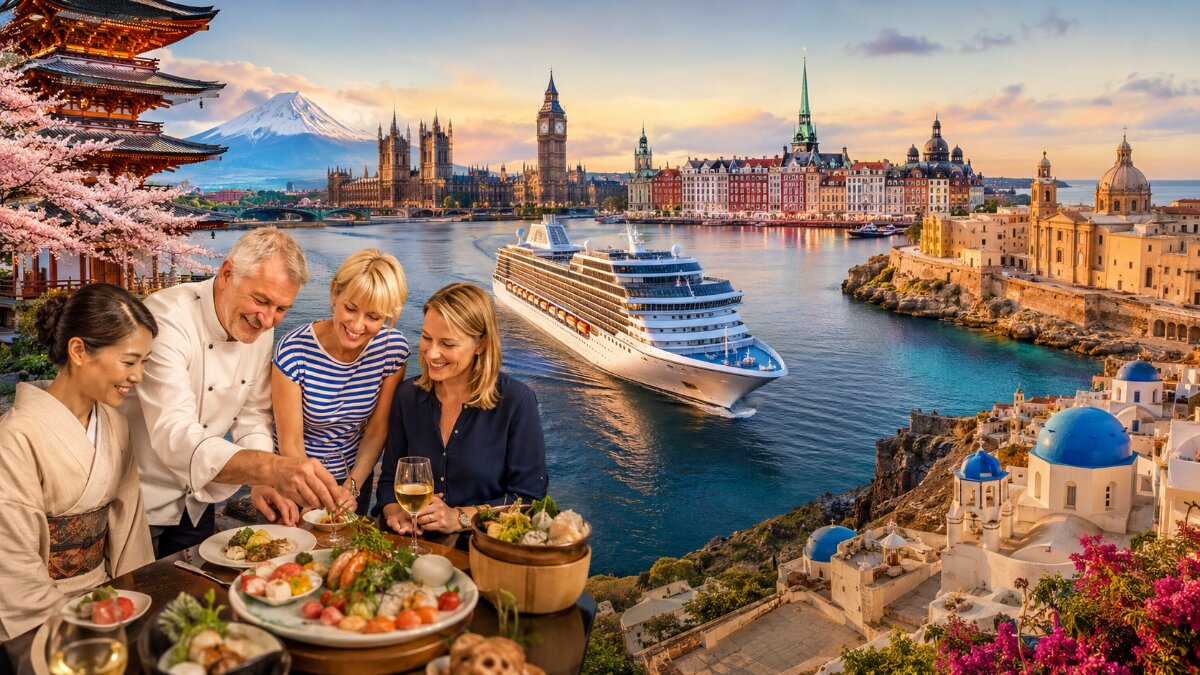
Image generated with Ai
Oceania Cruises’ 2027 specialist programme is emerging as more than a collection of celebrity-hosted holidays. Four date-specific departures spanning Japan, South Korea, the United Kingdom, Northern Europe and the Mediterranean place expert programming inside approximately 4,900 lower berths, creating limited inventory that cannot be replicated on alternative dates. Booking codes unlock early access to selected programming, while evolving UK and European border systems increase the value of professional travel planning. Several accommodation categories on the Baltic departure were already waitlisted during an inventory check on 21 July 2026.
Oceania Cruises Converts Expert Access into Scarce Premium Inventory
The commercially important development is not simply the participation of Claudine Pépin, Sara Moulton, Samantha Brown and Oceania’s senior culinary team. Each personality or specialist group is attached to one ship, one departure date and one geographical itinerary.
Travellers wanting Claudine Pépin’s Japan programme must select the 30 September 2027 departure aboard Oceania Riviera. Sara Moulton’s Baltic programme operates only on Oceania Marina from Southampton on 8 June 2027. Samantha Brown’s Mediterranean journey begins in Trieste on 7 November 2027, while the Culinary Luminaries departure operates from Athens on 2 June 2027.
That creates a fundamentally different product from routine onboard entertainment. A traveller can change cabin categories, but cannot move to another week without losing the advertised host-led component. This increases booking urgency and gives travel advisers a defensible reason to discuss the voyage earlier in the purchase cycle.
Advertisement
Advertisement
The official booking pages also require specific promotional codes for early access to exclusive programming. These are CPEPIN, SMOULTON, SBROWN and CULINARY. The codes do not replace a cruise reservation, but they connect eligible bookings to early access procedures for the specialist content.
Four 2027 Specialty Cruises Cover 15 Countries and 37 Gateways
An analysis of Oceania’s published schedules identifies 48 marketed voyage days, eight full sea days and 44 port-day entries across the four departures. After duplicate calls are removed, the programme connects approximately 37 individual gateways in 15 countries.
Advertisement
Advertisement
| Specialist departure | Ship and date | Principal route | Marketed duration | Full sea days | Indicative fare from, checked 21 July 2026 | Access code |
|---|---|---|---|---|---|---|
| Claudine Pépin Japan cruise | Oceania Riviera, 30 September 2027 | Tokyo round trip through nine Japanese gateways and Busan, South Korea | 11 days | 1 | US$5,149 per guest | CPEPIN |
| Sara Moulton Baltic cruise | Oceania Marina, 8 June 2027 | Southampton round trip through Denmark, Sweden, Finland, Estonia, Latvia and Germany | 14 days | 4 | US$6,049 per guest | SMOULTON |
| Culinary Luminaries cruise | Oceania Vista, 2 June 2027 | Athens to Rome through Greece, Italy, Croatia, Slovenia and Malta | 13 days | 2 | US$7,099 per guest | CULINARY |
| Samantha Brown Mediterranean cruise | Oceania Allura, 7 November 2027 | Trieste to Barcelona through Slovenia, Croatia, Greece, Italy and Malta | 10 days | 1 | US$3,849 per guest | SBROWN |
The fares were displayed by Oceania in US dollars on 21 July 2026 and were marked as starting prices per guest. Published fares, promotions and cabin availability remain dynamic and should be reconfirmed before quotation or deposit collection.
Baltic Waitlists Provide an Early Scarcity Signal
The strongest evidence of inventory compression appeared on the Sara Moulton Baltic sailing. At the time of review, the Owner’s Suite, Vista Suite, Deluxe Ocean View and one Inside Stateroom category were marked as waitlisted. Other categories remained available or were being sold on a guarantee basis.
This does not demonstrate that the entire voyage is close to selling out. It does, however, show that specialist programming can influence the availability pattern within particular accommodation bands more than a year before departure.
For agents, the implication is practical. Clients prioritising a specific suite location, accessibility requirement, connecting accommodation or lower fare band may face fewer alternatives than clients purchasing an ordinary regional cruise.
Global Cruise Growth Makes Differentiation More Valuable
Cruise Lines International Association recorded 37.2 million ocean cruise passengers worldwide in 2025. Its institutional forecast rises to 38.3 million in 2026 and 40.3 million in 2027, the operating year for Oceania’s specialist programme.
The relevant destination regions are also growing, although at different speeds. Asia and China recorded the strongest increase among Oceania’s targeted regions during 2025, while the Mediterranean remained one of the world’s largest cruise markets.
Advertisement
Advertisement
| Cruise-market indicator | Latest institutional figure | Commercial relevance |
|---|---|---|
| Global ocean cruise passengers in 2025 | 37.2 million | Expanding addressable market for differentiated premium products |
| Forecast global passengers in 2027 | 40.3 million | Greater competition for ports, air capacity and pre-cruise accommodation |
| Mediterranean cruise passengers in 2025 | 5.96 million, up 3.4% | Supports two separate Oceania specialist departures |
| Non-Mediterranean Europe passengers in 2025 | 3.22 million, up 5.8% | Strengthens the Baltic and Northern European sales opportunity |
| Asia and China passengers in 2025 | 3.11 million, up 19.6% | Reinforces the commercial case for the Japan and South Korea itinerary |
| Previous cruisers intending to cruise again | 89.7% | Creates a large repeat market seeking new reasons to book |
| Repeat cruisers taking at least two cruises annually | 27.7% | Supports narrow-interest and personality-led departures |
| Recent cruise travellers using a travel adviser | 63.4% in December 2025 | Gives agents significant influence over complex fly-cruise purchases |
CLIA’s passenger, destination and consumer data indicate a market in which repeat travel is strong, but simple destination access is no longer enough to distinguish every sailing. Around 27.7 per cent of committed repeat cruisers take two or more cruises annually, increasing demand for a new narrative, specialist access or a deeper regional theme.
Specialist Programming Arrives as Europe Demand Faces Uneven Pressure
Oceania’s parent company, Norwegian Cruise Line Holdings, carried 861,060 passengers during the first quarter of 2026 and recorded occupancy of 103.8 per cent. Occupancy above 100 per cent reflects cabins carrying more than two passengers in some cases.
Nevertheless, the company entered 2026 behind its targeted booking curve. Geopolitical disruption, higher fuel costs and softer consumer demand for some European travel prevented the booking position from closing as quickly as planned. Europe was identified as a particular pressure point.
This makes the timing of Oceania’s programme strategically significant. Two Mediterranean sailings and one Baltic voyage are being differentiated through culinary or broadcasting expertise rather than discounted purely as interchangeable European capacity.
The Samantha Brown departure is especially relevant because it operates in November, beyond the Mediterranean’s core summer period. Its route links Trieste, Koper, Dubrovnik, Igoumenitsa, Gythion, Piraeus, Argostoli, Catania, Valletta and Barcelona, giving the cruise line a recognisable content proposition for a shoulder-season sailing.
Japan Cruise Creates a High-Intensity Culinary Port Corridor
The Claudine Pépin voyage is the most geographically concentrated of the four. After leaving Tokyo, Oceania Riviera calls at Hakodate, Niigata, Kanazawa, Sakaiminato, Busan, Hiroshima, Kochi, Kobe and Shimizu before returning to the Japanese capital.
Advertisement
Advertisement
Only one complete sea day appears in the schedule. This creates a port-intensive journey in which Japanese regional food cultures, markets and local production areas can be connected to onboard demonstrations and selected hosted excursions.
The Busan call also makes the voyage an international round trip rather than a wholly domestic Japanese circuit. Travel advisers must therefore treat it as a multi-jurisdiction itinerary even though embarkation and disembarkation both occur in Tokyo.
A further operational detail affects travellers purchasing goods under Japan’s tax-free system. Japan Tourism Agency guidance specifies that passengers taking a cruise from Japan, visiting an overseas port and returning to Japan complete the relevant tax-free departure procedure at the domestic airport used for their eventual international departure. The procedure takes place before checked baggage is handed over. Passengers do not complete it during the temporary overseas call.
That rule is directly relevant to the Tokyo–Busan–Tokyo structure and should be incorporated into final-day airport transfer and baggage planning.
United Kingdom and EU Digital Borders Add a Second Sales Layer
The Southampton round trip creates a dual-border planning requirement for many non-European travellers. Eligible visa-exempt visitors entering the United Kingdom need a UK Electronic Travel Authorisation unless exempt. The authorisation currently costs £20 and normally permits multiple journeys for up to two years or until the linked passport expires. Travellers must use the same passport associated with the application.
The voyage subsequently enters European Union and Schengen destinations across Denmark, Sweden, Finland, Estonia, Latvia and Germany. The EU Entry/Exit System became fully operational at external border points on 10 April 2026, recording eligible non-EU short-stay travellers through electronic travel-document data and biometrics.
Advertisement
Advertisement
ETIAS was not operational on 21 July 2026. The European Union currently expects its introduction during the final quarter of 2026, with the precise commencement date still to be announced. Because all three European speciality departures operate in 2027, travel businesses should assume that documentation processes may differ from those in force when deposits are collected. Final requirements must be checked closer to departure.
Trade Analysis: Why the Real Product Is Controlled Access
The strongest information-gain angle is that Oceania has converted specialist knowledge into controlled, date-bound inventory. The personalities are not travelling across a season or rotating among multiple ships. Their availability is concentrated within four departures carrying roughly 4,900 guests at double occupancy.
That architecture can improve yield without changing the underlying vessel. The cruise line can use a host, booking code and itinerary-specific programme to distinguish cabins that would otherwise compete against numerous Mediterranean, Baltic or Japanese voyages. Early-access codes also create measurable booking pathways, allowing specialist interest to be identified before the full programme is delivered.
For travel advisers, this changes the value proposition. The sale is no longer confined to a cabin. It includes long-haul air, airport-to-port transfers, UK and EU digital permissions, pre- and post-cruise hotels, insurance, dining expectations, private shore arrangements and contingency management.
The risk is equally concentrated. Oceania’s official conditions state that host appearances and specialist programming may change. A package should therefore be sold on the strength of the ship and itinerary as well as the named expert. Marketing the personality as the sole reason for travel may create dissatisfaction if participation or programming is modified.
Critical Operational Takeaways for Travel Agents and Tour Operators
- Record the correct access code: Use CPEPIN, SMOULTON, SBROWN or CULINARY where applicable and retain evidence that it was attached to the reservation.
- Verify host status before final payment: Recheck both the named specialist and the detailed programme because appearances and activities can change.
- Do not treat the Baltic voyage as a single-border holiday: Review UK entry permission separately from EU and Schengen requirements.
- Reconfirm ETIAS nearer departure: Its exact 2026 implementation date remained pending on 21 July 2026, while all relevant European departures operate in 2027.
- Protect scarce cabin requirements: Waitlists already affected several categories on the Sara Moulton sailing during the latest check.
- Build air disruption tolerance: International passengers should arrive at least one day before embarkation, particularly for Tokyo, Southampton, Athens and Trieste departures.
- Allow extra time after the Japan voyage: Travellers using Japan’s tax-free refund process may need to complete procedures before checking baggage for their final international flight.
- Sell the itinerary independently of the personality: Product descriptions, terms and client records should make clear that specialist programming is an enhancement rather than a guaranteed substitute for the core cruise.
Outlook: Expert-Led Cruising Could Become a Precision Deployment Tool
Oceania’s 2027 programme indicates that specialist cruising is moving beyond conventional enrichment lectures. The emerging model combines small-ship capacity, recognisable expertise, access codes and port-dense routes to create a product that is difficult to compare purely on price.
Advertisement
Advertisement
For Japan, the strategy links culinary education with a concentrated regional itinerary. For the United Kingdom and Baltic region, it adds a specialist reason to undertake a documentation-heavy multi-border journey. In Italy, Greece, Croatia, Malta and Spain, it gives Mediterranean capacity a clearer identity during both the main and shoulder seasons.
As the global cruise market moves towards a forecast 40.3 million passengers in 2027, this type of controlled-access voyage could become increasingly important to premium operators seeking higher-value bookings without relying only on new ships or aggressive fare reductions. The long-term advantage will belong to travel businesses capable of packaging the personality, destination and operational detail as one coherent international journey.
Advertisement
Advertisement