
With roughly 28 years of investing experience under my belt, I find myself more and more aligned with Warren Buffett’s investing philosophy. Namely, I’m constantly looking to the horizon and am unwavering when it comes to value.
Many of my more than three dozen positions have been held for several years. But with the stock market a stone’s throw from its priciest valuation in history, I’ve struggled to find good deals. Although I’ve been a net seller of stocks in 2026, one of the few exceptions to this selling activity has been ultra-high-yielding business development company (BDC), PennantPark Floating Rate Capital (PFLT -1.82%).
Image source: Getty Images.
Including the dividend reinvestment plan I’ve set up, my stake in the company has grown by 242% since the start of the year. While things aren’t picture-perfect for PennantPark, the catalysts, which include a 13.2% yield and a monthly payout, far outweigh the headwinds.
BDCs have drawn Wall Street’s ire in 2026
A BDC is a company that invests in the debt and/or equity (preferred or common stock) of small- and micro-cap businesses, often known as “middle-market companies.” At the end of June, PennantPark’s $2.5 billion portfolio consisted of $254.3 million in preferred and common stock, with the remainder in debt securities.

PennantPark Floating Rate Capital
Today’s Change
(-1.82%) $-0.14
Current Price
$7.36
Key Data Points
Market Cap
Day’s Range
$7.36 – $7.50
52wk Range
$6.83 – $10.29
Volume
8.1K
Avg Vol
1.2M
Gross Margin
80.48%
Dividend Yield
17.17%
The obvious worry with BDCs like PennantPark is that their loan portfolios are tied to mostly unproven businesses. If the U.S. economy weakens (e.g., the July nonfarm payroll report showed a surprise loss of 23,000 jobs), it can spark delinquencies, known as non-accruals.
Wall Street and investors also have concerns about the private credit market. While many of these concerns have been tied to credit quality in the tech sector amid a breakneck artificial intelligence data center build-out, they’ve nevertheless impacted PennantPark and its peers.
However, I believe these fears represent the ideal attack point for patient investors.

Image source: Getty Images.
Tailwinds are mounting for PennantPark Floating Rate Capital
PennantPark found itself behind the proverbial eight-ball when the Federal Reserve cut interest rates six times between September 2024 and December 2025. With 90% of its portfolio in debt securities and 99% of these loans sporting variable rates, a rate-easing cycle constrained its net investment income (NII).
But thanks to the effects of the Iran war and President Trump’s tariffs, above-average inflation may force the Federal Reserve to raise interest rates. When rates rise, PennantPark’s NII grows.
PennantPark’s loan-vetting team has also done an exceptional job of protecting its invested principal. The company’s $2.5 billion portfolio is spread across 159 companies, leading to an average investment size of $15.8 million. No single investment is critical to generating profits or capable of capsizing the ship.
Furthermore, more than 99% of its $2.25 billion loan portfolio is comprised of first-lien secured debt. First-lien secured debtholders are at the front of the line for repayment in the event that a borrower seeks bankruptcy protection.
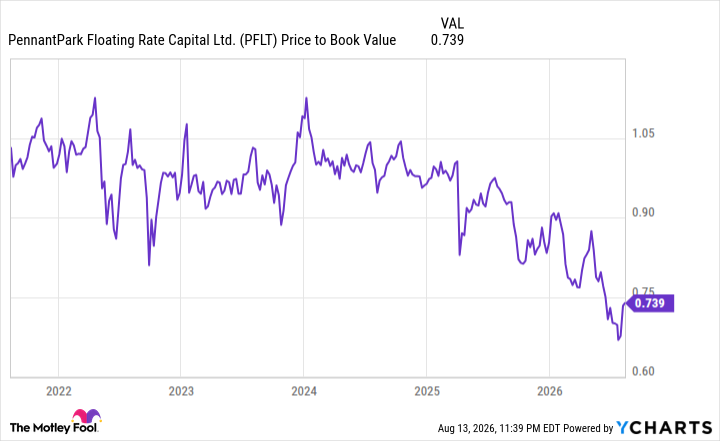
PFLT Price to Book Value data by YCharts.
But most importantly, PennantPark Floating Rate Capital offers value amid a historically expensive stock market. It closed out its fiscal third quarter with a net asset value (NAV) of $10.26 per share. However, shares of the company ended the Aug. 13 trading session at a 26% discount to NAV. Among ultra-high-yield dividend stocks, PennantPark stands out for all the right reasons.