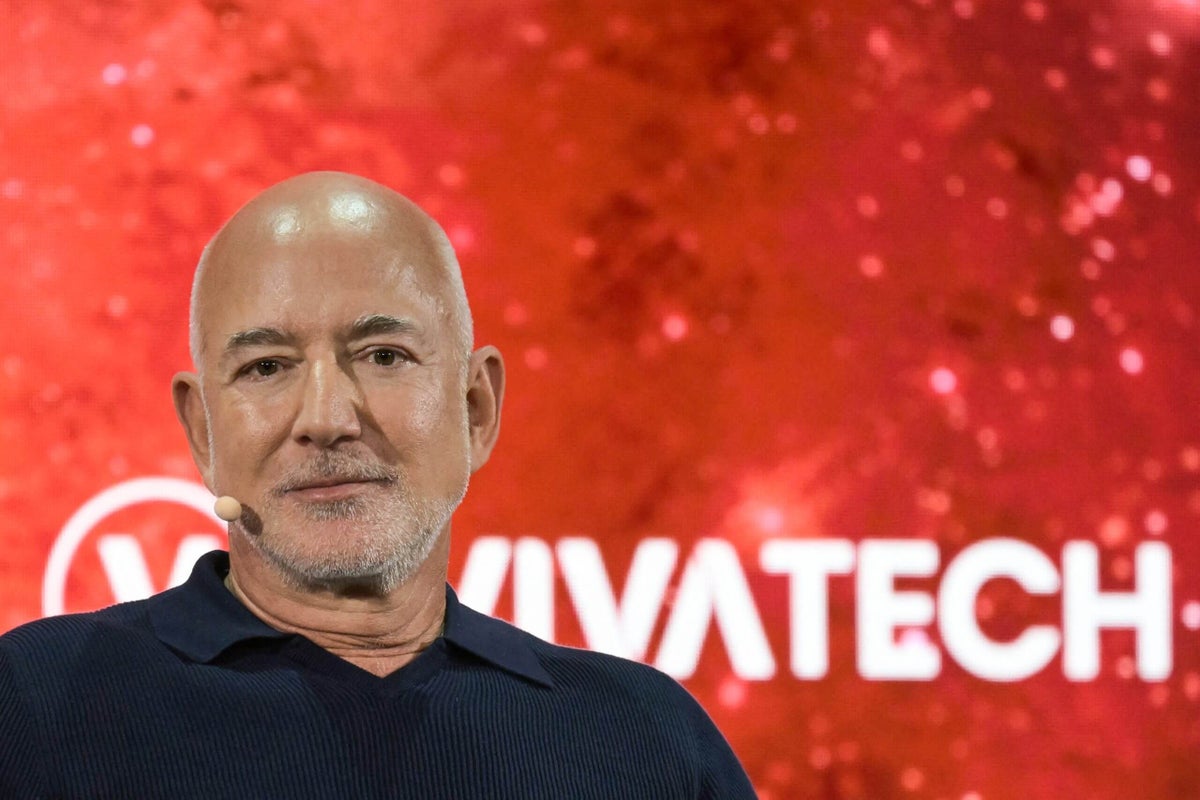
Plastered across the top of Jeff Bezos’ social media accounts is a history lesson that clearly motivates him.
“Six thousand years ago, someone invented the plow, and we all got wealthier,” he states on Instagram and X. “A gentle reminder that all civilizational wealth is driven by invention.”
By pushing boundaries in commerce and technology, Bezos has become the third-richest person on the planet — as of yesterday, Forbes’ real-time online calculator estimated his fortune to be $267.4billion.
Yet on Wednesday morning, the same tool claimed Bezos had lost $1.6bn since the closure of markets on Tuesday.
An astronomical sum, but loose change to someone like Bezos, and ultimately typical of the way water flows in the extreme world he inhabits.
The volatility of the markets helps explain why Bezos, on the face of it, has targeted Liverpool for investment.
He needed to only analyse the profits the club’s current owners have made by selling a chunk of their asset to him to realise high-end English football is a safe place to spread a relatively small amount of your money if you can afford to stick around over a long period of time.
Fenway Sports Group bought Liverpool in 2011 for around $470m. Fifteen years later, they have sawn off around 38 per cent of the club to the consortium that includes Bezos for around $2.7bn.
With a new television-rights deal to be brokered by the Premier League inside the next two years, the value of its members will only increase. And if something resembling the European Super League ever happens, it will stretch even further.

Liverpool’s value will be further boosted by the next TV rights deal (ANDY BUCHANAN / AFP via Getty Images)
FIFA’s plotting under Gianni Infantino this summer has proven that the vessels in charge of the sport believe growth in any form is permissible, even if it cuts away at the impression of independent governance.
Liverpool appears to be an easy win for Bezos, who will not take a position on the club’s board for the time being, allowing him to avoid direct operational burdens and, in theory, sit back while the value of the club steadily goes up along with his own money.
For context, he is part of a group that now owns around 10 per cent more of Liverpool than another minority shareholder at Manchester United. By comparison, INEOS has signed up to deal in the day-to-day and everything that comes with that. Bezos might ask: why bother?
With cold eyes, maybe he has realised that football has reached an unsettling point where well-run famous clubs can allow the richest people to get richer without doing much beyond paying another very rich person to be involved.
FSG is adamant that business will continue as usual, insisting a full takeover is not imminent. Yet a bit of journalistic digging last week painted a potentially different picture of the future, because it was quickly discovered that 1892 Holdings, led by Amit Bhatia, could take full control for around $8bn inside the next 12 months, which, it has to be stressed, is considerably more than Liverpool is estimated to be worth.
The Athletic has nevertheless since established that the group’s initial commitment to Liverpool was somewhat larger than first claimed: rather than taking between 30 per cent to a third of the club, it is closer to 40 — and therefore the jump to a majority is not as far as it seemed.
Such factoids matter, particularly to followers of Liverpool, a fanbase that has had trust issues with ownership since the club’s iconic manager, Bill Shankly, started challenging the boardroom figures who were “only there to sign the cheques” following his appointment in 1959. More recently, banks would register their concern at the club’s ability to continue following the leveraged buy-out by Tom Hicks and George Gillett in 2007. Not disclosing things as they are represents a bad start for the new arrangement.
FSG’s principal owner John W. Henry will be 77 in a month. The club’s chairman Tom Werner will celebrate the same birthday next year and FSG president Mike Gordon is 61. While Bezos is a year older than Gordon, the other members of the consortium are much younger, with Bhatia aged 46 and Eduardo Saverin, 44.
Time is not on the side of FSG and it would be typical of them to try and lead a phased handover, ensuring softer exits and landings as well as an increased sense of normalisation around a big change. That is how the Massachusetts-based venture capitalist firm have tried to run Liverpool at executive level, with a series of sporting directors, for example, gradually disappearing from view rather than with a sudden jolt.

Could Tom Werner (left), Mike Gordon (second left) and John Henry (second right) sell Liverpool in a phased handover? (Carl Recine/Getty Images)
Bhatia has a long history with English football through his association with Queens Park Rangers, while Saverin is famous because of his involvement in the launch of Facebook. The motivations of Bezos, however — described on Liverpool’s official statement last Friday as the “lead investor” in one of two funds — feels the most relevant because of his position at the forefront of the tech industry.
You can imagine some of his bros from the old days in Seattle paying attention because, if his relationship with Liverpool works out, others will become curious. English football clubs have experienced eras under the control of local businessmen turned millionaires. After they were replaced by oligarchs, along came nation-states and sovereign wealth funds. Is this the period in which tech giants shape the game?
It would seem to go against Bezos’ instinct to not strongly influence what is happening at Anfield at some point. Look at more of his messaging on social media, where he begins and signs off posts with the corporate motto of his aerospace manufacturer, Blue Origin. Gradatim ferociter translates as “step by step, ferociously”.
Bezos sees himself as an inventor and he has changed the world when the canvas in front of him has been blank. Football club ownership is a different space because histories, connections and emotions are already embedded. Liverpool’s unionised supporter base has a sharp sense of what they want to hear and see from the people who run their club, and many are well aware of Bezos’ handling of an institution like the Washington Post, which has experienced union-busting and lay-offs since his purchase of the newspaper in 2013.
Until Bezos, or any of his new partners, speak publicly, the conversation about what comes next will be nervous.
The FIFA sell-off scandal, explained
Hannah Vanbiber and Reuben Pinder