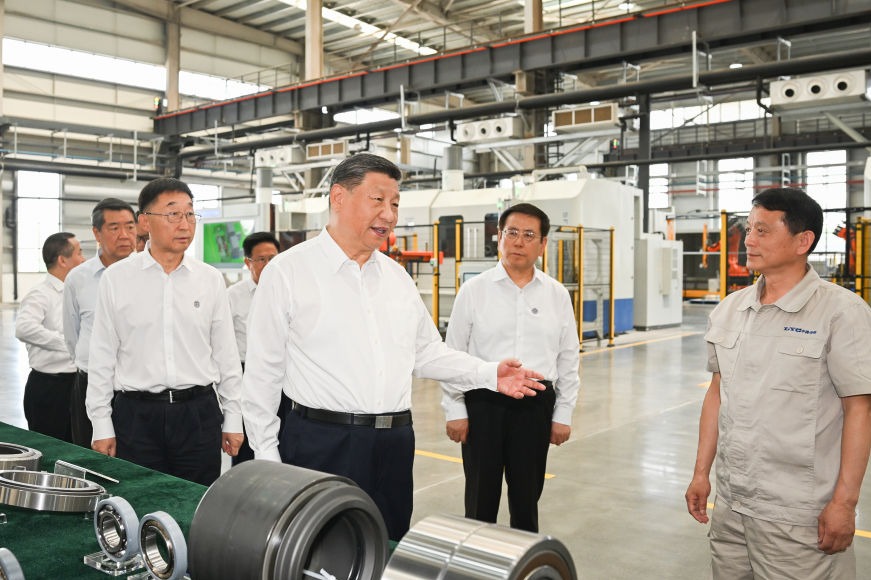

During a visit to LYC Bearing Corp in Central China’s Henan province on May 19, 2025, President Xi Jinping put China’s industrial transformation into historical perspective.
“China has always adhered to the path of developing the real economy. From the past reliance on imported matches, soap and iron, to now becoming the world’s largest manufacturing country with the most complete industrial categories, we have taken the right path,” Xi told workers.
Among those listening on the factory floor was Song Huahua, deputy director of the company’s technology center. More than a year later, she said Xi’s words still ring in her ears.
“Whether or not they were there that day, everyone at the company felt a deep sense of pride,” Song said. “If General Secretary Xi cares this much about something as small as a bearing, what reason could we possibly have not to make it well?”
Bearings are small enough to disappear inside a machine, yet they are often described as the “joints of industry”. As Song put it, “Wherever something turns, you need one.”
Over her 16 years at the company, the things that turn — and the demands placed on them — have kept changing. From aerospace and wind power to new energy vehicles, robots and drones, each industrial advance brings new requirements for precision, durability and reliability.
During the visit, Xi emphasized that “modern manufacturing relies on sci-tech empowerment”, calling for greater efforts to achieve core technological breakthroughs and pursue independent innovation.
For Song, that call is reflected in the daily work of identifying new problems and developing new products.
“Independent innovation has become part of who we are,” she said, adding that innovation at the company is driven by both the market and national priorities.
“Customers keep raising the bar, and that is a constant source of momentum for innovation,” Song said. “At the same time, taking on major national projects requires us to keep pushing beyond our own limits.”
She cited new energy vehicles as an example. Because they operate differently from gasoline-powered cars, they need purpose-designed bearings, she said, noting that engineers first study a vehicle’s operating conditions and customer requirements before developing and testing a new product.
LYC Bearing Corp was one of 156 key projects developed during China’s First Five-Year Plan (1953-57) period.
From making basic bearings largely by hand to seeing high-end bearings account for 70 percent of its total output value in 2025, the company has filled domestic gaps in a range of fields and helped underpin China’s bearing industry.
Its seven-decade transformation mirrors the broader rise and upgrading of Chinese manufacturing. China has ranked first globally in manufacturing scale for 15 consecutive years. The country has 41 major industrial categories, 207 intermediate categories and 666 subcategories, making it the only country in the world with industries across all categories listed in the United Nations’ industrial classification, according to the National Bureau of Statistics.
That same shift — from filling gaps to raising standards — can be seen in the tractors that Zhao Xu works on every day. Zhao is deputy head of the product research and development department at YTO Group Corp, a leading agricultural and construction machinery manufacturer.
During an inspection tour of Henan in April 2009, Xi, then China’s vice-president, visited two manufacturers, including YTO Group Corp, where he learned about independent research and development, production and operations, and encouraged efforts to develop new products in response to market demand.
According to the company, digital and intelligent upgrades allow different models to be assembled on the same line, with one tractor rolling off every three minutes on average and overall efficiency up more than 20 percent.
“A tractor can no longer merely get the job done,” Zhao said. “It must help farmers work more efficiently and comfortably.”
The company has launched, or is developing, tractors with power-shift and continuously variable transmissions, and hybrid and battery-electric power trains. Autonomous and driverless models have also entered commercial use, Zhao said.
“Our goal is to advance agricultural machinery technology and strengthen our ability to develop high-end products of our own,” he said.
Zhou Mi, a senior researcher at the Chinese Academy of International Trade and Economic Cooperation, said that as China’s industrial system became more complete and competition intensified, older industrial enterprises had to find new strengths through innovation.
In his view, the shift of both LYC Bearing Corp and YTO Group Corp toward higher-end, smarter and greener production reflects the combined influence of government guidance, market demand and competition.
“New technologies can raise productivity and make products more competitive, creating higher returns,” he said. “That, in turn, draws more companies into innovation and creates a combined force for industrial upgrading.”
Lan Qingxin, director of the BRICS Research Center at the University of International Business and Economics in Beijing, attributed the continuity between the major industrial projects under China’s First Five-Year Plan and the focus on advanced manufacturing in the 15th Five-Year Plan (2026-30) to sustained long-term planning under the leadership of the Communist Party of China.
“What has remained unchanged is the long-term goal of industrialization and modernization,” Lan said. “What has changed is the path and the methods used to achieve it.”
In the new era, he said, the emphasis is on innovation-driven, high-quality development, with China working to maintain a reasonable share of manufacturing in the economy and to vigorously develop advanced manufacturing.
Lan said this evolution also reshaped the relationship between government and the market. The state concentrated resources on basic industries at the early stage, while market competition later pushed enterprises to become the main drivers of innovation.