The ideal writing residency, I think, would last an entire lifetime, not be confined to any specific location, and leave you at leisure to write as much or as little as you liked.
I’m recently back from a month-long writing residency in Hong Kong, during which I wrote nothing at all. Not a jot. I considered writing out there, moving forward with my next book, but after a few days I dropped the idea. Then I thought I might write about Hong Kong, my first visit to the region, the writing residency itself. I started taking notes… but soon gave up on even that. There was too much to see, to do, to eat – writing felt like a waste of time. Taking notes would have gotten in the way of all the things I took no notes about. I didn’t even read in Hong Kong. To be in a new and enticing place, I remembered, is to read, turning the pages of the book you walk through with the passing days. It was all so rich and novel that, now I’m back in Dublin, I’ve decided to write about it after all. I just wish I’d taken notes.
I flew to Hong Kong on the first day of March. I was lucky to make it – two of the five other guests at the International Writers Workshop, a Kenyan and a Slovenian, were delayed by a week, waiting for rescheduled flights that would skirt the drone-swarmed Middle East. Every time I visit Asia, it seems, a new war breaks out. In the lockdown days of February 2022, I was in Singapore on a six-month writing residency when Putin sent his armies into Ukraine. I resented Singapore with an ingrate’s passion. For a feverish few days, I’d envisioned the war spreading and me getting stranded out there on that island of mall-shopping technocrats. Maybe Europe would be obliterated by Russian nukes and I’d have to make a new life in the normcore nation.
Being stranded in Hong Kong after a global conflagration wouldn’t have been so bad. A certain rivalry exists between Hong Kong and Singapore, these twin skyscraping finance capitals in the Orient. But to the finance-indifferent Westerner only wanting to have a stimulating time of it, there’s no contest – Hong Kong is miles out in front. I felt more energised in 48 hours there, wandering the shabby-futurist streets of Sham Shui Po and Mong Kok or idling on the pavilions in Kowloon Walled City Park, than I did in half a year in the country I thought of as Sing Sing.

Subscribe to the New Statesman for £1 a week
One thing the two glassy islands have in common is that everything works. The Hong Kong public transport system is a smoothly running, metronomically regular marvel. You pay onto the MTR trains or the buses (or pay for your groceries or your restaurant meal) with your Octopus card – which in my case was embedded on my phone as an app. Effortless, like everything in Hong Kong. But here we note an alarming defect in the regional, and beyond that the Chinese and possibly the entire East Asian mindset: they’ve rigged their society so that it’s impossible to leave your cramped apartment (even well-earning Hong Kongers are squeezed for space) without your phone. Nobody seems bothered by this. In Ireland it’s become for me not just a point of nostalgic humanist pride but a matter of psychic upkeep to leave my phone at home for a couple of hours every day. In Hong Kong, if you were to even think about doing that, your fellow citizens would probably alert the authorities. Moreover, you wouldn’t be able to use the lift to leave your building, go shopping (cash is not king but squire), or do much of anything.
But yes, everything works – especially the people. Naturally, Hong Kong is a long-hours town, a wage-slave metropolis. The phrase “work-life balance” is tossed around with affable irony: they’ve heard of such a thing. The administrative region aspires to the status of a corporation – its highest political office is Chief Executive. “All the gods here are money gods,” noted the Slovenian novelist, Gabriella, when I walked with her around Central, visiting an incense-wreathed temple in the shadow of a bank. “All their prayers are for prosperity. Religion is a function of commerce.” It was largely true – though not out on Lantau island, where I rode a cable car to the top of a verdant peak to see the Big Buddha: an accurately named statue surrounded by six kneeling devas, located next to a large monastery. As I gazed up at the Enlightened One, two Spring Breakers thrusting selfie-sticks into the air manifested at my side.
“Dude, is that like a Nazi sign?”
He pointed to the insignia on Buddha’s chest.
“Uh, yeah, but the Nazis turned it the other way. That’s what makes it evil.”
During downtime at the campus hotel where we were staying, I listened to podcasts that explained why the war in Iran was even more stupid, heedless and disastrous than it looked. The prize one-liner came from Yanis Varoufakis: “Not only was there no plan B – there was no plan A.”
It wasn’t my war, but Europe would share in the cost, potentially by being deluged with refugees. What a mess it all was, how broken our world appeared. I felt in Hong Kong like the white-skinned emissary of a legacy civilisation – a hemisphere still respected for its cultural production, but in all other regards going to the dogs. The truth of the Chinese future beamed from the TV screens I saw while out roaming the city. My first fortnight in Hong Kong coincided with the Chinese Communist Party’s grand political summit, the “Two Sessions”: vast, red-hued assemblages of stateliness and order, with Xi Jinping and his elite commissars apprising semi-circular rows of comrades of their nation’s new Five-Year Plan. And then the screens would switch to global news: Operation Epic Fury, a military campaign whose name sounds like it was chosen by Beavis and Butthead, and whose anchorman-in-chief, Pete Hegseth, was that duo’s spiritual third. Pete Hegseth. I was fascinated by the man, this avatar of shocking American collapse, just as I’d been fascinated by Liz Truss during her brief reign as UK Prime Minister – God’s gift to anti-English schadenfreude. The CCP’s sober, long-game strategising and the US’s video-game war: show-don’t-tell confirmation that the Chinese really were the adults in the room, the Americans a regime of destructive clowns.
Usually on writing residencies, or when I travel alone, I sink into an acute yet welcome solitude, a comfortable depression. Not so in Hong Kong. The professors and assistants who ran the residency had arranged for us to do some public events – including the Hong Kong International Literature Festival, a spirited and cheering enterprise in a city where books are not a high priority – and laid on an assortment of optional dinners, lunches, parties, and excursions to help us immerse in Hong Kong life. I said yes to everything – including an overnight visit to the Chinese mainland city of Zhuhai, where we would read our work at the university. We drove there over the recently erected Hong Kong-Zhuhai-Macau Bridge – the largest sea-crossing in the world – to pass through an internal-migration checkpoint as big as an airport. “A small-sized city,” I was told. But to my eyes Zhuhai stretched out far and wide, a curiously empty, spacious grid of white high-rises under a perfect blue sky. It looked like it had sprung up overnight, which in a sense it had. I haven’t travelled extensively in China, but I’ve seen enough to know that it does something to your sense of scale. Out in the towns and villages they have a proverb: The mountains are high and the emperor is far away.
During the drive I spoke to Michael, a novelist and professor at the university who accompanied us to Zhuhai. Much of what we heard about China in the West, he said, was propaganda meant to obscure just how prosperous much of the country had really become. Shenzhen, another nearby city, was today the most technologically advanced city on earth – taxis were driverless, food deliveries arrived via drone, robots cleaned the streets and waitered at restaurants. The future was here, we just couldn’t fully see it behind the Great Firewall.
But Michael also told me about students of his who, seven years after the mass protests in Hong Kong against encroaching Chinese State power, were still in prison as dissidents. In some cases, the young men and women had been arrested months or years after their alleged crimes and punished under new, retroactive laws – sent to prison for crimes that were not crimes at time of committing. One of Michael’s students was living out the prime years of his youth behind bars for simply holding up a blank piece of paper on a social media post – a symbolic gesture the protestors had adopted after the State declared it treasonous to display texts listing the pro-democracy movement’s five key demands.
Back in Hong Kong, there was much talk of repression and censorship. One night the English Faculty put on a dinner. As is the custom, waiters kept placing new dishes onto the large rotating disc in the middle of the table and everyone helped themselves. Local writers and academics had been invited to the feast. Danny, a young but slightly greying poet seated next to me, was throwing the wine into him. After a few glasses, he got going about the situation for writers since the protests of 2019 had been harshly suppressed. Danny had published a collection of poems that alluded to his experiences at the demonstrations (you could only allude: admitting participation was to admit guilt). After the book was published, he had received a letter from the government censuring him for using certain words. Which ones? I asked. “Tear-gas,” he said. “Visors.” It was too late for the State to suppress Danny’s poems, but the message got through. Don’t do it again. We’re watching you now. Danny didn’t do it again. “I have to protect myself,” he said. He repeated this phrase several times, with more sorrowing emotion as he guzzled the wine – he now held a glass of red in one hand and a glass of white in the other.
Initially I suspected Danny was putting it on a bit, playing up to the role of the dissident (and dissipated) poet. Perhaps the fantasy lent an air of importance to an already marginalised vocation – Hong Kongers in general didn’t read much, so where did that leave the contemporary poet? But as he continued speaking, more loudly and vehemently than anyone else at our dining-wheel which was strewn with half-empty dishes, I saw the truth of it: they’d done a number on this guy. A cohort of his fellow-writers and former friends, he said, scorned him as a coward. After the protests, these peers had emigrated to Taiwan, where they could still express themselves freely (for now). From their exile, they called attention to how Danny’s recent work no longer had anything to say about the mass arrests, the police brutality, the climate of unfreedom. “I have to protect myself,” Danny said again, finishing off another bottle. “I admit that I am an alcoholic,” he muttered, possibly to himself.
Sure, I sympathised. Danny had a little girl, his parents were getting old; he didn’t have the stomach for exile. Of course I didn’t envy him or his peers – not just for the mundane harassments of state censorship, but for how the grey ambience of politics had insinuated itself into their artistic consciences, denying them the freedom of not having to choose sides, which is the freedom to dream. But truthfully, nothing out there roused me to real indignation. I didn’t mind my life of principled idleness in the West, building my little raft of meaning as the ship went down. And yet, life in China seemed so calm. The vision of a sane, peaceful, orderly society all watched over by Confucianist superintelligences had me on the fence regarding free expression. In the years since social media had transformed even the most witless citizen into both publisher and hot-take hack, I’d watched the West degrade itself more efficiently than its external enemies could dream of. Unbridled free expression churned up ever-rising waves of cultural derangement, each one in reaction to the last, till finally you were left with… Pete Hegseth. As the 2020s ground on, were we really so sure that everybody was entitled to their opinion?
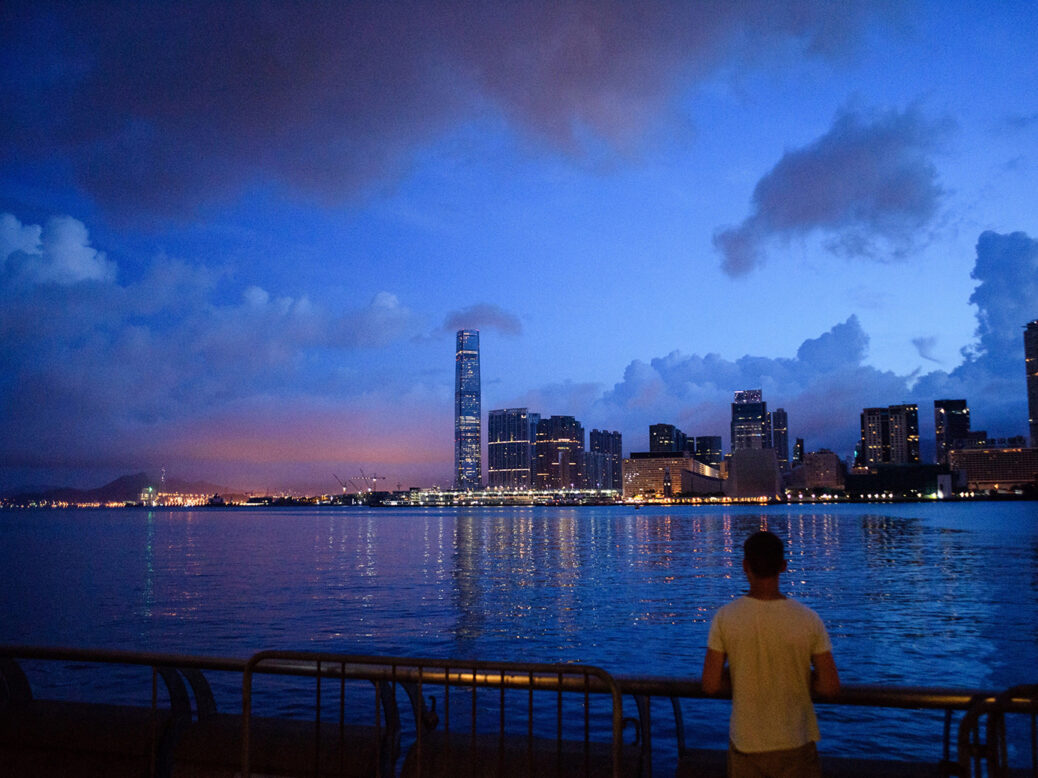
In Cameo, the novel I read from at events around Hong Kong, during a promotional visit to Beijing an autofictional author is approached by agents of the CCP. They offer him an agreeable new life in China if he is willing to help them out in return: by positively or negatively reviewing this or that writer, keeping them abreast of what’s being gossiped at the West’s book launches, and so on. Sadly, no such overtures were made to me during my month in Hong Kong. When I might have been plotting to defect, I was out strolling in the goldfish market in Mong Kok, admiring the cyberpunk skyline from Victoria Bay, eating durians at the Shanghai Street fruit stalls. It may be that I need the CCP more than the CCP needs me. My line, however, remains open.
[Further reading: In China, you can barely move for pandas]
Content from our partners