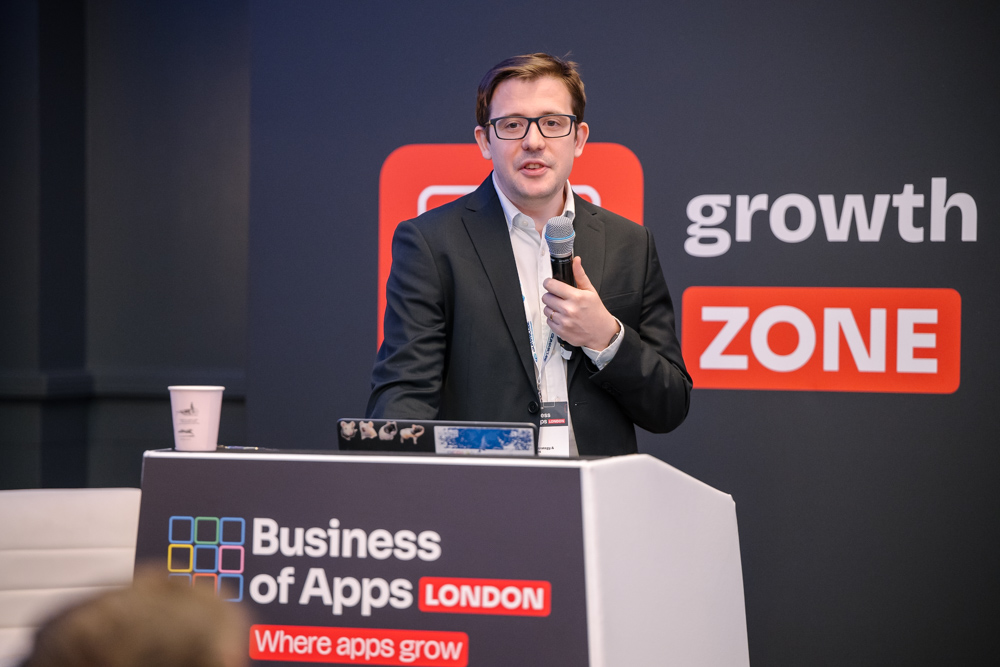
Simon Thillay is Head of ASO at AppTweak, a platform that has been working in app store optimization for over ten years. At Business of Apps London 2026, he and AppTweak’s VP of Product Michael Greppi laid out how LLMs are changing app discovery and what teams can do about it today.
Key takeaways:
- LLMs are becoming part of the app discovery process, sitting before the App Store in the user journey
- Over 50% of ChatGPT citations for app-specific prompts in the US reference an App Store page
- Measuring AI visibility by intent clusters gives a much stronger signal
- Your website, App Store long description, listicles, and Reddit are four concrete places to start

There’s an app for that — except now there are too many
The old App Store promise — “there’s an app for that” — no longer works the way it used to.
– Advertisement –

Is your privacy opt-in rate costing you $525,000 a year?
The gap between a 65% and 90%+ privacy opt-in rate can mean $525,000 in lost revenue annually for a 100K DAU app — and most teams have no idea where they stand.
This guide breaks down the true cost of consent debt, why the average app sits at just 80% opt-in, and the exact tactics top performers use to consistently hit 90%+: prompt timing, banner design, vendor list optimization, and more.
Download the Guide.
“In 2026, there’s too many apps for that. People are looking for an app that’s going to do the job for them. They want to feel it’s not an app, it’s the app that matches their need.”
That shift is pushing users toward LLMs as a filtering layer before they ever reach the App Store. They ask ChatGPT for a recommendation, get a shortlist, and then head to the store to download. In other words, app marketers now need to clear an elimination round that didn’t exist before.
How LLMs actually surface apps
Before getting to tactics, Simon walked through how LLMs actually process a query since the mechanics matter for anyone trying to influence the output.

When a user submits a prompt, the LLM doesn’t immediately search. It first identifies entities and intent, then builds what Simon called a query fan-out, a set of related variants it uses to research the original question.
“ChatGPT has not yet performed any search. It just took your initial prompt and started building multiple variants. It’s going to cover not just what you’ve said, but what you might have wanted to say as well.”
It then pulls from two sources: its core trained knowledge base and live web retrieval. That second source includes your website, community platforms like Reddit, authority sources like Wikipedia, and your App Store page.

“Over 50% of the citations we’ve seen for app-specific prompts in the US returned an App Store page as a source.”
After retrieval, the LLM scores chunks of content for relevance, synthesizes them, and produces a text answer. That last point matters. ChatGPT is not in the business of sending traffi; rather, it produces opinions.

Measuring visibility by intent, not prompt
Individual prompts are a poor unit of analysis, Simon argued. Research from Gumshoe found almost no one types the same prompt twice.
AppTweak’s approach is to measure visibility across clusters of prompts that share a single intent. Their AI Visibility for Apps solution maps app categories to sub-categories they call App DNA — so “health and fitness” breaks into weight loss, women’s health, outdoor activities, meditation, and so on — and tracks how visible an app is across the different intents within its DNA.
“Rather than trying to calculate visibility based on a single prompt, it’s much more relevant to measure visibility across multiple prompts that share a single intent. That provides a much stronger signal.”
Sentiment matters here too. Because LLMs produce text rather than links, the way an LLM describes your app — positive, neutral, qualified — is part of what influences a user’s decision.

Simon demonstrated this with a comparison of Hulu, Netflix, and Disney+. Hulu showed concentrated visibility on its core intents. Netflix and Disney+ were more spread out, potentially a signal that their positioning is less clearly read by LLMs, or that secondary use cases are drowning out primary ones.
Four experiments to run now
Simon was clear that AI visibility is early-stage, somewhere around where ASO was ten years ago. But the teams that moved early on ASO tended to benefit most. The same logic applies here.

Build a structured website
Your App Store page has character limits. Your website doesn’t. LLMs crawl it, and they reward clarity.
“Make sure your website states a primary workflow for your app, who it’s for, what it does, what it doesn’t do. It’s about describing benefits, not features. And LLMs prefer bullet points.”
FAQs are particularly effective since LLMs are drawn to structured, question-and-answer formatted content.
Rewrite your App Store long description
The App Store page is already one of the most-cited sources in LLM answers. Grammarly’s long description is notably more structured and detailed than ChatGPT’s own, which is part of why, on grammar-related prompts, ChatGPT recommends Grammarly over itself.
Go after listicles and PR mentions
“Best X app for Y” articles carry authority with LLMs. If your app is already featured in one, mention it to Apple; they run their own versions of the same content.
Reddit AMAs
Reddit has genuine authority with LLMs. The challenge is showing up without looking like a plug.
“People on Reddit do a lot of AMAs. If you can convince someone on the product side to host one, that’s a great way to generate text that holds authority with LLMs.”
One thing Simon flagged as worth watching but not yet actionable was turning your app into an MCP. OpenAI has published an SDK that lets ChatGPT perform actions inside apps. Google has released something similar for Android. Neither currently surfaces app recommendations as part of that flow, but the direction of travel is clear enough to make it worth keeping an eye on.
Our next event is in New York. Join us here.