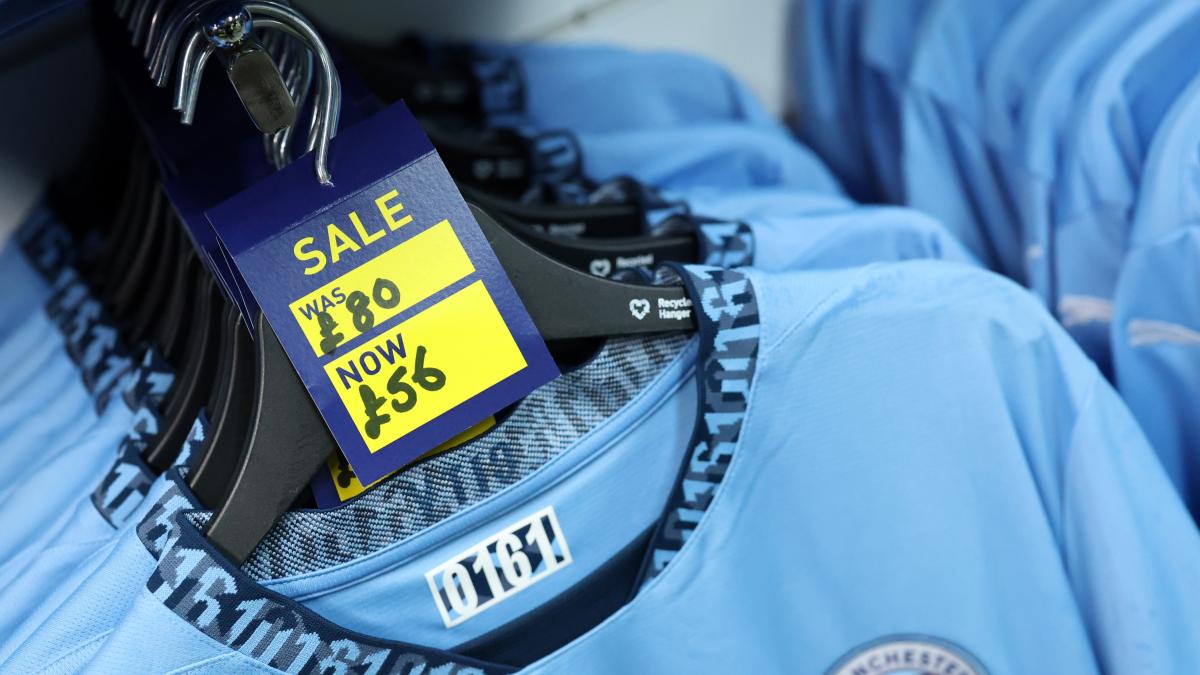
A journey through the kits of Europe’s top five leagues: none are like Ligue 1 for price, but Serie A has the highest cost relative to average salary.
The football shirt is increasingly a commercial product, perhaps even more than a symbol of belonging. Every summer, clubs unveil their new kits, and fans face the choice of buying the simpler version or the one closer to what the players wear. But how much does a shirt cost today in Europe’s top leagues? An analysis by La Gazzetta dello Sport across the five major European leagues reveals that the average price of the cheapest available replica shirt is €92.7. Ten years ago, in the 2016/17 season, the same analysis showed an average of €74: thus, the price has increased by 25% in a decade.
How Much Do Shirts Cost? The Data
—
However, this growth has not been uniform across all leagues. The league where shirts have become most expensive is the Premier League, rising from an average of €63 in 2016/17 to €93 currently, an increase of 48%. This is followed by La Liga (+23%), Ligue 1 (+21%), Serie A (+21%), and the Bundesliga (+17%). Today, the league with the highest average price is Ligue 1, at €95.2, ahead of Serie A at €94.2, the Bundesliga at €93.3, and the Premier League at €93. La Liga, however, has the lowest average, at €88.3. To ensure the most consistent comparison, the analysis considers the cheapest replica version available online for each club as the starting point. This is then supplemented by checking how much the same kit can cost with the maximum available customisations, sponsors, and patches. It is here that significant differences emerge between one shirt and another. In Italy, the average shirt price is €94.2, slightly higher than in the other major leagues. Even when comparing this figure to the average gross monthly salary (Eurostat data), the picture remains consistent. In Italy, purchasing a shirt accounts for 3.4% of the average gross monthly salary, compared to 3.1% in La Liga, 2.6% in Ligue 1, and just 2.1% in the Premier League and Bundesliga. The difference, therefore, lies primarily in purchasing power: a shirt costs roughly the same across the five leagues, but it impacts the buyer’s income differently.
Impact on Salary
| League | Average Shirt Price | Average Gross Monthly Salary | Impact % |
|---|---|---|---|
Club Choices
—
Within individual leagues, commercial strategies are not always the same. In Serie A, some clubs have opted to offer a more affordable entry point for fans, providing a reduced-price replica alongside the version worn by players. This is the case for Napoli, Fiorentina, and Torino, who offer a replica version for less than €60, while the ‘match’ version, closer in characteristics to what the players wear, is offered at a higher price. The distinction between replica and match shirts is, however, now widespread in other leagues too. The difference is that, in many cases, even the cheapest replica version starts at a higher price. For this reason, when comparing clubs, the most accessible available option was always considered. Como’s case is unique for another reason: at the time of the analysis, only the shirt with the Champions League patch was available on the club’s online store. Another Italian peculiarity is that three of the twenty Serie A clubs have not yet put their shirts on sale on their official online stores (Frosinone, Monza, and Sassuolo). Looking abroad, however, some clubs stand out differently in the European landscape. Brentford, in the Premier League, has decided to keep the shirt introduced for the 2026/27 season identical for 2027/28 as well. This decision breaks with the established model of annual new kit launches and, beyond the commercial aspect, also introduces a reflection on the sustainability and consumption of sports kits.
Complete Kits
—
It’s no coincidence that basic shirts can quickly increase in price. Simply adding a name and number, sponsors, and competition patches is enough. In Serie A, the average for the most complete configurations thus reaches €121.2, compared to €92.6 for the cheapest replica shirt. In Ligue 1, a complete kit can cost an average of €123, with Monaco holding the national record at €156 (of which €30 is solely for sponsors), although the European record belongs to Newcastle, at an astonishing €159, within a Premier League average of €122.8. Conversely, complete kits are cheaper in the Bundesliga (€112.8) and La Liga (€105.6).
Comparing the Data
—
The historical comparison remains the most striking data point, considering only the cost of the basic shirt. The average across the five leagues has indeed risen from €74 in 2016/17 to €92.7 in 2026/27, an increase of 25%. The Premier League is therefore the clearest example: in ten years, the average price has increased by €30, almost half as much again as the starting price. Serie A, despite now having a higher average than La Liga, has recorded a more contained growth of 19%.
The Increase Over 10 Years
| League | Average Price 2016/17 | Average Price 2026/27 | Change % |
|---|---|---|---|
The shirt market thus reflects a transformation in football that extends beyond the pitch. Clubs have increasingly segmented their offerings: from the cheapest replica to the match version, including customisations, sponsors, and patches. And while the average shirt across the five major leagues now costs €92.7, the bill for those wanting the most complete version can be significantly higher. Meanwhile, over ten years, fans are spending almost €20 more.
This article was originally written in Italian by La Gazzetta dello Sport editor. The English version has been generated using AI translation tools. If you notice any translation errors or have suggestions, please contact us at iniziativegazzetta@rcs.it
© RIPRODUZIONE RISERVATA