As consumers look to overcome roadblocks to their healthy eating goals, Instacart sees a prime opportunity to marry the convenience of e-commerce with digital tools like shoppable recipes and category-specific stipends — and help boost retailer partners’ sales.
Healthy eating can pose considerable challenges, though, to consumers — and the retailers looking to reach them — from boring recipes to complex nutritional restrictions for different health conditions. While most grocers’ latest moves have focused on healthy eating broadly, Instacart Health, the initiative that Instacart started in 2022 to address these issues, is taking a tailored approach through partnerships aimed at reaching thousands of recipients of health-focused services.
For retailers, this means they can connect to these consumers through Instacart, with the grocery technology company essentially serving as the conduit.
This spring, Instacart Health said it is scaling its partnership with Wellabe, a supplemental health insurance provider, to offer Fresh Funds — Instacart’s category-specific stipends — to as many as 100,000 of the provider’s members this year. Instacart Health also expanded its ability to support Medicaid managed care organizations in states where nutritious food programs are designated as a covered service. Most recently, Instacart Health linked up with Teladoc, a telemedicine and virtual healthcare company.
“We’re a retailer enablement company. We also want to be a healthcare enablement company,” Sarah Mastrorocco, vice president and general manager of Instacart Health, said in an interview about the Teladoc partnership.
The grocery industry sees a large consumer cohort that retailers can tap into. Three in four adults in the U.S. have at least one chronic condition, and over half have two or more, according to the Centers for Disease Control and Prevention. Chronic disease care accounts for more than 85% of U.S. healthcare costs, according to research done by the National Institutes of Health.
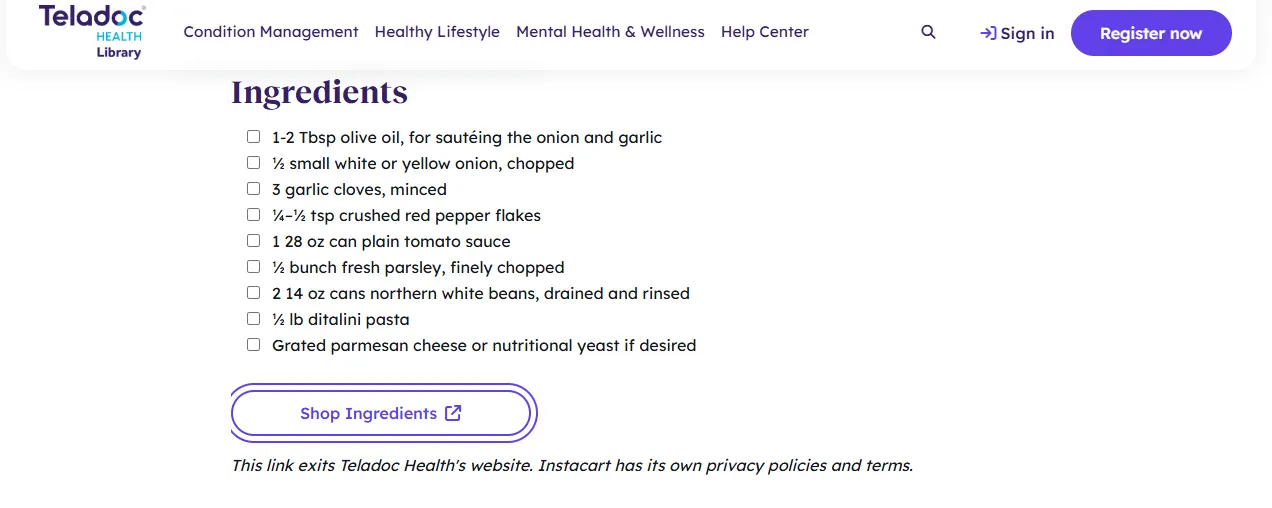
A shoppable button on a Teladoc recipe to get ingredients at Instacart.
In announcing its Instacart Health partnerships, the grocery technology company has focused on consumer demand for nutritious food — and pointed out how e-commerce and digital shopping tools can simplify the grocery shopping experience. Just as Instacart has enabled e-commerce services for many retailers, it sees itself playing a key role in helping them with health-focused food retailing.
Wading into the complex healthcare and food-as-medicine space has been tricky for retailers. Instacart pointed to its scale — the company claims to reach 98% of U.S. households and works with approximately 100,000 stores — as a key advantage. Its “magic” is the technology capabilities that it can use to connect retailers, consumers and platforms such as Teladoc, Mastrorocco said.
What tackling healthy eating roadblocks looks like
The Teladoc tie-up is a prime example of how Instacart Health is looking to solve multiple challenges around healthy eating.
Linking up with Instacart’s digital capabilities is intended to reduce friction around healthy eating behaviors, Erin Koffel, Teladoc Health’s applied behavioral science director, said in an interview. Eligible Teladoc Health members can now earn Instacart Health Fresh Funds — digital grocery stipends that can cover the cost of specific food items at Instacart’s retailer partners — by completing program-specific device checks, like a blood glucose reading, a blood pressure reading or a smart scale weigh-in.
“Those checks are really important to catch problems early and to kind of keep people on top of their health if they’re managing a chronic condition, and research shows that rewards can actually help increase monitoring follow-up and lead to better long-term outcomes,” Koffel said.
Teladoc and Instacart can see if someone used a Fresh Fund stipend and on what — compiling useful data on the buying behavior of people with chronic conditions. In a blog post, Koffel noted that Fresh Funds can incentivize inactive Teladoc members to take steps to support ongoing condition management.
“A lot of what we’re working towards is trying to really get people to act today in service of tomorrow,” Koffel said in the interview.
Teladoc members can access health coaches and nutrition guidance through curated recipes and articles, and with the Instacart partnership, can more easily build an online grocery cart through shoppable content.
“If you have a member with hypertension who’s looking for a heart-healthy meal plan, they can go to our curated recipes, search for a meal that they’re excited to make and then instantly add the ingredients to their cart,” Koffel said.
She continued: “The contrast to that is someone who maybe thinks they need to eat healthy. They’re trying to Google recipes. They might try to look up nutritional information. They have to make the list. They have to go out and find the ingredients. Get them home. Every step along the way is a point of friction that makes it less likely that the behavior is going to occur.”
Koffel noted that Teladoc’s recipes, which registered dietitians and nutritionists create, are also designed to appeal to consumers’ tastes: “We have one that I looked up today that was, ‘Heart-healthy recipes that are not a sad salad.’”
For consumers, the transparency of seeing their running total as they build a basket can help keep them on track with their budget as well as maximize their spending on healthier foods, Mastrorocco said.
To help evaluate the success of the partnership, Teladoc will track how many Teladoc members do device checks, work with Instacart to test different types of rewards to incentivize that behavior and look at engagement rates for the shoppable recipes, Koffel said.