This Energy Explained post represents the research and views of the author(s). It does not necessarily represent the views of the Center on Global Energy Policy. The piece may be subject to further revision. Contributions to SIPA for the benefit of CGEP are general use gifts, which gives the Center discretion in how it allocates these funds. More information is available here. Rare cases of sponsored projects are clearly indicated.
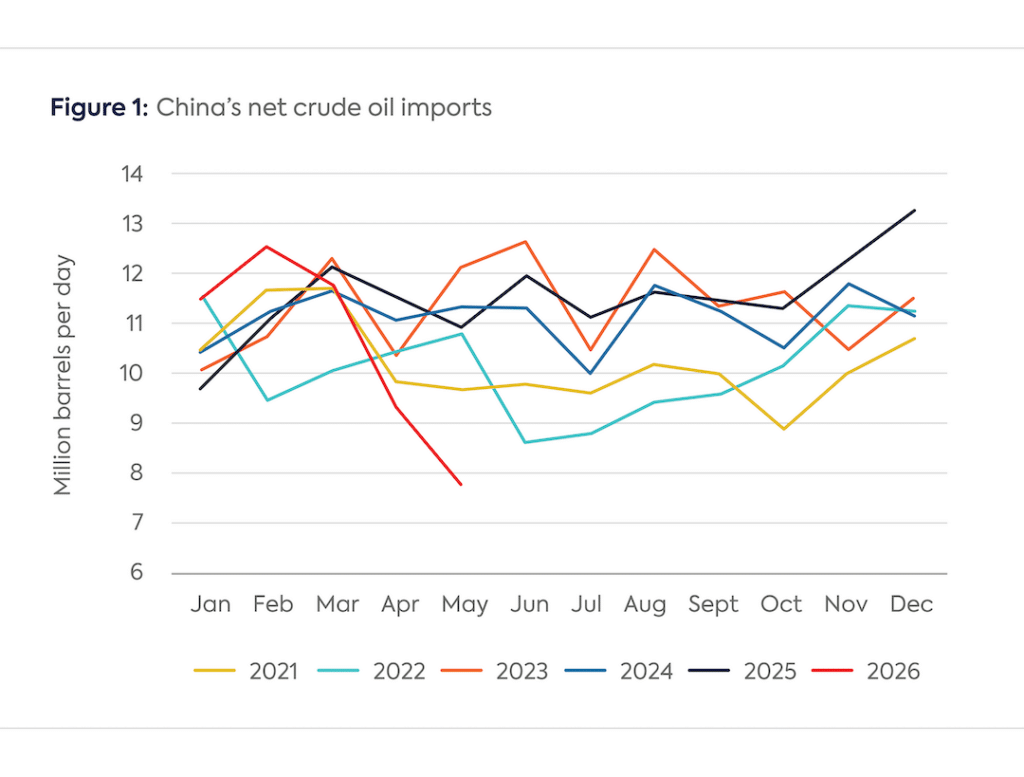
- China reduced its net crude oil imports by 30% in the second quarter of 2026, year-over-year, or 3.5 million barrels per day (bpd).
- Official Chinese data point to reductions in the implied amount of crude put into storage (1.9 million bpd) as well as the decline in crude processed by refineries (1.6 million bpd) due to squeezed margins.
- Whether China’s crude imports fully recover to pre-crisis levels partly depends on whether end-user responses to higher prices become permanent changes rather than short-term behavioral adjustments.
The ongoing disruption of oil exports through the Strait of Hormuz has caused a substantial decline in China’s crude oil imports. China, the world’s largest oil importer, decreased its crude oil imports by 30% percent in April–June 2026, year-over-year, with its June imports plunging to the lowest level since October 2016. And China apparently did this without any meaningful decline in economic activity.
How China managed this feat has been the subject of much discussion. Analysts have identified explanatory variables including inventory drawdowns, reduced refinery runs, restrictions on refined product exports, and changes in consumer behavior. Determining exactly how much weight to attribute to these variables—and which are temporary rather than structural—is difficult, partly because Beijing does not publish data on China’s oil demand and has not revealed the size of China’s oil inventories since December 2017.
In this blog post, the authors assess the plunge in China’s crude oil imports by analyzing the oil data that Beijing does publish. They find that changes in the amount of oil China put into storage equated to more than half of the decline, while the reduction in crude for refinery runs, with squeezed margins driving those choices, made up the rest.
Falling Imports
The mystery of how China reduced its crude oil imports began in April. Not only did China’s imports fall by 20% year-over-year (2.3 million bpd) in that month, China also modestly increased its crude inventories. Additionally, Chinese refiners sold cargoes of West African crudes instead of importing them. In May and June, imports plummeted further (see Figure 1).
Source: China’s General Administration of Customs (GAC) and Oxford Institute for Energy Studies (OIES).
Changes in Stockpile Additions
Based on official Chinese data (production, net imports, and refinery runs), monthly changes in the implied amount of oil being stockpiled accounts for more than half of the decline in China’s crude oil imports. Not only did China not stockpile the 1.57 million bpd of crude it put into storage in Q2 2025, but China also withdrew 363,000 bpd in Q2 2026. The combined 1.93 million bpd is 54% of the decline in China’s Q2 2026 net crude oil imports (see Figure 2).
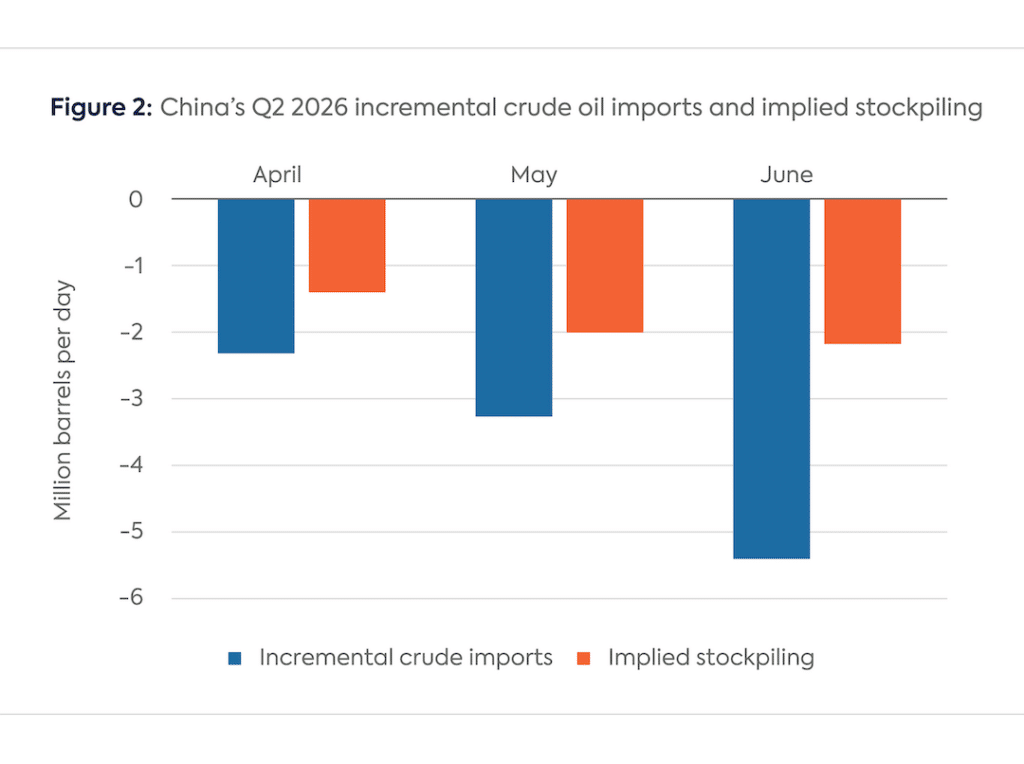
Source: China’s General Administration of Customs, http://stats.customs.gov.cn/, and National Bureau of Statistics, monthly reports on energy production in April, May, and June.
Refinery Run Cuts
The second contributor is reduced refinery throughput. In Q2 2026, refinery runs averaged 12.8 million bpd, a 1.6 million bpd reduction from Q2 2025. In June alone, Chinese refiners cut runs by 18% year-over-year (-2.7 million bpd) to 12.5 million bpd, their lowest since January–February 2020. Refiners have cut throughputs for several reasons: First, the loss of crude supplies from the Gulf, alongside rising oil and shipping prices, disincentivized runs. Second, with Beijing reportedly reluctant to allow refiners to draw down crude stocks early in the crisis, refiners reduced their operating rates (see Figure 3).
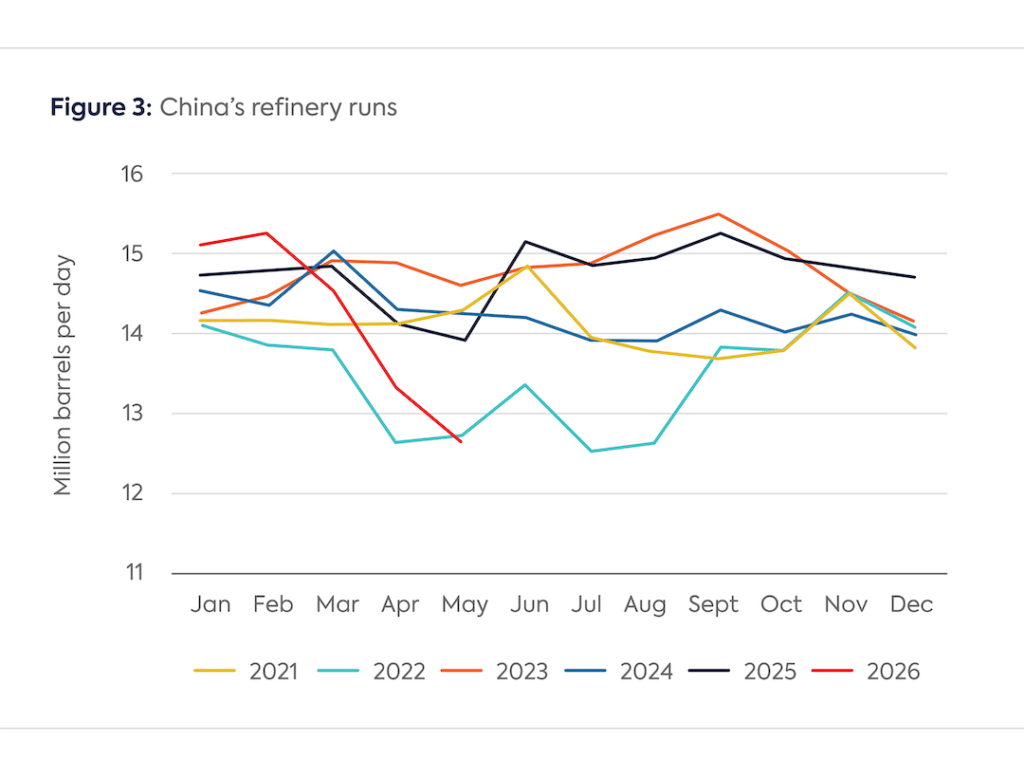
Source: National Bureau of Statistics’ monthly reports on energy production.
Meanwhile, domestic prices for road transport fuels rose in line with a formula that tracks international prices, limiting transport fuel demand. By early April, wholesale gasoline prices increased by RMB 2,275/metric ton and wholesale diesel prices rose by RMB 2,185/metric ton, or around $40/barrel ($1/gallon)[1] (see Figure 4).
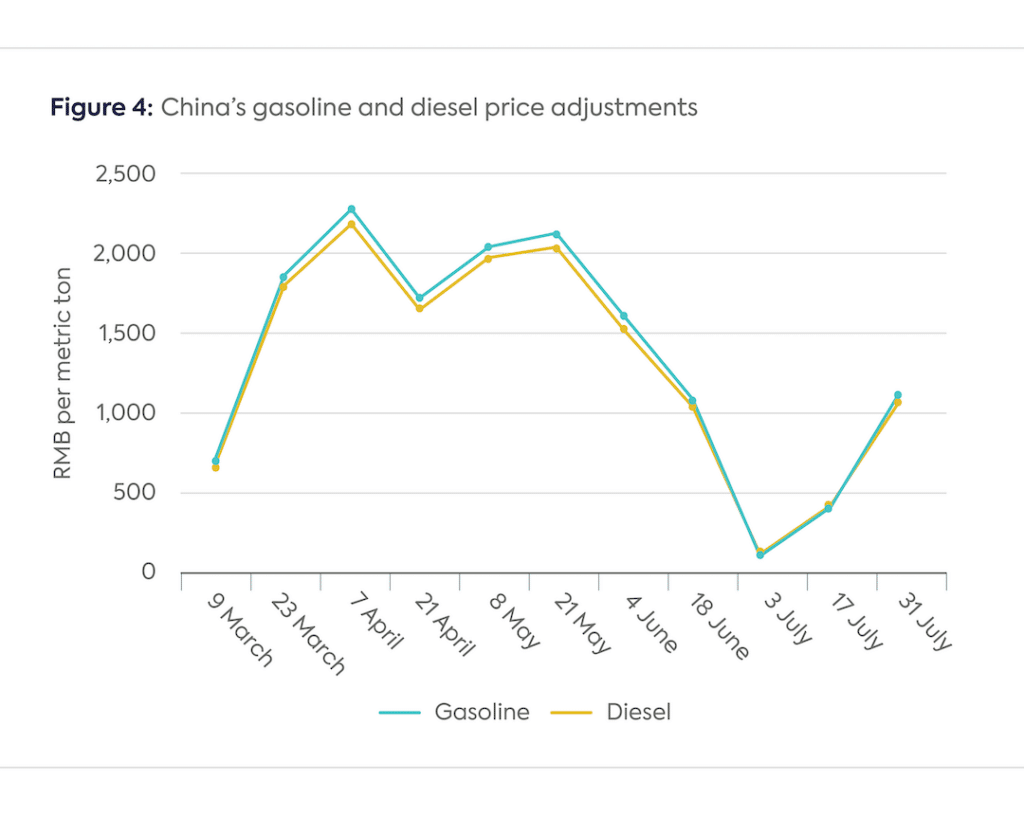
Source: National Development and Reform Commission.
Despite the cap, and the downward price adjustments, end user prices increased, especially in March–June, leading to declines in transport fuel demand. Note that data on Chinese oil product demand is extremely limited. Official data (production and imports) reflects implied demand and does not include data on stock trends. Based on implied data, in Q2 2026, gasoline demand declined by 5% year-over-year (y/y), while diesel demand fell by 13%. For the first half of 2026, implied data show that gasoline consumption was lower by 1%, while diesel demand fell by 13%. This compares with Chinese estimates for the same period that peg the fall in diesel at around 6–7% y/y, while estimates for the drop in gasoline vary from 7% to almost 12%.
While China’s gasoline use is falling structurally due to electric vehicle penetration, high prices at the pump likely further discouraged driving. Anecdotal reports point to more taxi usage and EV rentals, as consumers determined it was cheaper to use taxis or rideshares than to pay for gasoline, but this also suggests that when prices fall, gasoline use could rise. Lower diesel demand, however, is due to several factors, including the weakness in construction and infrastructure investment, softer industrial and logistics activity, and the substitution of electric and LNG heavy trucks related to higher oil prices.
Beijing’s Visible Hand
With weaker demand, refiners reduced operating rates, but run cuts were also driven by weaker margins due to domestic price adjustments and product export restrictions. According to the pricing mechanism, wholesale gasoline prices should have risen by 3,700 RMB and diesel by 3,560, or $65–$70 per barrel (around $1.50–$1.70 per gallon) in April, but China’s National Development and Reform Commission capped the rise to limit the impact on consumers. So, although domestic product prices increased, refiners were unable to pass through their full crude import costs.
One of Beijing’s first responses to the Strait of Hormuz crisis was to restrict refined product exports to ensure supplies for the domestic market. China’s exports of diesel, gasoline, and jet fuel registered year-over-year declines of 551,000 bpd in April, 474,000 bpd in May, and 418,000 bpd in June—a y/y drop of about 60% for Q2 2026.
The export restrictions made a modest contribution to the Q2 crude oil import decline because China’s refining system is designed to supply the domestic market. Exports, which Beijing manages with quotas, serve as a balancer. China’s exports of gasoline, diesel, and jet fuel accounted for around 10 percent of China’s production of these fuels in 2021–2025.
But product export restrictions mean that refiners have not been able to capitalize on higher export margins. As Beijing eases the restrictions, margins could recover, prompting refiners to raise runs.
Will Higher Imports Resume?
If Beijing offers refiners some predictability about product exports, and margins remain attractive, refiners will raise throughputs. Whether they draw crude from inventories or tap global markets will depend on prices (with discounted crudes likely prioritized).
China’s crude oil imports in July grew by 22% over June but were still 24% lower than the July 2025 level, boosted by increased oil flows through the Strait of Hormuz and more purchases from exporters outside of the Middle East.
China almost certainly will return to the market to replenish oil inventories and fill new storage capacity, but there is no urgency. Given the size of its inventories, China can wait until the price is right. While Beijing will likely resume stockpiling, how many days of net import coverage it will seek remain unclear.
A key unresolved question is whether Chinese crude oil imports will return to pre-war levels. That will in part depend on whether adjustments consumers made in response to higher prices, such as greater EV use, become permanent changes rather than short-term necessity shifts.
[1] These prices reflect the magnitude of the mandated cost pass-through, but they do not necessarily reflect the increased prices at the pump, given that pump prices vary by province and station with margins and taxes included. That said, this is the magnitude of the cost pass-through. It assumes a conversion rate of RMB 6.75 = $1, conversion rate of 8.5 barrels/metric ton for gasoline and 7.5 barrels/metric ton for gasoil, and 1 barrel = 42 US gallons.