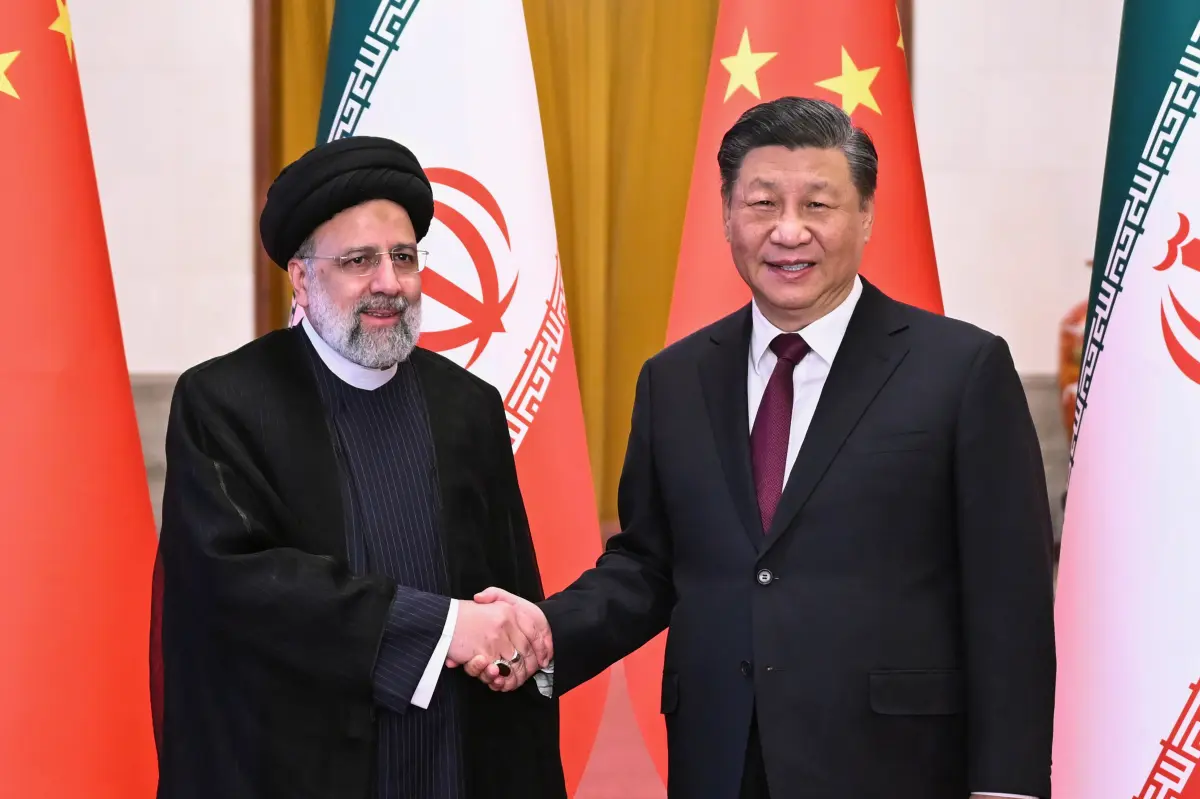
China is a central actor in the war with Iran, though it remains largely unnamed in Washington’s public debate. Without Beijing’s money, oil purchases, sanctions‑busting networks, and satellite support, the Iranian regime would not be able to fight.
The story begins with energy and finance. In March 2021, Chinese premier Xi Jinping and Iran’s leadership signed a 25‑year “Comprehensive Strategic Partnership,” widely reported as a $400 billion framework for Chinese investment in Iran’s oil, gas, banking, and infrastructure in exchange for long‑term access to discounted Iranian crude.
The timing was not accidental. Tehran was searching for an economic lifeline. Beijing came to its rescue.
By mid-decade, China was absorbing the overwhelming majority of Iran’s exported oil — roughly 1.4 million barrels per day, often at a steep discount. Iran used the proceeds to support the Iranian Revolutionary Guard Corps (IRGC); Hezbollah’s arsenal in Lebanon; Shiite militias in Iraq and Syria; and the Houthi campaign in the Red Sea.

Beijing has not limited itself to purchasing the oil. It has helped build a maritime and financial architecture designed to blunt the force of American sanctions.
Iran’s regime now relies on a “shadow fleet” of aging tankers registered to shell companies under rotating flags. Vessels switch off their transponders, conduct ship‑to‑ship transfers in the Gulf of Oman, then arrive in Chinese ports with paperwork falsely declaring the cargo to be Malaysian or Indonesian crude. Chinese institutions move the payments under the guise of infrastructure and construction contracts.
In parallel, a growing share of these transactions is settled in yuan rather than dollars, outside traditional Western banking channels. In practice, Beijing and Tehran have built a parallel payments system whose purpose is to insulate Iranian oil revenues from American leverage.
The economic lifeline is paired with a steady flow of military and technological assistance. Chinese companies export dual‑use components that feed directly into Iran’s ballistic missile and drone programs. Those systems now show up in the hands of proxies firing on U.S. naval vessels and commercial shipping.
Other Chinese entities have done business with the IRGC, despite its U.S. designation as a foreign terrorist organization, under the cover of routine industrial cooperation. Beijing has also helped strengthen Iran’s air defenses with more modern surface‑to‑air systems and related technology, complicating Western air operations.
Even after U.S. and Israeli strikes began, state‑linked Chinese vessels were documented loading sodium perchlorate, which is a key precursor for solid rocket fuel, for shipment to Iran. While American and Israeli pilots were risking their lives to degrade Iran’s missile arsenal, Chinese state companies were quietly helping Tehran replenish it.
The most consequential element of Chinese support, however, is not visible in satellite photos of ports or factories. It is in space.

For years, American and Israeli planners assumed that in the event of a major confrontation, they could degrade Iran’s strike accuracy by jamming GPS, the U.S.‑controlled Global Positioning System on which many weapons rely. That assumption has been undermined by Iran’s shift to China’s BeiDou navigation satellite system.
BeiDou is Beijing’s alternative to GPS, a global constellation that provides high‑precision positioning and timing independent of U.S. infrastructure. In earlier barrages, many of Iran’s missiles went wide of the mark once GPS was disrupted. In this war, intelligence analysts have observed a marked improvement in Iranian accuracy. The reason is plainly because Iranian missiles and drones have begun integrating BeiDou signals into their guidance packages.
In practical terms, Chinese satellite support is making it harder to intercept Iranian missiles aimed at American and allied forces. Beijing does not have to announce this openly. The assistance is structured to look commercial and deniable, but its battlefield effect is real.
China’s political posture has been calibrated just as carefully. Beijing has condemned U.S. and Israeli strikes, called for an immediate ceasefire, and tried to cast itself as a responsible stakeholder by floating “peace initiatives” and urging the reopening of the Strait of Hormuz. At the same time, it has quietly evacuated its own citizens from Iran, kept Chinese forces well away from potential engagement, and avoided any step that would put its assets at risk.
The picture that emerges is well-orchestrated. China finances Iran through energy purchases and investment. It shields Iran’s regime from sanctions with a bespoke shipping and financial network. It arms and enables them through dual‑use technology and satellite services. It denounces those who respond militarily, and it does all of this while keeping its own forces and territory far from harm.
This is not just a confrontation with Iran’s regime. It is an early demonstration of how China intends to challenge American power, indirectly, by arming and funding our enemies.
American policymakers can no longer afford to discuss Iran’s aggression without naming and confronting the role China has chosen to play in making that aggression possible.
Lisa Daftari is a foreign policy analyst and media commentator based in Los Angeles.