The news came just days after the U.S. District Court for the Western District of Michigan dismissed a lawsuit challenging the procedure by which the Nuclear Regulatory Commission approved Palisades’ restart. Started under the Biden administration, the revival project was one of the first the Trump administration allowed to move forward after taking office, part of a broader effort by the Department of Energy to spur a resurgence of reactor construction in the U.S.
2. Federal court upholds California’s air pollution rules on industrial boilers
Last week, the U.S. Court of Appeals for the Ninth Circuit blocked a challenge to California’s rules on emissions from industrial boilers, the latest legal victory for local regulations on planet-heating pollution from buildings. In 2024, the South Coast Air Quality Management District, the air pollution agency in charge of broad swaths of Southern California, set new restrictions on smog-causing nitrogen oxide from industrial boilers, appliances that either burn a fossil fuel such as gas or oil or use electricity to heat up water. The policy — which would slash the equivalent of half the nitrogen oxide produced by every car in Los Angeles combined — is part of the state’s long-standing effort to curb pollution. It’s not the only win for the fight to curb emissions from buildings. Since 2024, federal courts have repeatedly upheld local and state authority to regulate pollution from buildings in New York, Maryland, and Washington, D.C.
On Thursday, meanwhile, the Trump administration proposed a new rule to gut money-saving standards for appliances nationwide. “While the agency portrayed the move as bringing an end to appliance standards writ large, that is not, in fact, what it is doing,” Heatmap’s Emily Pontecorvo wrote last week. “The proposal would update the DOE’s so-called ‘Process Rule,’ which governs how the agency develops standards, adding onerous requirements that will make it much more difficult to make any changes at all.” When I spoke to the American Council for an Energy-Efficient Economy about the changes, the advocacy group told me the proposal would set minimum savings thresholds below which the new rule wouldn’t find federal support. It would also add a mandatory 180-day waiting period between before proposing new appliance standards based on novel testing procedures, require the Energy Department to show deference to industry-established standards, and force regulators to carry out extra analyses and rulemaking processes before enacting new rules.
3. Maine’s independent senator comes out against the NextEra-Dominion merger
Senator Angus King, the independent from Maine who caucuses with the Democrats, has urged the Federal Energy Regulatory Commission to reject the proposed utility megamerger between NextEra Energy and Dominion Energy. In a letter last week to the agency, King said the combination of the two giants risked putting too much power in the hands of one company. “The combination would create the largest electric utility in the United States, concentrating an unprecedented mix of merchant generation, rate-based generation, and transmission assets in the hands of a single company with a documented record of using its market position and political resources to suppress competition that threatens its merchant revenues,” King said in the letter, according to Utility Dive. Specifically, he cited NextEra’s lobbying to derail the New England Clean Energy Connect project in 2021, a transmission line to connect the Northeast’s grid to the almost entirely renewable hydroelectric system in Quebec.
Sign up to receive Heatmap AM in your inbox every morning:
4. Trump pardons six for tampering with vehicles’ emissions controls
Last week, the Environmental Protection Agency put out new regulatory guidance on the president’s “freedom to fix” agenda, reminding automakers of their “long-standing legal obligation to release the service information, training information, and tools necessary to diagnose and repair vehicles,” even if the driver could use what they learn to tamper with the emissions controls. Meanwhile, on Friday, President Donald Trump announced that he’d pardoned six people “who were persecuted by the Biden administration” and were either in prison or headed there for violating Clean Air Act prohibitions against rigging the vehicles’ emissions control systems. “While I know this sounds ridiculous, it is nevertheless a fact, and part of the Weaponization and Stupidity that our Country had to endure during four long years of Sleepy Joe Biden,” he wrote in a post on his Truth Social platform. “I AM SETTING THEM ALL FREE, RIGHT NOW!”
In non-emitting vehicle news, Rivian is eyeing a better sales year than expected. While the electric automaker previously said it would ship between 62,000 and 67,000 vehicles this year, it told investors on Thursday that it now expects to deliver between 65,000 and 70,000 vehicles, in what TechCrunch called “a small but potentially meaningful bump.” The announcement came the same week BYD crushed Tesla’s deliveries yet again, as I told you in my last newsletter.
5. Chile shifts gears on green hydrogen
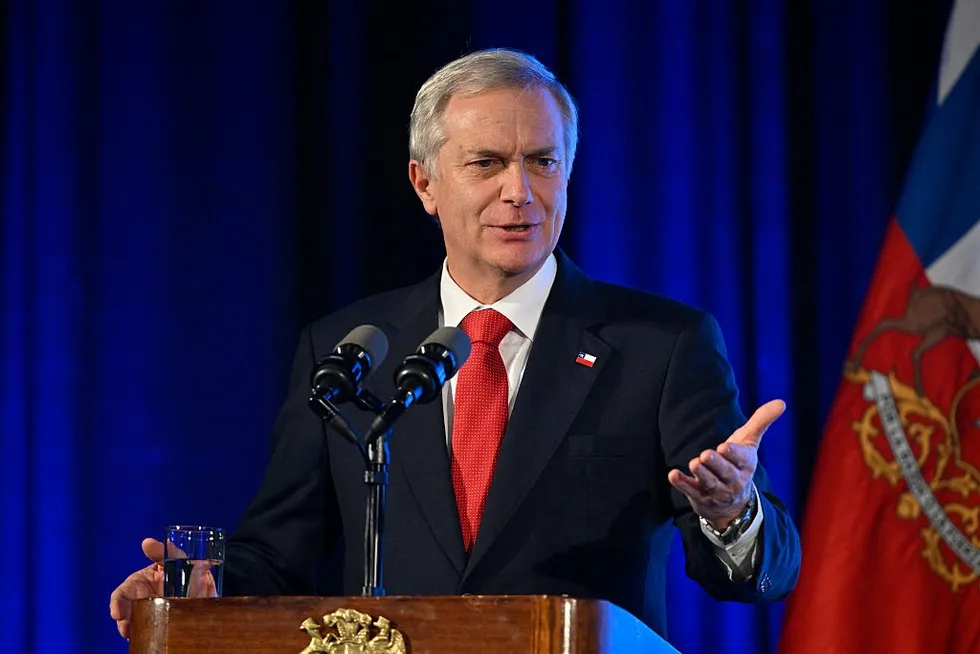
 Chilean President José Antonio Kast. Santiago Mazzarovich / AFP via Getty Images
Back in March, I told you that Chile’s most right-wing president since the fall of dictator Augusto Pinochet could take the country’s budding green hydrogen business in a different direction. Now President José Antonio Kast is doing just that. Last week, Chile’s state-owned Production Development Corporation, known by its Spanish acronym CORFO, announced plans to refocus the country’s strategy for green hydrogen on domestic use rather than exports, Hydrogen Insight reported.
China, as I have reported for you many times before, is going hard on green hydrogen, especially since the Iran War forced Beijing to ramp up efforts to find alternatives to imported fossil fuels. Here’s yet another data point: China just laid out plans to build the world’s largest green hydrogen plant using solid-oxide electrolyzers, which operate at higher temperatures. The facility will also produce, methanol, which uses hydrogen as a key ingredient. At peak capacity, the facility in rural Gansu province will produce 100,000 metric tons of renewable methanol per year for use in international shipping. Meanwhile, Spain is investing nearly $21 million into grants for hydrogen projects as the country seeks to make use of its booming solar industry. As I wrote last week, the surge in solar panels is creating problems for Spain, since its grid can’t handle all that power during peak daytime hours. Funneling that electricity into electrolyzers to make molecules that can be cleanly burned later may offer a solution.
THE KICKER
Last month, I told you about a catchier term for the very small-scale solar panels being legalized to go on windowsills and balconies, opening the door to more apartment dwellers generating a small share of electricity themselves. That term, which I first read in Inside Climate News, is “guerilla solar.” Well, that solar rebel mindset is coming to the “Live Free or Die” state. On Thursday, New Hampshire Governor Kelly Ayotte, a Republican, put out a list of 74 bills she signed into law before Fourth of July weekend. Among them was SB-540, legalizing plug-in solar panels. The law will take effect on July 27, according to PluginSolarUS, an advocacy group.