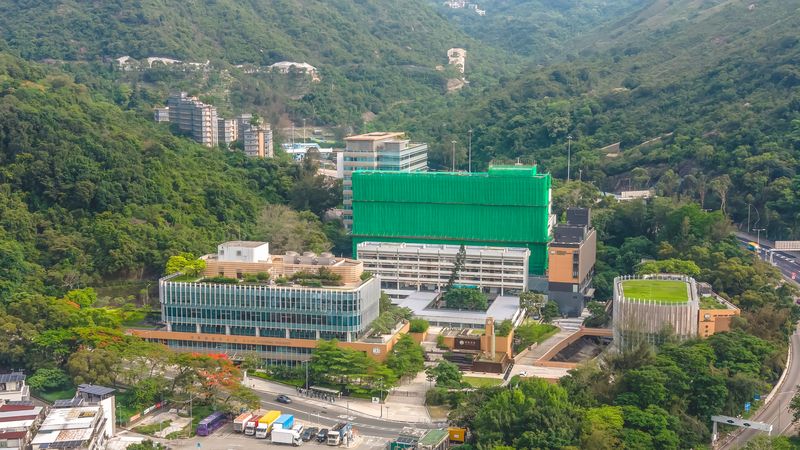
Hang Seng University campus in Sha Tin
Universities in Hong Kong are finding appeal among lenders as the resilient tertiary education sector continues to grow and helps lift the territory’s commercial real estate market out of its rut.
The universities are emerging as consistent buyers of commercial real estate and tapping debt to fund the purchases. They have committed close to HK$10bn (US$1.28bn) to commercial property acquisitions over the past 18 months, according to market sources and press reports.
In late May, Hang Seng University of Hong Kong (HSU) closed the acquisition of an entire floor in an office building in the Shek Mun area in the New Territories, following up on the purchase of another floor last November and taking the combined cost to about HK$200m. HSU funded the acquisitions through two loans from several banks, marking its first commercial borrowings.
“Universities may consider commercial borrowing as an option if no interest-free loan is available from the government, instead of drawing on their own cash reserves, in part on the view that investment returns could exceed financing costs,” said Simon Ho Shun-man, president of HSU.
When Hong Kong Metropolitan University (Metro U) looked to raise a loan to finance its HK$2.6bn December 2024 purchase of One HarbourGate’s East Tower in Kowloon’s Hung Hom district, Chinese, Japanese and Singaporean banks submitted proposals. In June last year, Metro U ended up raising a HK$1bn seven-year secured term loan and a HK$500m revolving credit facility, structured to qualify as a social loan.
“Bank participation was strong, and we received a broad range of competitive proposals from local and international institutions,” said Raymond Chiu, director of finance at Metro U. “Lenders showed clear willingness to support the higher education sector despite subdued credit demand in other parts of the economy.”
Shopping spree
Other universities have also been on a shopping spree for commercial properties and quite a few of those purchases have been debt-funded.
The University of Hong Kong (HKU) has established a US$1bn medium-term note programme for campus development and could become the first public university in the city to issue in the public bond market. Separately, HKU was reported in March to be acquiring a building in Hong Kong Island’s Sai Wan district for HK$4bn. The Hong Kong University of Science and Technology (HKUST) is evaluating both loan and bond options for its new medical school, according to sources.
HKU declined to comment, while HKUST did not respond to a request for comment.
Last December, the City University of Hong Kong acquired the office tower at Festival Walk in Kowloon Tong for HK$1.96bn, following its HK$880m acquisition of the retail podium at Inter-Continental Plaza in Tsim Sha Tsui a year earlier.
Last July, Lingnan University paid HK$120m for the retail and car-park components of the T-Plus tower in the New Territories, while HKUST acquired the former Metropole restaurant premises in Admiralty that same month for HK$354m to house its executive MBA programme.
An acute shortage of student housing is fuelling the buying spree. JLL’s Hong Kong capital markets head Oscar Chan told a media briefing last July that universities are actively scouting self-use properties – for dormitories as well as administrative and teaching uses – and he expects more acquisitions to follow.
Cushman & Wakefield’s Talent Housing and Student Accommodation report puts the student-to-bed ratio at the eight public universities at 3.4 to 1, with the firm’s Hong Kong head of research, Rosanna Tang, projecting a shortfall of at least 55,400 beds by 2027 even on conservative assumptions.
Banks have been busy marking down their exposure to Hong Kong office and retail landlords in response to defaults and forced sales. Yet the same buildings, in the hands of a university, have become some of the most sought-after collateral in the city.
“The competition on pricing and terms was encouraging, reflecting banks’ appetite for high quality, asset-backed exposure to universities at a time when they are more cautious on cyclical and property-related borrowers,” Metro U’s Chiu said.
He pointed out continuing appetite among lenders for strong, publicly backed or quasi-public borrowers, even as overall loan growth in Hong Kong remains soft. “Banks are selectively redeploying capital from more stressed sectors, such as commercial real estate, into resilient segments like universities and statutory bodies,” he said.
With stable cashflows, deep reserves, an improving outlook for revenues and very low risk of default, universities offer strong lending propositions. For instance, HKU alone sits on reserves of over HK$40bn. For institutions of that size, tapping the loan market is not really driven by liquidity needs.
Beyond credit quality, the government’s recent loosening of the non-local student cap from 40% to 50% gives lenders further comfort on future cashflows. International tuition runs at roughly twice the local rate, and Hong Kong’s drive to position itself as a regional education hub stands to channel fresh revenues to private and public institutions alike.
“The relaxation of the cap on non-local undergraduate student intake enhances Hong Kong’s internationalisation and supports universities’ revenue growth,” said Ho from HSU. “As universities expand following the policy change, tuition income is expected to continue rising.”
Government tightening
The government is encouraging universities to pursue commercial financings. Facing a yawning fiscal deficit, it has not only cut recurrent funding to universities, but in February 2025 asked the eight publicly funded institutions to return a combined HK$4bn from their reserves.
HSU, for example, has historically drawn on more than HK$1.1bn in interest-free government loans, of which over half has been repaid through private donations, according to Ho.
Loans remain the financing instrument of choice for the universities compared to bonds.
“We wanted a committed, medium-term source of capital tailored to our needs, without the execution risk and disclosure requirements associated with capital-market issuance,” Chiu said of Metro U’s debut deal. “Bank financing also allowed us to secure competitive all-in pricing relative to comparable public sector borrowers at the time, while keeping documentation and investor relations overheads manageable for a first-time transaction.”
Metro U invited multiple lenders, narrowed the field on more than just pricing, and ultimately built a club. “We placed weight on banks with a strong Hong Kong presence, a track record in public-sector and higher-education lending, and the ability to lead a club transaction efficiently,” Chiu said.