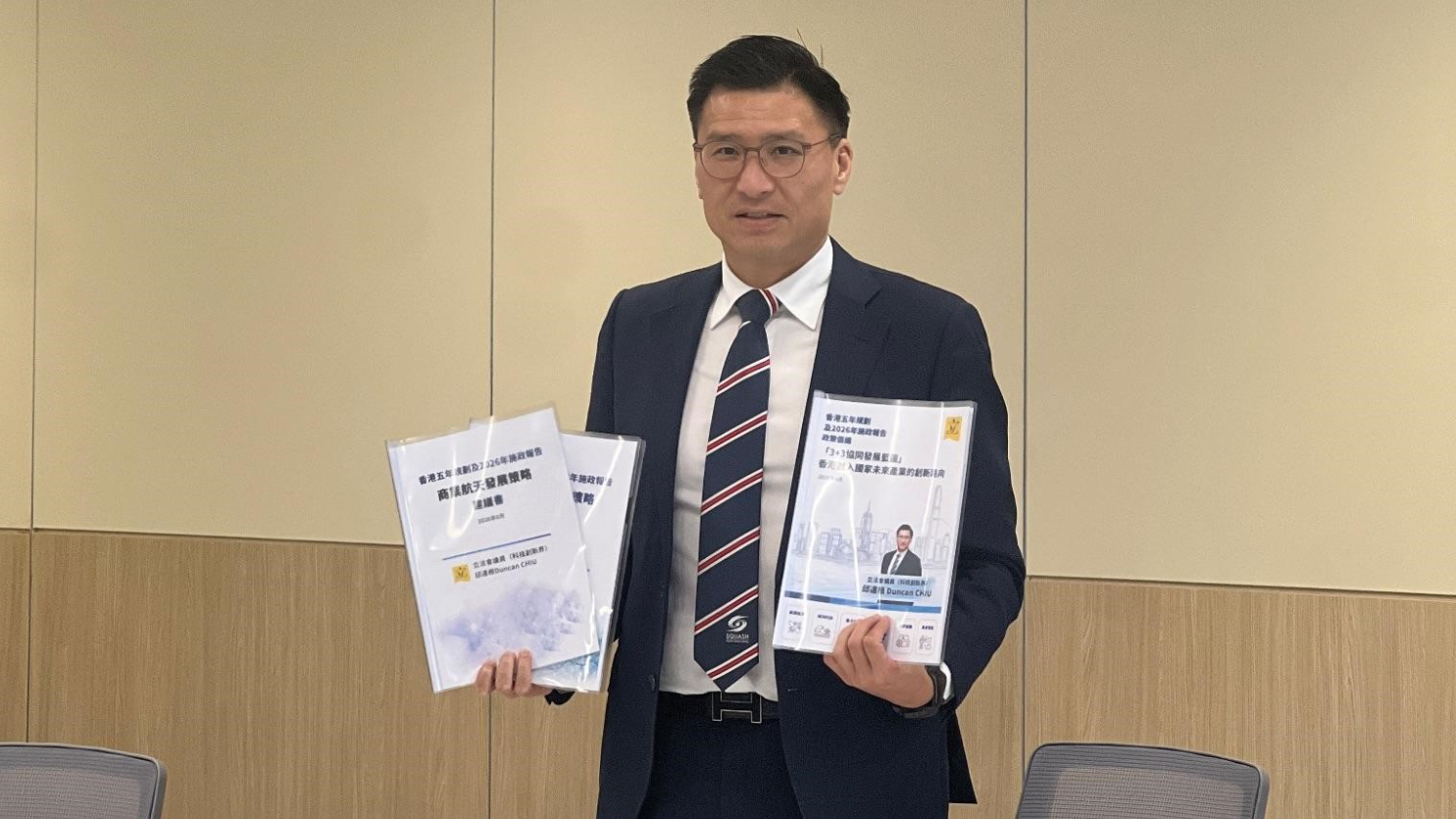
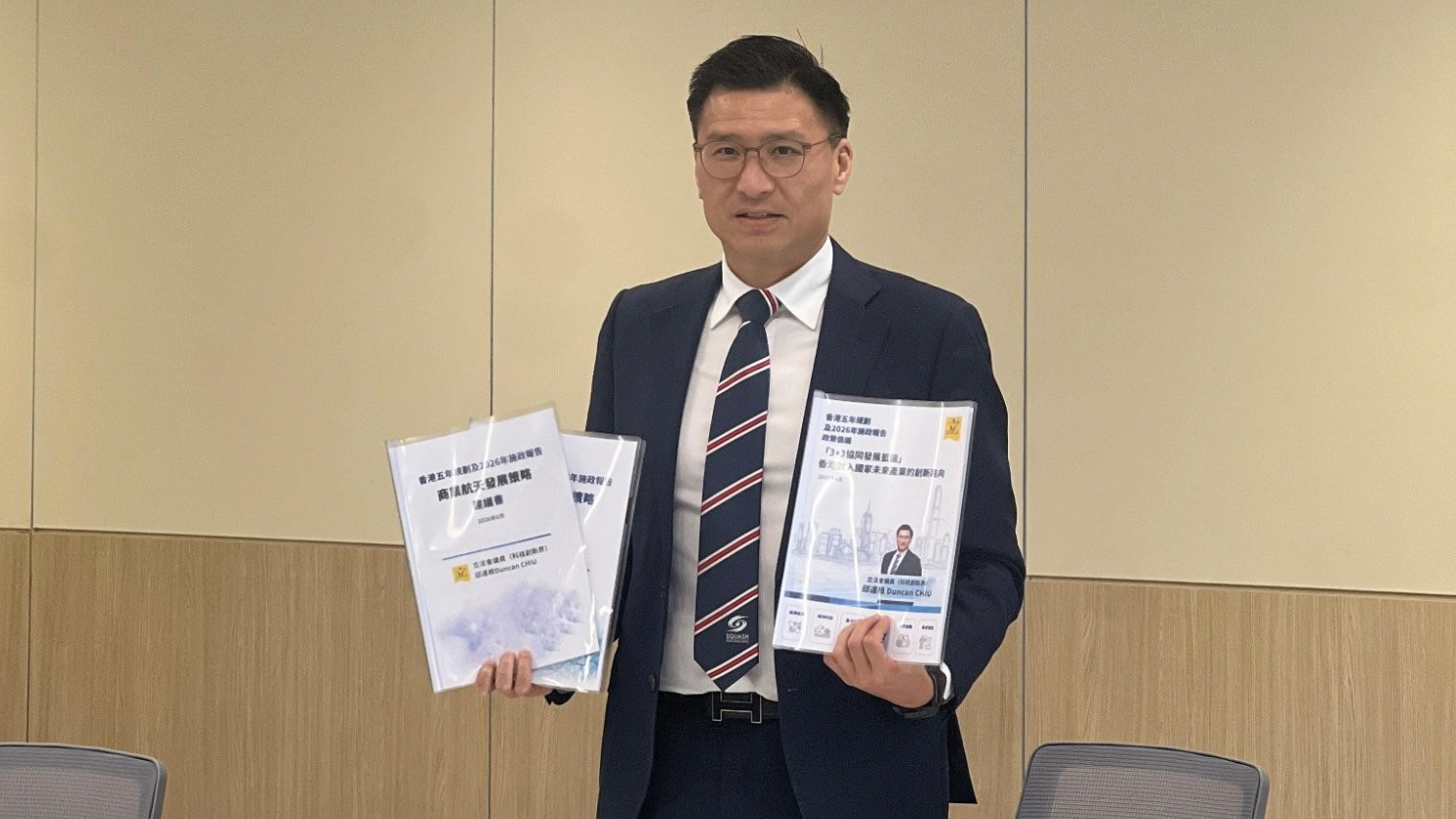
The Hong Kong Special Administrative Region government should allocate resources to establish the SAR as an international aerospace hub, cementing its crucial strategic position in the global space economy value chain, including establishing a high-level task force led by secretary-level officials and setting a development road map and timeline, according to Duncan Chiu, technology and innovation sector lawmaker.
The suggestions were among his “3+3” recommendations covering three emerging industries — commercial aerospace, quantum technology and marine technology — and three fields requiring deeper exploration — life and health technology, digital finance, artificial intelligence and robotics — to the Hong Kong government for the SAR’s first five-year plan and the 2026 Policy Address, both scheduled to be published on Sept 16.
ALSO READ: Hong Kong blasts off to be Asia-Pacific space science hub
Speaking to the media at a tea gathering on Tuesday, Chiu, who is also a member of the Board of Directors of the Hong Kong Science and Technology Park Corp, said the country has listed commercial aerospace as a strategic emerging industry, while Hong Kong’s 2025 Policy Address also explicitly calls for promoting the development of aerospace technology and supporting the space economy.
In his suggestions, Chiu urged the government to set up a high-level task force led by secretary-level officials, responsible for strategic planning, resource coordination, and oversight of major aerospace projects. The proposed task force should also have a dedicated director-level official and establish an expert advisory committee.
He also stressed the importance of setting development key performance indicators, a road map, and a legislative timeline, while liaising with the China National Space Administration on technical standards.
READ MORE: HK strengthens its developing aerospace industry
On the research front, priority could be given to researching areas including high‑precision payloads, advanced materials, photovoltaics, thermal management, space‑ready artificial intelligence chips and data centers, and space robotics, Chiu said.
He also proposed an annual space summit and scholars’ program, while urging interdisciplinary training and talent retention in aerospace, materials, AI, and computer science.
Highlighting Guangdong-Hong Kong-Macao Greater Bay Area synergies, he suggested leveraging the advanced manufacturing capabilities of Shenzhen and Guangzhou’s Nansha to establish a complementary ecosystem, with a strategic focus on the “light‑asset, high‑value‑added” design and development of precision aerospace instruments.
READ MORE: Hong Kong ready to enter new era of aerospace innovation
On quantum technology, Chiu said that quantum communication mainly involves encryption-related needs, and as Hong Kong is an international financial center, system security is of paramount importance.
“Therefore, we must push forward in the quantum field — not because quantum itself is a big business, but for defensive reasons: to safeguard our financial security and communication security,” Chiu said.
He urged the government to draw up a development road map aligned with the national 15th Five‑Year Plan (2026-30), back more university and institutional research, drive industrialization, and deepen Greater Bay Area collaboration in the field.
Contact the writer at stacyshi@chinadailyhk.com