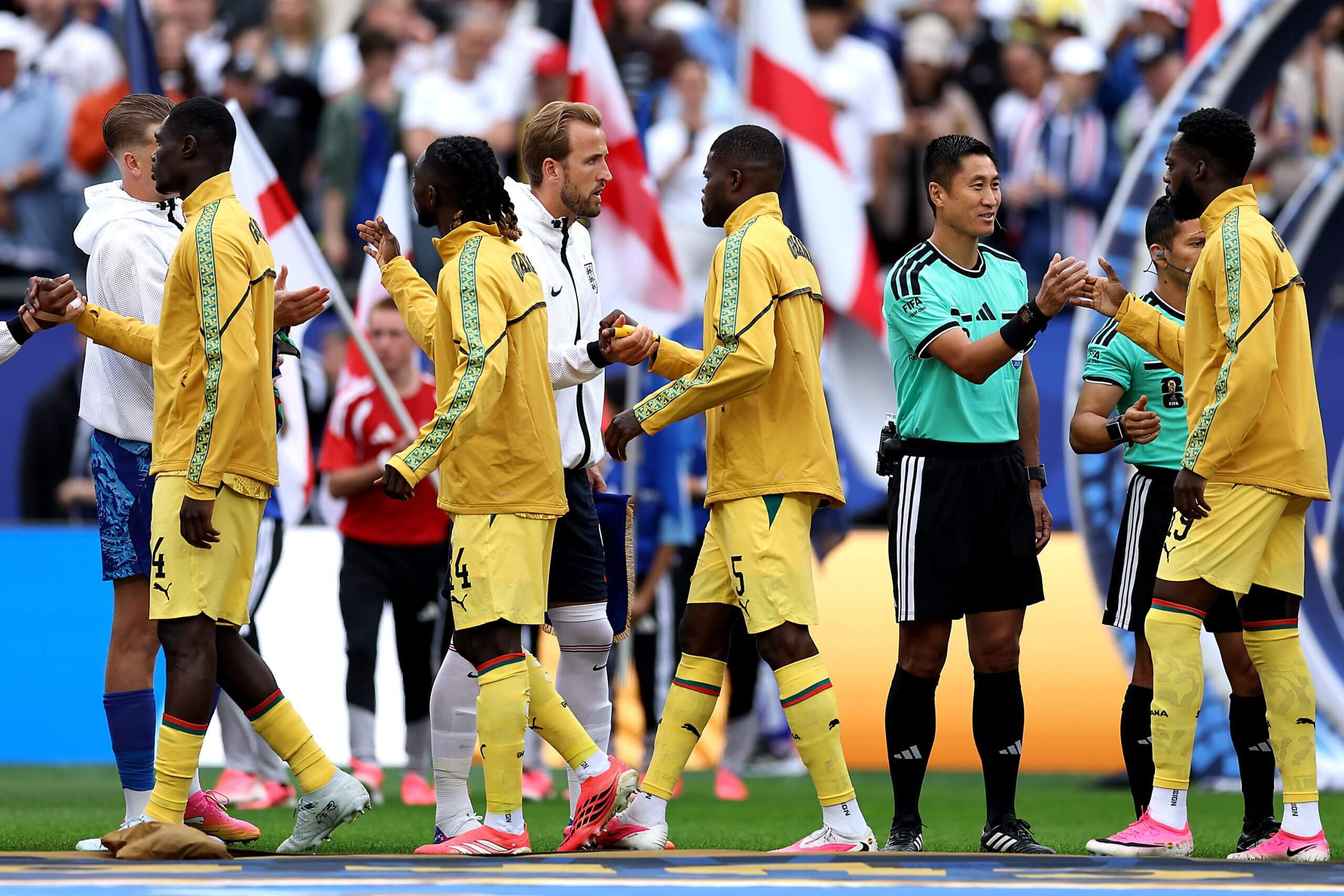
The pre-match handshake in football is usually a formality. For England’s game against Ghana, it became far more.
How would England’s players respond when they crossed paths with Ghanaian midfielder Thomas Partey, who, until last summer, played for Premier League club Arsenal alongside England stars Declan Rice and Bukayo Saka, and who, shortly after leaving the club, was charged with rape and sexual assault?
As it turned out, everyone shook hands with Partey — except Tottenham Hotspur defender Djed Spence, who appeared to snub Partey as he walked past.
Partey, 33, was charged with five counts of rape and one of sexual assault in July 2025, and two further counts of rape in February 2026. He denies any wrongdoing and has pleaded not guilty to all charges ahead of his trial at Southwark Crown Court in London, expected to take place in 2027. His lawyer, Jenny Wiltshire of Hickman and Rose, has said in a statement that her client welcomes “the opportunity to finally clear his name”.
He is entitled to a fair trial and the opportunity to defend himself, and it may well be that a jury decides he is not guilty on all counts. But his participation in the World Cup has once again brought into the spotlight how football is split when it comes to dealing with allegations of sexual violence against players.
Spence appeared to snub Partey; Rice was pictured embracing him after the game. Loud sections of the crowd booed when Partey was on the ball, but his manager Carlos Queiroz has defended his decision to select him on the grounds of “the presumption of innocence”.
Even the host nations have disagreed on how to handle the charges hanging over him. Partey was able to play in the 0-0 draw against England in Foxborough, Massachusetts, as he was granted entry to the U.S. However, he was not allowed into Canada and therefore missed Ghana’s opening 1-0 win against Panama in Toronto.

The focus was on whether England players would shake Thomas Partey’s hand when far more important factors are at stake (Buda Mendes/Getty Images)
The level of scrutiny and division is clear from the response to something as small as how BBC presenter Gabby Logan addressed the interaction between Partey and Spence. At half-time, Logan explained the reports that Spence had not shaken hands with Partey, and the background that the Ghanaian had been refused entry to Canada, the charges against him, and that he denied them. Some on X posted praising her for addressing the allegations but others questioned why she raised the issue.
But for all the important coverage, debate and scrutiny these moments have generated, I have seen little evidence that it will lead to meaningful change.
As a football journalist, I have played a small part in The Athletic’s coverage of Partey’s case and spent months investigating football’s relationship to violence against women more broadly. But before that, I grew up as a female football fan and have watched the game fail, time and time again, to truly take a stand on sexual violence.
As a teenager, I vividly remember waking up in January 2022 to see the images and audio recording that played a part in then-Manchester United player Mason Greenwood’s arrest and charges of attempted rape, assault occasioning actual bodily harm, and engaging in controlling and coercive behaviour. He denied the allegations and charges were later discontinued.
As debate raged over whether he would or should be accepted back into the team at United (eventually, he was not), I wondered whether the case would prompt a serious review of how football bodies dealt with cases like this and whether clear guidance would be set. I wondered whether it would prompt any soul-searching about the culture in football or whether it would be made clear to victims and survivors that they are welcome and supported in football.
But the case left the headlines and the conversation went quiet.
When Partey was charged and questions were being asked over Arsenal’s handling of his situation last July — including attempts to negotiate a new contract for him before the charges were made public — I thought that might be the watershed moment. He signed for Villarreal in Spain and tight restrictions around reporting of ongoing criminal proceedings in the UK have limited the opportunity for further conversation. That is also why comments on this article have been turned off.
When Roberto De Zerbi returned to the Premier League to manage Tottenham Hotspur and fans questioned his support of Greenwood in their time together at Marseille, I wondered if this marked a shift towards men in football being held more accountable for how their words and actions shape attitudes towards violence against women and girls. De Zerbi addressed his comments, saying he “never wanted to downplay the issue of violence against women or violence against anyone more broadly” and that he was “sorry if I offended anyone’s feelings with this subject matter”. After that, the conversation went away.
So when I wonder whether stories about Partey at this World Cup are going to lead to any deeper introspection, I know the answer.
Football has been grappling with how to deal with allegations of sexual misconduct for some time, and when I ask myself what has actually changed — whether the sport is any closer to having a clear approach to such allegations — the only answer, to me, is that it has not tried hard enough. The very fact that such scrutiny was on England players’ individual decisions about a pre-match handshake shows that whenever questions like this surface, fans, players, coaches, and federations continue to be left in an ambiguous and uncomfortable situation. There is still no consistency or clarity.
Greenwood, though the case against him was discontinued, did not play for Manchester United again, but is playing in Ligue 1 for Marseille. Achraf Hakimi will stand trial for rape in France, which he denies. He has continued to play for Paris Saint-Germain and captain the Morocco national team since the allegation emerged.
Each time such allegations surface, there is a familiar pattern: the accused often denies wrongdoing, managers, clubs, or governing bodies asked about the issue decline to comment for legal reasons, and then once the case is resolved — or drops out of the news cycle — the broader issue disappears from discussion. The ambiguity and lack of action continue, and the responsibility continues to fall to individual clubs, team-mates, and coaches to decide how they want to respond.
Sometimes, it does not feel that those responses fit the seriousness of the allegations. That sits uncomfortably with me — and, judging by the boos, with many fans in Foxborough.
As a woman immersed in football, I find it hard not to conclude that if the issue is not thrust into the spotlight by high-profile allegations, football does not give violence against women a second thought. Decision-makers do not consider it worth their time to come up with clear policies, or consider the message that they want to send in these situations — both to players about what is acceptable and to survivors about what the consequences will be of them coming forward. It means football is left without a clear policy and is unable to take a credible stand.
Legal experts have pointed out to The Athletic before that plenty working in other professions — like lawyers, doctors, or teachers — would be suspended if under investigation for an offence as serious as rape. Some clubs have also made the decision to suspend players while allegations of misconduct are being investigated.
Court documents from Partey’s unsuccessful appeal against the decision not to allow him into Canada show that the Canadian government recognised a distinction between the presumption of innocence, and business as usual. It said the fact Partey has not been convicted of the crimes he is accused of was “irrelevant” to the analysis conducted by immigration officials, adding: “Given the explicit nature of the allegations in the indictment, it was open to the (immigration) officer to conclude that the applicant committed serious acts of sexual violence that render him inadmissible to Canada.”
While Partey is entitled to the presumption of innocence, the Canadian government does not view him as entitled to be treated the same as somebody who is not facing such serious charges. It is that nuance which football struggles with.
The idea that there can be no consequences of any kind unless and until someone is found guilty in a court of law is an oversimplification but some in football seem happy to use it as a way to avoid taking action. The presumption of innocence was used by Queiroz to justify the decision to include Partey in Ghana’s World Cup squad and by Spanish club Villarreal to justify his signing last summer as a free agent.

Thomas Partey’s participation in the World Cup has opened up a conversation (Buda Mendes/FIFA via Getty Images)
The NFL, for example, has a publicly available conduct policy that sets out how those facing accusations of sexual or domestic violence will be dealt with. It reads: “It is not enough simply to avoid being found guilty of a crime in a court of law. We are all held to a higher standard and must conduct ourselves in a way that is responsible, promotes the values of the NFL, and is lawful.”
These are the discussions that could have a long-term impact, rather than poring over footage of a pre-match handshake. But rather than drawing up a consistent approach, football tends to only discuss these issues when they make the headlines — at which point, of course, criminal proceedings are often ongoing and little can be said due to the risk of prejudice. And so the cycle continues.
Discussion over Partey’s visa, how other players interact with him, and his participation at the World Cup will continue for as long as Ghana remain in the tournament. It will almost certainly crop up again once his next club is confirmed, with Villarreal not intending to renew his contract when it expires next week.
But after that, will the broader discussion about football’s handling of sexual violence allegations continue?
The preference seems to be to wait for each of these storms to pass. But for victims and survivors, the storm is never really over.