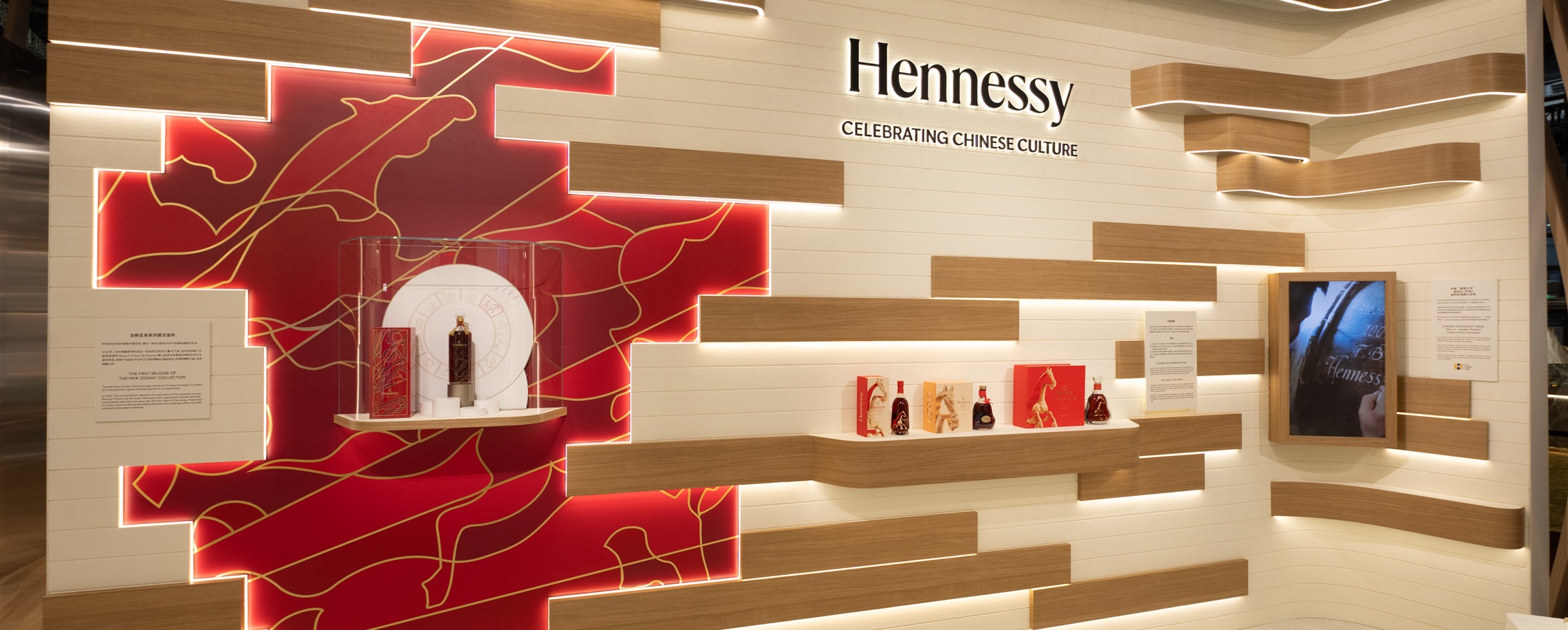
Hennessy’s booth at the CIIE drew steady attention without theatrics. The world’s leading cognac maker, owned by LVMH, came with a clear message: resilience, patience, and the long view.
Charles Delapalme, president and CEO of Hennessy’s, described the expo as a reminder of China’s central place in the brand’s story.
“CIIE is a unique platform for us to reaffirm our partnership with China,” he said. “It’s not just about business opportunities; it’s about cultural dialogue.”
China ranks among Hennessy’s three largest markets worldwide, alongside the United States and France. Yet the context is shifting. After several years of double-digit growth, the cognac segment has entered a milder period.
Delapalme takes the view that this is a transition, not a retreat.
“Every market evolves,” he said. “Consumers are becoming more selective, more thoughtful about value and meaning.”
For Hennessy, that means engaging a wider geography and broader set of drinking occasions.
“Historically, our sales were concentrated in south China,” he noted. “Now we see new opportunities emerging in the north and west. China’s diversity of cuisine and culture creates endless possibilities for pairing cognac.”
Indeed, cognac’s role in China has been shifting. Once tied almost exclusively to banquets and formal dinners, it is now appearing in more casual, experimental settings, from cocktail bars to regional tasting events.
“Chinese consumers are sophisticated,” Delapalme said. “They enjoy discovery, but they also have a deep respect for craftsmanship.”
Credit: Ti Gong
Caption: Hennessy’s booth at CIIE
That duality, he argued, mirrors Hennessy’s own philosophy: to stay rooted in tradition while remaining open to reinterpretation. “Our job is to keep the same level of excellence while telling our story in new ways,” he said. “It’s not about changing the product; it’s about deepening understanding.”
Digital storytelling has become central to that strategy. Hennessy’s collaborations with Chinese artists and musicians, including long-time ambassador Jackson Wang, are part of an effort to blend cultural relevance with authenticity.
“Digital is where curiosity starts,” Delapalme said. “People want to know how things are made, who makes them, and why it matters.”
He pointed out that authenticity in today’s market extends beyond branding to production itself. “Cognac is made of three elements – grape, water, and wood,” he said. “If we don’t protect those, we lose everything.”
Hennessy has planted over 25,000 oak trees in France’s Cognac region since 2021 and continues to invest in vineyard biodiversity and water-use efficiency. “Sustainability for us is not communication,” he added. “It’s the condition of survival.”
Policy developments have added another layer of complexity. Earlier this year, China announced provisional anti-dumping duties on European brandy, ranging from 27 to 35 percent.
Credit: Ti Gong
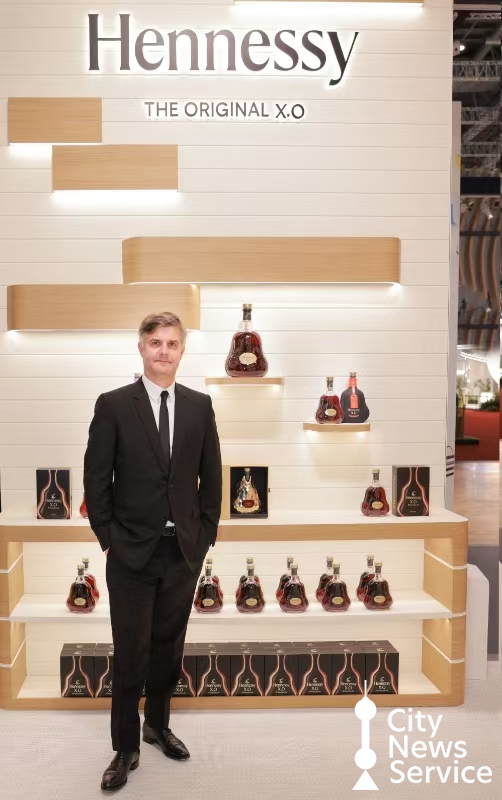
Caption: Charles Delapalme, President and CEO of Hennessy
Despite ongoing negotiations with the European Union, the move caused significant disruptions in the sector. Delapalme welcomed the recent signs of de-escalation, describing them as “a step toward stability.”
Despite those headwinds, Hennessy continues to view China as a cornerstone market. The country’s premium spirits consumption is projected to grow around 6 percent annually through 2027, according to Euromonitor, supported by an expanding middle class and a younger demographic seeking quality over quantity.
“Consumers may buy differently, but they have not lost their taste for excellence,” Delapalme said.
What underpins his optimism is a philosophy anchored in time. “You can’t rush cognac,” he said. “It’s about decades of patience, precision, and consistency.” To him, Hennessy’s endurance lies in its ability to preserve the same sensory standards from one generation to the next – an idea that resonates with both heritage and discipline.
As he looked ahead, Delapalme returned to what he calls the brand’s first principle.
“My objective is to make sure the quality of our cognac remains the same for the next 160 years,” he said. “There is nothing more important than taste.”
