The recent food safety raids by government authorities have made foodies think twice before eating out. But even that is not enough. A recent talk by dietitians at SOS Children’s Village revealed that there are many more factors to keep in mind to eat healthy and stay fit.
“Diners cannot ask to see FSSAI (Food Safety and Standards Authority of India) certificates or check kitchens at restaurants they visit. So the learning from these raids is that it is healthiest to cook at home,” said Malabika Datta, president of Indian Dietetic Association (IDA) Bengal Branch. Nonetheless, she and her colleagues listed out tips for the children and their “mothers” to ensure nutrition.
“We have 118 children in our care, who live in separate cottages headed by ladies appointed to be their “mothers.” The kids love non-vegetarian food but we are hoping the dietitians can instil in them the importance of eating vegetables and fruits too,” said Nipuna Sen, who is in-charge of the BK Block Village. “Also, we have 50-60 girls and want to know how to protect them from anemia, that is common among women and girls.”
Junk food control
The biggest concern of the children was junk food. “I know chips, chocolates, chops and telebhajas are not healthy but feel tempted to eat them whenever I go out or see them,” confessed a teenage girl. To this Jayeeta Adhikary, life member of IDA Bengal branch, shared tips to control their urges-
1. Don’t eat junk food when you’re hungry. “Have junk only after a proper meal and never on an empty stomach. You’re likely to eat a smaller portion then,” Adhikary said.
2. Never eat junk food alone. Share it with others. That way, you’ll end up eating less of it.
3. Don’t start munching chips simply because you feel like it. Give yourself five minutes. Ask if you’re really hungry and if you really need to eat it. Don’t eat something you’ll regret.
4. Don’t believe everything you see in advertisements, especially when products are labelled “diet”, “sugar-free” “low-fat” etc. “Diet colas may not contain sugar but to make it tasty they often resort to substitutes that can be worse for health. It’s the same with “Diet Chirey” that has become popular these days. Oil is needed to make the chirey crunchy and if they’re avoiding oil they are using something worse,” said Adhikary.
5. If you’re craving a peyaji, make it at home. “That way, you know what oil and ingredients have gone into it and how hygienically it has been prepared. Many eateries, especially the roadside ones, keep reusing the oil to fry items and this can be carcinogenic,” she warned.
6. Packaged foods use a lot of sodium as preservatives, and excess sodium can affect memory, Adhikary told the children. “So stay away from packaged foods as far as possible,” she said.
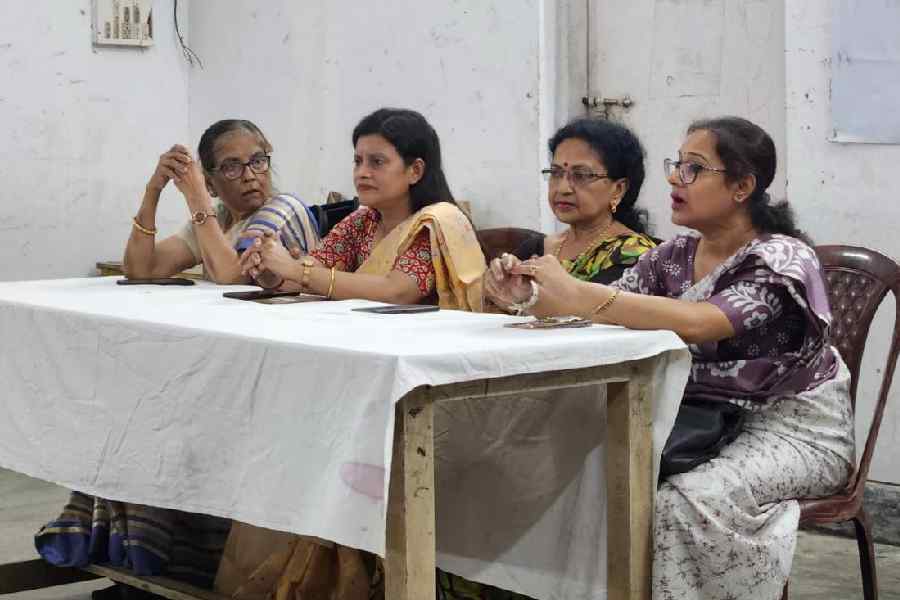
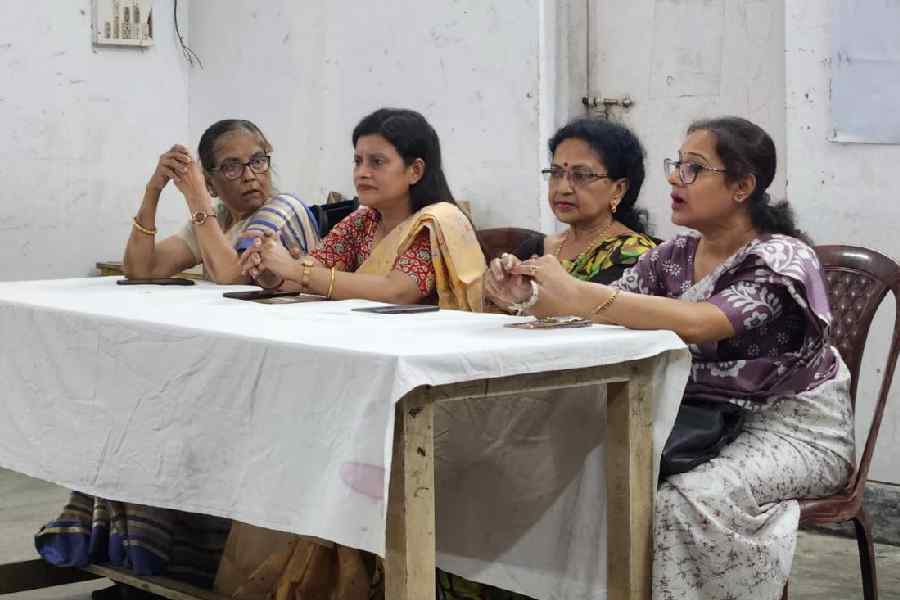
The team of dietitians addresses the audience at SOS Children’s village.
Brinda Sarkar
Colour palette
An easy way to eat healthy, is to aim for roughly all the colours of the rainbow to reach your table, said Shanoli Majumder, secretary of IDA Bengal Branch-
V — violet: kalo jam, black grapes
I — indigo: water
B — blue: blueberries
G — green: spinach
Y — yellow: pumpkins
O — orange: carrots, oranges, papaya
R — red: tomatoes, reddish lentils, pomegranate
- Have seasonal fruits and vegetables. “If you have peas or cauliflowers in summer you will be spending money on them, feeling full eating them but since they have been frozen since winter, they won’t have much nutritional value,” explained Datta.
- Have whole grains such as chhola and gom. “These are foods that retain more of the outer layer (khosha). Soak them overnight and eat them raw when they sprout shoots,” said Majumder, a resident of BF Block. “In fact the easiest way to start a kitchen garden is to cut up plastic bottles, turn them into pots and grow chhola. You can also try coriander or pui shak.”
- Soya bean is a great source of protein. “Whole soya beans should be soaked in water, boiled, and have the water discarded before being cooked. Even if you’re eating packaged soya chunks, boil first and throw the water. Else it can be carcinogenic,” said joint secretary of IDA, Ila Roy.
- Iron helps make haemoglobin, that carries oxygen around the body. Good iron sources include meat, fish, eggs, pumpkin seeds, moringa (sojne) leaves, dates, chhola that has sprouted, etc. Vitamin C improves the absorption of iron, so have a lime a day too.
But iron absorption reduces if consumed along with calcium. So after having (iron-rich) non-vegetarian food, take at least a 40 minute break before having calcium-rich diary products, including desserts.
- For fiber, have vegetables like spinach and fruits like guavas. “Think of the intestines like pipes in a house; the way pipes need to be cleaned out to keep movement smooth, fiber helps bowel movement. Have whole fruits instead of their juice, for the sake of this fiber,” added Majumder.
- If you cannot have fruit every day, have an onion. “Raw onion is easier to digest than cooked onion so have it as salad,” she added.
- Never drink water from unknown sources. “If you’re eating out ensure that even the glass and water jar are clean,” said Roy. “And drink adequate water. Adults needs 2.5-3.5l of water a day on average.”
Kitchen tips
- Wash hands before washing vegetables, cooking and eating.
- When bringing home vegetables from the market, dunk them in a basin or bucket of water for 30 minutes. “This will remove pesticides. It’s even better to add a little salt to the water as insects (in the vegetables) cannot stand salt,” said Majumder. “Wash vegetables only before cutting else water-soluble nutrients will get washed away too.”
- Do not wash lentils for too long before cooking, for the same reason as above.
- Boil papayas and potatoes in as little water as possible. If any water remains, use it to cook something else rather than throwing it away as this water is now rich in nutrients.
- Use no more than 15ml (3tsp) of cooking oil per person per day. This may be easier to monitor while cooking at home, but the minute you bite into a chop or singara made outside, the equation can go haywire as you don’t know how much oil was used, what kind of oil it was or how many times the oil was reused.
- Excess heat can reduce nutrients so try not to use high flame. Use low flame and cover the container while cooking.
- Do not use aluminum pans while cooking as the metal can leach into food. Try to use iron kadai instead.
- When cooking, add salt towards the end. “Many cooks leave the salt box open while cooking and keep adding a little now and then. It is healthier to use it at the end,” said Datta.
- “Bhaat-er fyan” contains starch and vitamin B1 and may be reused to make dal. This is especially healthy for children. “Conversely, use less water so there is minimal water to drain out at the end,” said Roy.
- Chhanar jol is the protein-rich whey that body builders rave about. “This shouldn’t be drained out either. Use it to knead wheat flour for roti or make sharbet out of it, adding salt, rock salt, jaggery etc,” she added.
- Curd is a good source of dairy nutrients and probiotics but it is best to home-make it. “Avoid mishti doi from shops as that often uses buffalo milk and may be harder to digest. Those with mild lactose intolerance can have curd comfortably too,” said Majumder.