This article is part of our Greatest Of All Time series. We will be looking back at previous World Cup tournaments and identifying the GOATs within a number of different categories.
Part one on the greatest goals is here. Part two on World Cup exits is here. Part three on the best individual campaigns by winning players is here.
In this article we’re looking at the greatest individual World Cup campaigns by players who never won the tournament. This doesn’t include great World Cups by players who did win another World Cup — eg, Ronaldo in 1998, Zinedine Zidane in 2002, Lionel Messi in 2014. This is purely players who never won football’s biggest prize.
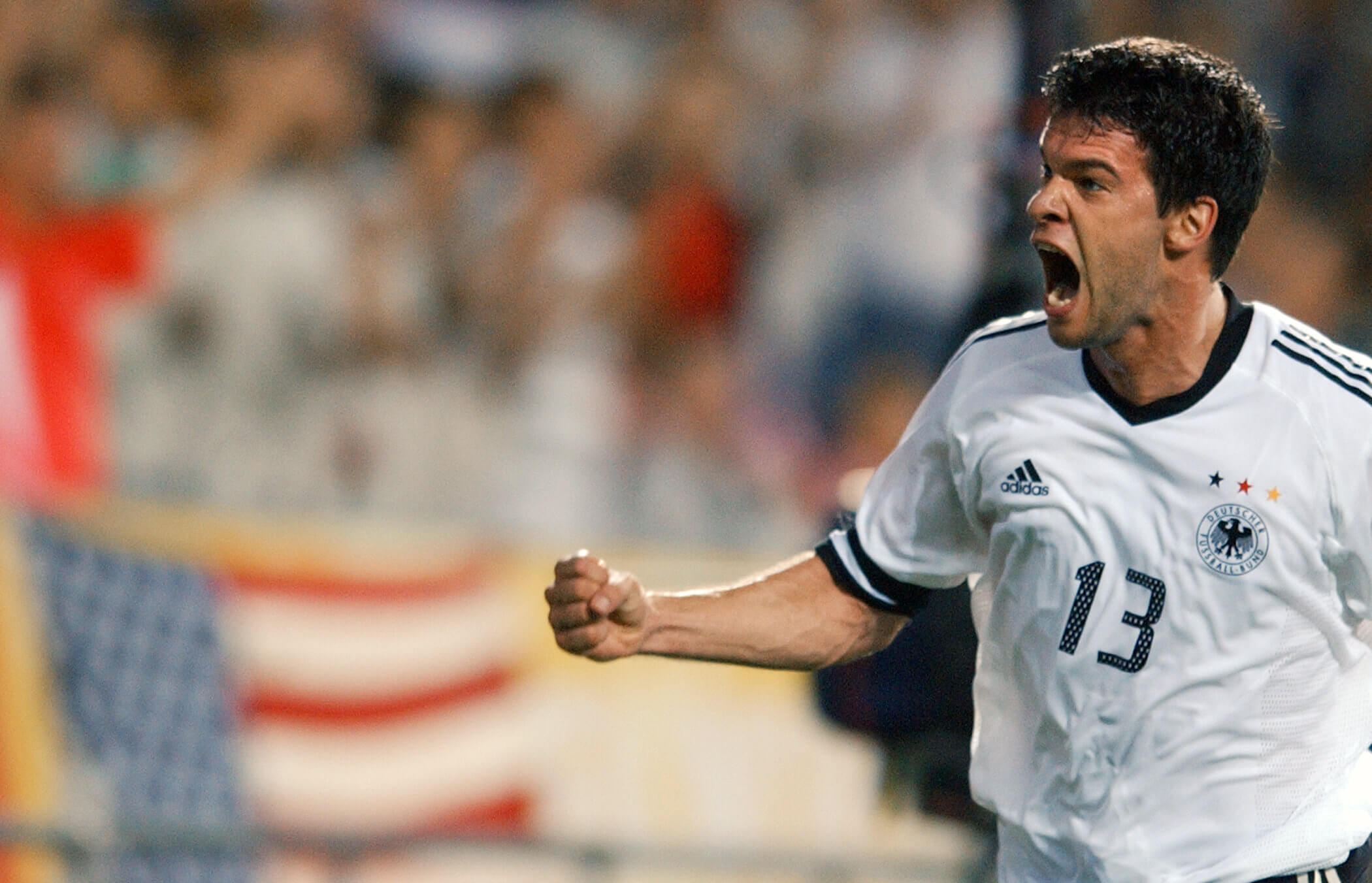
Michael Ballack, Germany 2002
At the turn of the century, Germany were a feeble side. Their Euro 2000 campaign was so disastrous that it forced the German federation to rip up their youth development system and start all over again, a process that culminated in the World Cup triumph of 2014. At this stage, Germany desperately lacked flair, invention or individual magic — with the exception of one player.
Ballack was a very German footballer: physically imposing, consistent, and dominant without being particularly flashy. He wasn’t necessarily the type of midfielder to dictate play, but he was absolutely sublime at bursting into the box to provide decisive contributions. He’d been close to the best player in Europe the preceding campaign. He’d finished one goal short of winning the top goalscorer award in Germany — from midfield — in a campaign when his Bayer Leverkusen side famously came close to winning the treble, but fell short in all three competitions. Ballack would again finish runner-up here.
In the group stage, he played some lovely inventive passes — he was excellent in the 8-0 thrashing of Saudi Arabia, assisted Miroslav Klose for Germany’s goal in a 1-1 draw against Ireland with a delicious left-footed clip over the top, and then in the 2-0 win over Cameroon, a foul on him by Patrick Suffo put the opposition down to 10 men, before Ballack crossed for another Klose header.
In terms of invention, Ballack was quieter in the knockout stage. But he provided the key contributions, heading home the only goal against the United States in the quarter-final, before popping up to provide the finish for the only goal against hosts South Korea. The poetic tragedy was that Ballack had earlier received a booking, which ruled him out of the final.
⏪ 📼 Time for some Korea/Japan 2002 memories
🇩🇪 Happy 45th birthday, Michael @Ballack pic.twitter.com/hC0FIBwPUE
— FIFA World Cup (@FIFAWorldCup) September 26, 2021
“He committed a tactical foul and put himself at the service not only of his team and manager but his whole country,” said his manager Rudi Voller afterwards. “He sacrificed himself and we should treat him with the highest respect.” Germany, without Ballack, lost the final to Brazil. They wouldn’t even have been there without him.
Eusebio, Portugal 1966
These days, Portugal usually go into a World Cup with half a chance of winning it. But they only appeared at one of the first 12 editions of the tournament, back in England in 1966. They were something of a revelation, storming to third place largely thanks to the efforts of Eusebio.
Eusebio became Portugal’s greatest player of the 20th century, but he’s also arguably the greatest African footballer in history. Born in Mozambique, then a Portuguese colony, he only moved to Lisbon at the age of 18, signing for Benfica after a complex tug-of-war with city rivals Sporting CP. He made his national debut almost immediately, though had to wait five years to play at a World Cup.
He assisted two goals from corners in the 3-1 win over Hungary, and scored the second in the 3-0 win over Bulgaria. But he really came alive in the 3-1 win over Brazil in the final group game. With Brazil needing a win to remain in the competition, they sent out a half-fit Pele, who was battered by Portuguese defenders. Eusebio, on the other hand, created Portugal’s first, headed home their second and took charge in the second half, smashing home the third goal. Pele was out. Eusebio was the star of the tournament.

Eusebio celebrates after scoring against Brazil at Goodison Park (Central Press/Hulton Archive/Getty Images)
In the quarter-final, underdogs North Korea took a shock 3-0 lead over Portugal, but Eusebio inspired arguably the greatest comeback in World Cup history with a magnificent display, scoring four of Portugal’s five goals. A powerful shot from the right was the pick of the bunch, although one of his two penalties came after a sublime dribble down the left flank, which drew a foul.
The semi-final against England felt like a battle of the two outstanding players at the World Cup: Bobby Charlton vs Eusebio. Sure enough, the game finished 2-1: two goals for Charlton, one for Eusebio from the penalty spot. That eliminated Portugal, although they subsequently beat the Soviet Union 2-1 in the third-place playoff, with yet another Eusebio penalty. His nine goals in six matches were certainly boosted by four from the spot. But Portugal’s displays revolved almost entirely around him.
⭐️ One of the all-time greats made his international debut 60 years ago today and, of course, marked the occasion with a goal 🎯
🇵🇹 Remembering the one and only Eusebio ❤️#OnThisDay | @selecaoportugal | #WorldCup pic.twitter.com/cITmI7aUyx
— FIFA World Cup (@FIFAWorldCup) October 8, 2021
Sander Kocsis, Hungary 1954
Ferenc Puskas was the better player, and his story — kicked off the pitch by West Germany in their group stage encounter, and not fit enough to influence the rematch between the sides in the final as he might have — dominates the 1954 World Cup.
But Kocsis had the better tournament. He scored a hat-trick in the 9-0 thrashing of South Korea, the biggest win in World Cup history. He then scored four in the incredible 8-3 win over West Germany with a succession of finishes which were overwhelmingly composed.
He then scored twice in a 4-2 win over Brazil; both goals coming with his head. Although an expert finisher on the ground, Kocsis was particularly renowned for his aerial ability. Compiling all-time statistics on this subject is difficult, but it’s possible he scored more top-flight headers than anyone in history.
His first crucial header in the 4-2 semi-final win over Uruguay was actually an assist, for Zoltan Czibor’s opener — before he settled the game in extra time with, of course, another two headed goals.

Kocsis celebrates a Hungary goal against Uruguay in the semi-final (AFP via Getty Images)
As Puskas returned for the final, Kocsis seemed to play more of a supporting role — in hindsight, perhaps Hungary should have continued with their previous approach. He didn’t add to his tally in the final, but in his only World Cup, Kocsis scored 11 goals. Eight of them came against three World Cup giants — Brazil, West Germany and Uruguay — which gets him on this list ahead of Just Fontaine, who scored 13 goals at the World Cup four years later.
Zico, Brazil 1982
A truly complete attacking midfielder capable of mazy dribbles, incisive through balls and scoring goals at the rate of top-class strikers. Brazil’s 1982 side are, along with the Dutch side of 1974, one of the most celebrated never to win the tournament. And Zico was their main man.
He was a brilliant set-piece taker, and found the net against Scotland with a glorious free kick. He then scored twice against New Zealand, including with an unusual scissor-kick. But these were minnows, and Zico saved his best performance for the showdown against Argentina; Zico against Diego Maradona. Zico scored the first, played lovely passes for the other two goals in a 3-1 win, while Maradona was, almost inevitably, sent off late on for kicking out at an opponent.
🙌 He’s one of THE great No10s of all time
🎂 Happy birthday, Zico!
🤔 Who’s your all-time favourite No10?
🇧🇷 #HBD | @Galinho1953 | @CBF_Futebol pic.twitter.com/Phex56Zug5
— FIFA World Cup (@FIFAWorldCup) March 3, 2021
Sadly, Zico and Brazil couldn’t quite get past Italy, losing a wonderful game 3-2. Zico played some good passes, but he was also shackled well by Italy’s legendary man-marker Claudio Gentile. Despite the defeat, though, Brazil remained the most fabled team of that World Cup, and were called the greatest national team ever by Pep Guardiola. Zico is still asked about that tournament today.
“Brazil had a fantastic team, recognised around the world, and everywhere we go people remind us about that team in 1982,” Zico said earlier this month. “If we had won that game [against Italy], football would have been different. Instead, we started to create football based on getting the result at whatever cost, football based on breaking up the opposition’s move, and based on fouling the opposition. That defeat for Brazil was not beneficial for world football.”
Johan Cruyff, Netherlands 1974
Rarely has one footballer’s tournament — and maybe his entire career — been so epitomised by one moment. Cruyff’s legendary turn in a group stage match to burst away from Swedish defender Jan Olsson was pure Cruyff: it was elaborate and beautiful, but also purely about efficiency rather than showboating.
The Dutch were the neutral’s favourites throughout World Cup 1974, their Total Football taking the game to a new level, and delighting supporters with their fluidity, high defensive line and commitment to keep on attacking. Cruyff was, in a sense, a bit of an outlier. This was a side supposed to be about collectivism rather than individualism, but Cruyff clearly had freedom to do as he pleased. At the same time, by starting up front but dropping deep to spray long passes downfield, he was a good summary of the Netherlands’ style. As well as dropping deep, Cruyff also drifted out wide and provided two assists in the group stage with fine crosses.
The first Cruyff turn. 🤩#OTD | #FIFAWorldCup pic.twitter.com/E84DqNGBmf
— FIFA World Cup (@FIFAWorldCup) June 19, 2025
In the second group stage, he was particularly impressive in a 4-0 thrashing of Argentina. He opened the scoring by controlling a difficult ball, rounding goalkeeper Daniel Carnevali — who always seemed to be 10 yards off his line — and prodding home. His pace is often underestimated, and he burst through for a one-on-one chance he couldn’t quite finish, before providing another cross for a headed goal, scored by Johnny Rep. He completed the scoring with a wonderful controlled volley from a tight angle after Carnevali was again out of his goal.

Cruyff rounds the keeper against Argentina (STF/AFP via Getty Images)
The Dutch were again brilliant in a 2-0 win over Brazil, with Cruyff scoring one and assisting the other.
Then came the final, against West Germany. Johan Cruyff versus Franz Beckenbauer, the two greatest players of their time. The Dutch opened the scoring before West Germany had touched the ball, when they put together a passing sequence straight from kick-off, Cruyff dropped deep to receive possession and then dribbled directly into the box, where he was tripped. Johan Neeskens scored from the spot.
Cruyff was marked well by Berti Vogts, although he also provided some nice passes that a more clinical Dutch side might have put away. West Germany eventually roared back to win 2-1. But when you think of World Cup 1974, you think of Cruyff.