Google, having lost its long-running antitrust case against Epic Games, will open Google Play to third-party app stores. The opening is limited to the US market; to participate, third-party app stores must pay an initial security review fee of $5,000 and an annual fee of $5,000, and must meet Google’s strict technical and security requirements.
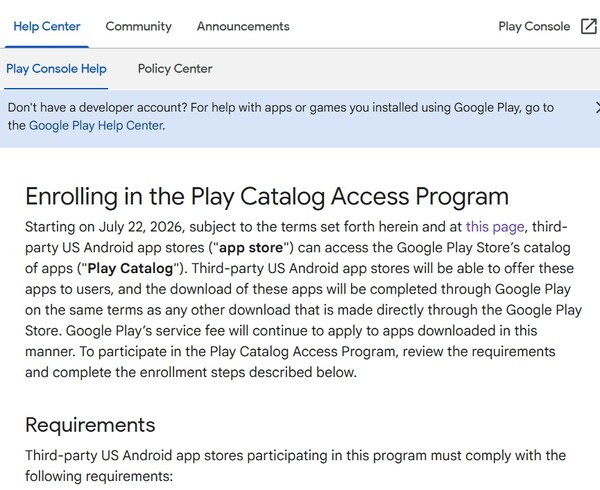
According to Google on July 15, local time, starting July 22, third-party app stores in the US will be able to use Google Play’s app catalog to offer apps to users. This implements a corrective order from a US court issued after Google’s loss in the Epic Games antitrust lawsuit.
In the US, third-party Android app stores will be able to access the Google Play app catalog through Google’s newly introduced Play Catalog Access Program. Apps and games developers have listed on Google Play will become available through participating third-party app stores as well; unless developers explicitly opt out, their Google Play listings will automatically be made available to those stores. From a developer’s perspective, listing an app on Google Play alone will make it visible through participating third-party stores too.
Users will be able to browse and install apps through third-party app stores inside Google Play. However, the actual download and installation will still be completed through Google Play as before, and the same Google Play service fees will continue to apply to apps installed this way.
Although Google is opening the platform, entry requirements remain stringent. Third-party app stores participating in the Play Catalog Access Program must pay a $5,000 upfront security review fee, followed by a $5,000 annual fee to maintain access to the Play catalog.
They must also satisfy a range of technical and security requirements set by Google and must serve users located in the United States; Google prohibits distributing apps to users outside the US through the Play catalog. Specifically, participants must: be open to all developers; maintain non-discriminatory operating policies; adopt clear Trust & Safety standards; keep malware installation rates below 1%; and serve only US-based users.
Microsoft’s Xbox Mobile App Store Back in Focus
One of the companies expected to benefit from the change is Microsoft. The company has repeatedly criticized the closed ecosystems of Google and Apple and said it would launch its own app store, though the plan has yet to materialize.
In 2024, then-Xbox President Sarah Bond said at the Bloomberg Tech Summit that Microsoft would launch its own mobile game store — an Xbox mobile storefront — in July 2024 in response to what she called Apple and Google’s closed app store policies. The plan envisioned starting as a web-based store featuring Microsoft’s own titles such as Minecraft and Candy Crush, then gradually expanding to third-party games before evolving into a full app-based store.
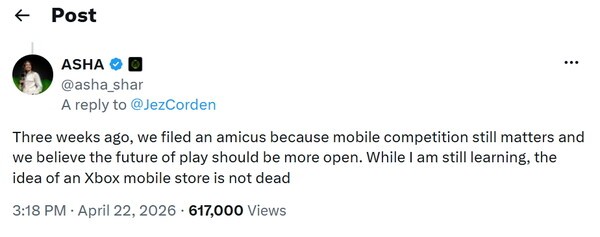
However, only a test site was ever launched, and the official storefront never materialized. In April 2026, the test website itself was taken offline (returning a 404 page), fueling speculation that Microsoft had abandoned the project. Asha Sharma, Microsoft’s newly appointed Xbox CEO, responded that “the Xbox mobile store idea is not dead,” confirming the project was still being pursued.
The fact that Microsoft has yet to launch its own app store is attributed partly to technical and regulatory considerations, but is also seen as reflecting Microsoft’s decision to watch how Epic Games’ lawsuits against Google and Apple played out. Epic Games first won its case in December 2023, but the court’s specific ruling — the injunction — was not issued until October 2024, and at the time it remained unclear whether Google would appeal, and what the injunction’s content and effect would ultimately be.
Microsoft submitted amicus briefs supporting Epic Games in both its lawsuit against Apple and its lawsuit against Google. The Apple case centered on allowing external payments and opening alternative app markets, while the Google case centered on opening competing app stores and the app distribution market — but both shared the broader goal of easing closed app ecosystems and expanding competition.
Does this mean Google only loses out? Even with Google Play now open to competing app stores, both the installation of those stores and the downloading of apps still take place entirely within Google Play, which also continues to provide the underlying catalog. Even as it opens up, Google retains control of the core distribution infrastructure — a dynamic several foreign media outlets have described as a form of “controlled” openness.
In addition to the Play Catalog Access Program, Google has, under its settlement with Epic Games, also expanded external payment options, allowing developers to direct users to their own payment systems or external websites. Google Play’s fee structure, which previously applied a uniform 30% commission, is now applied differently depending on the developer type, payment method, and applicable program.
The US Mandates Third-Party App Stores — What About South Korea?
This move raises the possibility that Google could pursue different app distribution policies in the US versus the rest of the world, since Google is obligated under the US court’s order to allow third-party app stores within Google Play only in the US.
As a result, Google’s future approach in markets outside the US, including South Korea, could take one of three directions: extending third-party app store support through the Play Catalog as it has done in the US; activating the Registered App Stores program first proposed last November; or maintaining the existing sideloading approach.
The Registered App Stores program was first included in Google and Epic Games’ settlement proposal in November 2025 and is based on the sideloading method. After the US court declined to accept that settlement proposal, the current Play Catalog Access Program was introduced instead. The court rejected the settlement because it did not reflect the original intent of prohibiting an anticompetitive environment.
Epic Games originally filed its antitrust lawsuit against Google over disadvantages built into the app installation process.
Unlike iPhone, Android allows users to install apps as long as they have the installation file (APK) — known as sideloading. Google has cited this as evidence of Android’s “openness,” but Epic Games argued that Google had made the process deliberately difficult for ordinary users.
Non-technical users must locate the APK file on a website, may be deterred by browser warnings that “this file could be dangerous,” and must enable “install unknown apps.” Multiple warning screens also appear during installation. By contrast, an app listed on Google Play can be installed with a single button after a simple search.
This distinction carries real weight for app distribution. It is well established that each additional step in an installation process significantly increases user drop-off. Simplifying the process — from search to install within Google Play, rather than website visit → APK download → allowing installation past multiple security warnings → install — has a major effect on both app reach and user experience.
Epic Games argued it should be possible to install the Epic Games Store itself as easily as any app downloaded from Google Play, contending that “although Google claims to have opened up, this is largely a formality — in reality, Google has built a structure that still steers users toward Google Play, obstructing competition.”
At trial, the jury largely accepted this argument. After losing, Google’s first proposed remedy was the Registered App Stores program. Because that program still requires a separate sideloading process, it cannot be said to meaningfully improve accessibility for ordinary users — and even though Epic Games had compromised on this point, the judge declined to accept it.
Will the Sideloading-Based Registered App Stores Program Survive?
Google and Epic Games reached an agreement in principle in November 2025 that included the Registered App Stores program, submitting to US District Judge James Donato a settlement proposal that would have partially modified his permanent injunction. In March 2026, Google and Epic Games announced that Google planned to introduce the Registered App Stores program, offering a simplified installation process for registered third-party app stores.
The Registered App Stores program may appear to recognize third-party app stores, but installation would still occur via the same APK method — the only change being that Google would reduce security warnings for app stores it deems trusted and verified. Users would still have to locate and install the APK themselves, as before.
Google argued the Registered App Stores program was sufficient to comply with the court’s order, but Judge Donato remained skeptical, and a hearing had been scheduled for July 16, local time, this month. That is because the order requiring Google to open Google Play to competing app stores was meant not merely to make APK installation more convenient, but to foster an environment in which Google Play and competing app stores could genuinely compete.
Google and Epic Games ultimately concluded they could not sustain the Registered App Stores approach and withdrew their modification request entirely, agreeing instead to fully comply with the court’s original injunction — leading to the announcement of the Play Catalog Access Program.
According to The Verge, the two companies agreed to withdraw their modified settlement proposal, and as a result, the court hearing that had been scheduled for July 16, local time, was canceled. A Google spokesperson told The Verge that rather than continuing a process that would create uncertainty for the Android ecosystem, Google agreed with Epic to withdraw its request to modify the US court’s corrective order.
Google said the decision allows the company to focus on reshaping its “global business model” to provide developers, app stores, and users with more choice, lower prices, and greater opportunity, and argued that it would build an ecosystem in which all app stores and developers can compete freely.
What matters here is that this measure implements a US court order that applies only to the US market. As a result, the Play Catalog Access Program likewise applies only to the United States, and Google is under no obligation to extend it to markets outside the US, including South Korea.
Google could therefore maintain its current sideloading approach in South Korea and other markets. That said, similar lawsuits could emerge elsewhere following the US precedent, or Google could simply decide that maintaining a cumbersome, dual-track policy isn’t worth the added complexity.
The second option — the Registered App Stores program — has roughly even odds of being adopted. One reason it remains plausible is that it is a policy Google has been developing since November 2025, and when Google and Epic announced their settlement proposal in March 2026, Google indicated it would roll out the Registered App Stores program outside the US first.
The idea was to implement the program abroad first while awaiting US court approval. Foreign outlets, including The Verge, expect Google to continue pursuing its existing Registered App Stores plans in markets outside the US.
In particular, foreign media have interpreted the “global business model” reshaping mentioned by Google’s spokesperson as referring to the Registered App Stores program. However, Google’s official announcement did not address a specific timeline or detailed guidelines for a Registered App Stores rollout outside the US.
There is also a possibility that the Registered App Stores program could be scrapped altogether. If Google runs the Play Catalog Access Program in the US and the Registered App Stores program elsewhere, it may see little reason to maintain the added operational complexity of running two separate systems.
Ultimately, Google’s third-party app store policy for markets outside the US is likely to hinge on how much the Play Catalog Access Program affects Google Play’s US revenue and competitive position.