
Quick overview
- Gold (XAU/USD) is trading just below $4,277 as positive U.S. economic data raises the likelihood of a rate hike in October.
- The S&P Global Composite PMI for the U.S. reached 58.4, the highest since July 2021, prompting markets to price in a 66% chance of a 25 basis point increase.
- While falling oil prices provide some support for gold, a stronger U.S. dollar and rising Treasury yields pose challenges for further price increases.
- Key support for gold is at $4,275, with potential downside targets at $4,254 and $4,235 if that level is breached.
Gold (XAU/USD) is trading just below $4,277 as more positive U.S. economic data increases the chances of another rate hike in October. On Friday, the S&P Global Composite PMI for the U.S. hit 58.4, the highest level since July 2021. Markets are now pricing in a 66% chance of a 25 basis point increase next month. While the drop in the price of oil provides some support, the Fed’s hawkish stance, and a rising U.S. dollar, create a challenging environment for further upside. The 50-day moving average continues to provide support, and as long as that level holds, the longer-term trend will remain up. The medium-term outlook continues to be bullish. Support is expected to hold at $4,275. A break below that level would provide support at $4,254 and then $4,235.
Strong U.S. Data Strengthens the Fed Case
The U.S. economy’s recent positive activity has raised gold prices. Recently, the preliminary S&P Global Composite PMI reported an index level of 58.4. This level has not been attained since July 2021. Most economists believe that the U.S. Federal Reserve (Fed) is attempting to slow the economy in an effort to reduce inflation. One of the most important observations of this report is that the economy can continue to grow, despite the recent increases in the Federal Funds target range. As this is the case, the Fed can continue to raise the target range and employ other restrictive monetary policies. It is expected that the Fed will increase the target range in October. From a gold analysis perspective, this continuation of higher rates increases the opportunity cost of holding gold.
Fed Officials Are Turning More Hawkish
Most recently, a number of Federal Reserve Board Governors have indicated that they expect inflation will continue to be elevated for a longer period of time, and that further increases in the Federal Funds target range will be necessary. Based upon the CPI data, most of the increase in inflation has been in the service related components of the economy. Given this broader inflation, it is expected that the Fed will be able to justify their restrictive monetary policy for an extended period of time.
Dollar and Yields Remain the Main Headwinds
The U.S. dollar and the yield on U.S. Treasuries have been supported by expectations for policy tightening by the Federal Reserve, and have therefore been headwinds for gold. One of the implications of a stronger dollar is that the price of gold is higher for buyers throughout the rest of the world. Also, a higher yield on U.S. Treasuries increases the opportunity cost of gold because investors earn a positive return on their investment by holding U.S. Treasuries. Gold bears have pointed to these two factors to justify the selling in the recent price of gold, which has traded at a one week low, in the face of geopolitical uncertainty and higher structural demand for gold.
Falling Oil Gives Gold Some Relief
Recently, the price of gold has benefitted from the recent decline in the price of oil. A lower price of oil removes some of the upward pressure on inflation and therefore reduces the case for a larger and more aggressive policy tightening by the Fed. Investors expect that if inflation pressures ease, the Fed will be less hawkish in the future.
ETF Demand Remains Exceptionally Strong
One of the implications of the expected structural surplus in the gold market is that investment in gold will increase, particularly if the return on other investments is low or negative. The second best monthly flow in the history of gold ETFs occurred in August. With continuous net buying of gold ETFs by institutions even with a stronger U.S. dollar, it can be assumed that the current price of gold reflects the fair value of the metal.
Central Banks Continue to Accumulate
Central bank purchases continue to be significant. This year through July, reported central bank purchases totaled approximately 130 metric tons. These purchases are part of longer-term strategies to diversify central bank reserves. Depending on the time horizon of these purchases, they provide a floor to the market. Unlike speculative traders who may be influenced by changes in the Fed’s stance or purchasing manager’s index, for example, in setting their stop losses, central banks are not.
Gold Technical Analysis: $4,275 Is the Key Trigger
Currently, gold is trading for around $4,277, just above the rising trendline and the support level of $4,275.35. There is an area of interest between the rising trendline and the broader falling trendline. Like always, price action is focused on the lower timeframes. This means there is a good possibility gold breaks below the falling trendline and the rising trendline.
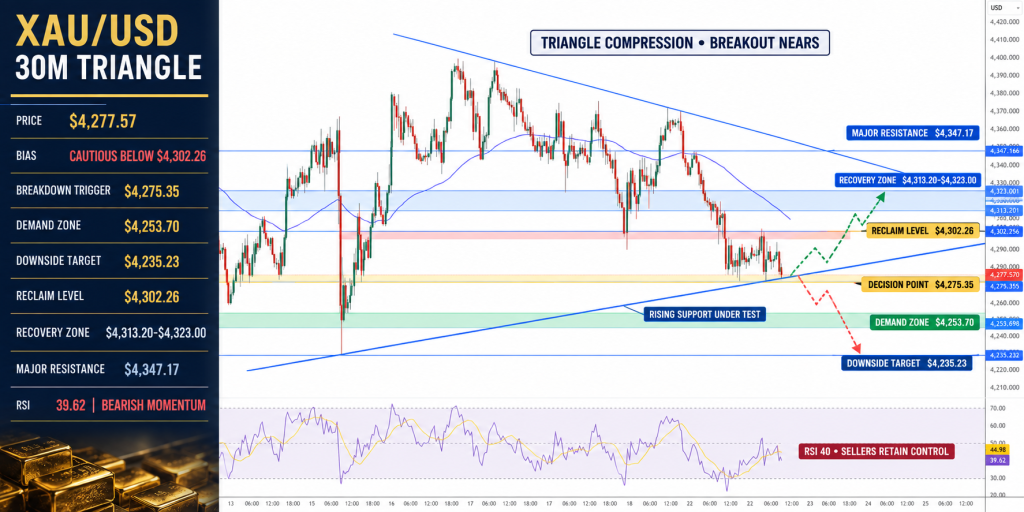
The area of interest between the trendlines is a falling wedge, and the lower trendline of the wedge is slightly sloping up. This means the probability of a rally occurring after a breakdown is increased. Overall, we believe selling gold at these levels is a good idea.
Situated slightly in favor of bears.
RSI is less than 50 and slightly less than its signal line, so bears have a very slight edge. Further bears might look for a close of below $4275 for an additional sell opportunity with downside objectives at $4253.70.
Below there, the next objective would be $4235.23. An obstacle to further decline would be a move above $4302.26, which would also open a move to $4313.20 and $4323.
Further out, a resistance would be located at $4347. Below there, support would be found at $4275, $4254 and $4235. Below the support, a move to $4254 would be bearish. Above the resistance at $4302, a move to $4313 and $4323 would be bullish.
Frequently Asked Questions
Why is gold under pressure today?
A stronger U.S. economic activity and a more hawkish Fed put odds for a fifth rate hike in October at 100%, boosting the U.S. dollar and Treasury yields.
What is helping gold?
Weaker oil prices, increased central bank buying, sustained ETF inflows and geopolitical tensions are working in gold’s favor.
What is the key XAU/USD support?
It is at $4,275, below which it can find support at $4,254 and then at $4,235.

Arslan Ali Butt
Lead Markets Analyst – Multi-Asset (FX, Commodities, Crypto)
Arslan Ali Butt serves as the Lead Commodities and Indices Analyst, bringing a wealth of expertise to the field. With an MBA in Behavioral Finance and active progress towards a Ph.D., Arslan possesses a deep understanding of market dynamics.
His professional journey includes a significant role as a senior analyst at a leading brokerage firm, complementing his extensive experience as a market analyst and day trader. Adept in educating others, Arslan has a commendable track record as an instructor and public speaker.
His incisive analyses, particularly within the realms of cryptocurrency and forex markets, are showcased across esteemed financial publications such as ForexCrunch, InsideBitcoins, and EconomyWatch, solidifying his reputation in the financial community.