
Quick overview
- Gold (XAU/USD) is currently trading at $4,281, facing downward pressure from a strengthening U.S. Dollar and rising Treasury yields.
- The near-term outlook for gold remains bearish, with key support at $4,252 and resistance at $4,302.
- FOMC members continue to advocate for tighter monetary policy, contributing to the negative sentiment around gold.
- Despite current challenges, structural support for gold remains, particularly due to ongoing institutional investment and demand for U.S. debt.
The price of gold (XAU/USD) is currently trading at $4,281. There is continued downward pressure on gold as the U.S. Dollar strengthens, the Yield on U.S. Treasury Bonds increases, and members of the Federal Open Market Committee (FOMC) become more hawkish. Long-lasting U.S. Treasury Bonds have increased to levels not seen in over 20 years, and gold is on pace to close the week with a decline of over 2%.
The near-term outlook for gold remains bearish. Important support is located at $4,252. Gold would need to rise above $4,323 to improve the near-term outlook.
Fed Officials Keep the Tightening Story Alive
Members of the FOMC continue to take away bounce in gold. The most recent FOMC meeting resulted in the Fed Funds Rate increasing to a target range of 3.75% to 4.00%.
Many members of the FOMC expressed a similar view as Philadelphia Fed President, and FOMC member, Anna Paulson. Paulson said that the target level of inflation of 2.0% does not justify an easing of monetary policy.
Paulson’s view was supported by New York Fed President and FOMC member John Williams who said that it was “reasonable” to expect another increase to the Fed Funds Rate this year.
Global Bond Selloff Intensifies
The bond market is making things even worse. Long-term U.S. Treasury yields are at their highest levels in over 20 years. There are multiple reasons for this. One, inflation is causing concerns about future tax increases. Two, economic growth and recovery from Covid has been strong. With the economy growing, the government is borrowing and spending a lot. Rising yields presents a greater opportunity cost for holding gold and other precious metals. Gold provides no cash flow and yields. Real yields are increasing. With rising yields and inflation, investors can achieve a positive real after-inflation return. In that environment, the demand for gold and other precious metals will likely decrease even further.
Dollar Strength Adds Another Headwind
The U.S. dollar is heading for roughly a 1% weekly advance, adding another layer of pressure on XAU/USD.
A stronger dollar makes gold more expensive for buyers using euros, yen, yuan and other currencies.
This leaves gold facing one of the more challenging conventional macro combinations: higher yields + stronger dollar + expectations for additional Fed tightening. That explains why bullion has struggled even though geopolitical risks remain elevated.
Labor Market Gives the Fed Little Reason to Pause
The labor market also indicates a more hawkish stance. Recently, initial jobless claims were within their lowest levels of the last 50 years. This shows that the workforce continues to adjust to higher interest rates and other restraint policies. Historically, the absence of sufficient employment to support further rate hikes was a prominent argument. More recently, the lagging labor market has not constrained further policy rate increases. The Fed has the latitude to keep tightening the monetary policy if inflation doesn’t subside.
Oil Rebound Revives Inflation Concerns
There is uncertainty surrounding energy prices. Saudi Arabia is still recovering from the recent missile attack. If geopolitical tension continues, there will be further disruption to international energy supply. For gold, continuing geopolitical issues make for increased safe haven demand. Because of the expectation for higher inflation and tighter monetary policy, the increased oil prices work against gold. While higher oil prices raise expectations for future inflation and a more hawkish monetary policy, these markets are not providing for gold’s safe haven demand.
Structural Support Has Not Disappeared
The bulk of the longer-term gold case remains constructive in our view, especially considering the weekly tune of the price action. Among the major central banks, only the U.S. Federal Reserve appears to have taken an “official” break from the gold-buying action. However, ETFs and other forms of non-central bank, institutional investment remain strong, in our view. Other forms of debt, including U.S. debt, remain at the forefront of gold demand. Regardless of the yield environment, U.S. debt, in our view, will remain a key catalyst for gold. Gold’s support at the $4,200 level is structurally strong; however, the near-term outlook is technically bearish, in our view. The Fed and yield action will likely make the largest near-term price impact on gold.
Gold Technical Analysis: $4,252 Is the Key Support
gold is at $4,281 on the 1 hour chart after bouncing from $4,252. Sellers have not been able to break the $4,252 support level, however, they have not allowed buyers to regain the $4,302 resistance level and retrace the down trend. Unless gold breaks the $4,302 level, the overall trend should be considered negative. The next levels of resistance should then be considered at $4,323 and $4,347. As far as support levels, the $4,252 level should be considered first, with the next levels of support seen at $4,235 and $4,214.
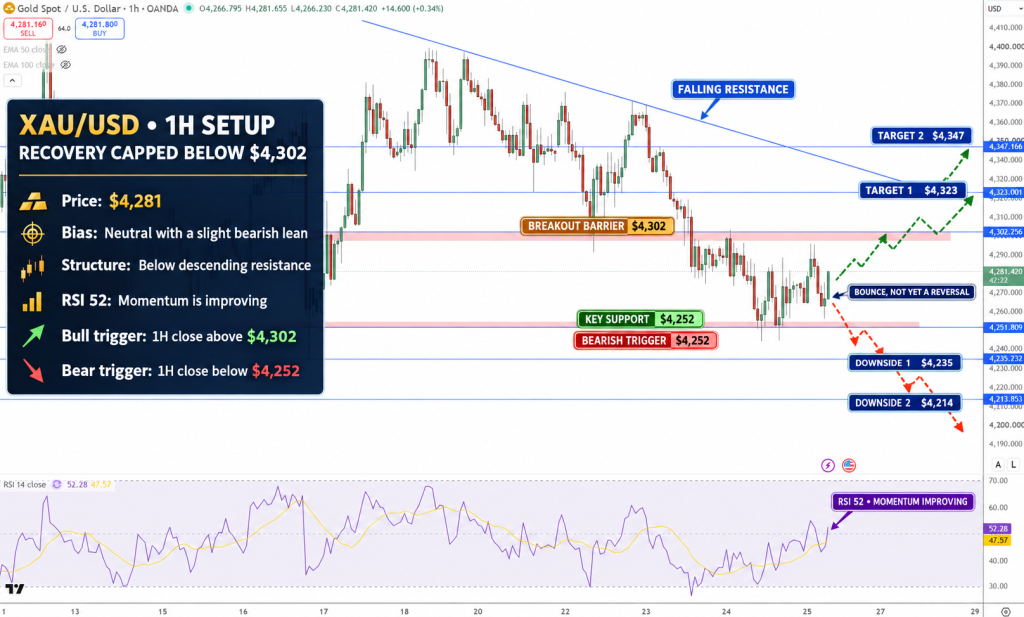
ooking at the relative strength index (RSI), a bullish crossover has occurred and it is currently in the 52 range. A break even slightly above $4,302 would help validate the bullish trend. The overall trend should still be considered negative and the $4,302 and $4,323 levels should be considered first. Support levels should still be considered in that same order as well. A bearish trend should be considered again if the $4,252 level is lost.
Frequently Asked Questions
Why is gold falling this week?
Gold is being pressured by a stronger dollar, rising Treasury yields and growing expectations that the Fed will raise rates again.
What is gold’s biggest near-term risk?
The biggest risk is that the Fed continues signaling additional tightening while bond yields remain near multi-decade highs.
What is the key XAU/USD support?
The immediate support is $4,252. Below that, the next downside levels are $4,235 and $4,214.

Arslan Ali Butt
Lead Markets Analyst – Multi-Asset (FX, Commodities, Crypto)
Arslan Ali Butt serves as the Lead Commodities and Indices Analyst, bringing a wealth of expertise to the field. With an MBA in Behavioral Finance and active progress towards a Ph.D., Arslan possesses a deep understanding of market dynamics.
His professional journey includes a significant role as a senior analyst at a leading brokerage firm, complementing his extensive experience as a market analyst and day trader. Adept in educating others, Arslan has a commendable track record as an instructor and public speaker.
His incisive analyses, particularly within the realms of cryptocurrency and forex markets, are showcased across esteemed financial publications such as ForexCrunch, InsideBitcoins, and EconomyWatch, solidifying his reputation in the financial community.