Job done?
For the first time since 2014, Germany have qualified from a World Cup finals group and are headed to the knockout rounds. Given how scarring those early eliminations were at Russia 2018 and Qatar 2022, their advancement alone has some restorative worth.
That’s the good news. The bad is that Germany’s first two group games teased out issues we suspected they had, before their third, Thursday’s 2-1 defeat against Ecuador, confirmed them.
“We can play better, and we must play better,” said former Liverpool manager Jurgen Klopp on domestic broadcaster Magenta TV after that game. Klopp has said a lot during this tournament, but here he is inarguably correct: Germany head to Boston now to play their round of 32 tie on Monday (almost certainly against Paraguay) and they have a lot of work to do over the next couple of days.
Get free access to the most comprehensive World Cup coverage in The Athletic app
Have Julian Nagelsmann’s side played well? In moments, certainly. Particularly during the opening 7-1 win against Curacao and the final 30 minutes of the 2-1 comeback victory over Ivory Coast. There have also been individual positives, such as the form of Nathaniel Brown, whose inversion from left-back has been a source of useful attacking variety.
Ecuador shock Germany and U.S.A. suffer defeat | World Cup Daily Briefing
Megan Feringa and Amitai Winehouse
But the list of disappointments is longer.
The ankle injury suffered by centre-back Nico Schlotterbeck, which ended his tournament in that second game, has weakened a defence that already looked vulnerable. The double-pivot of Aleksandar Pavlovic and Felix Nmecha in midfield has not functioned especially well, and Florian Wirtz and Jamal Musiala have not broken free of their indifferent club form last season.
Given the disruption caused by goalkeeper Manuel Neuer’s last-minute return to the team from two years of international retirement at age 40, his performances are also cause for concern.
This is turning into a strange tournament for Germany, full of duelling energies.
Television audiences back home are roughly double what they were for the previous World Cup four years ago. Many fans were ideologically opposed to that Qatar-hosted tournament and would have preferred a German boycott. Those who did tune in were left disappointed and disenfranchised by meek performances and another early humiliation.
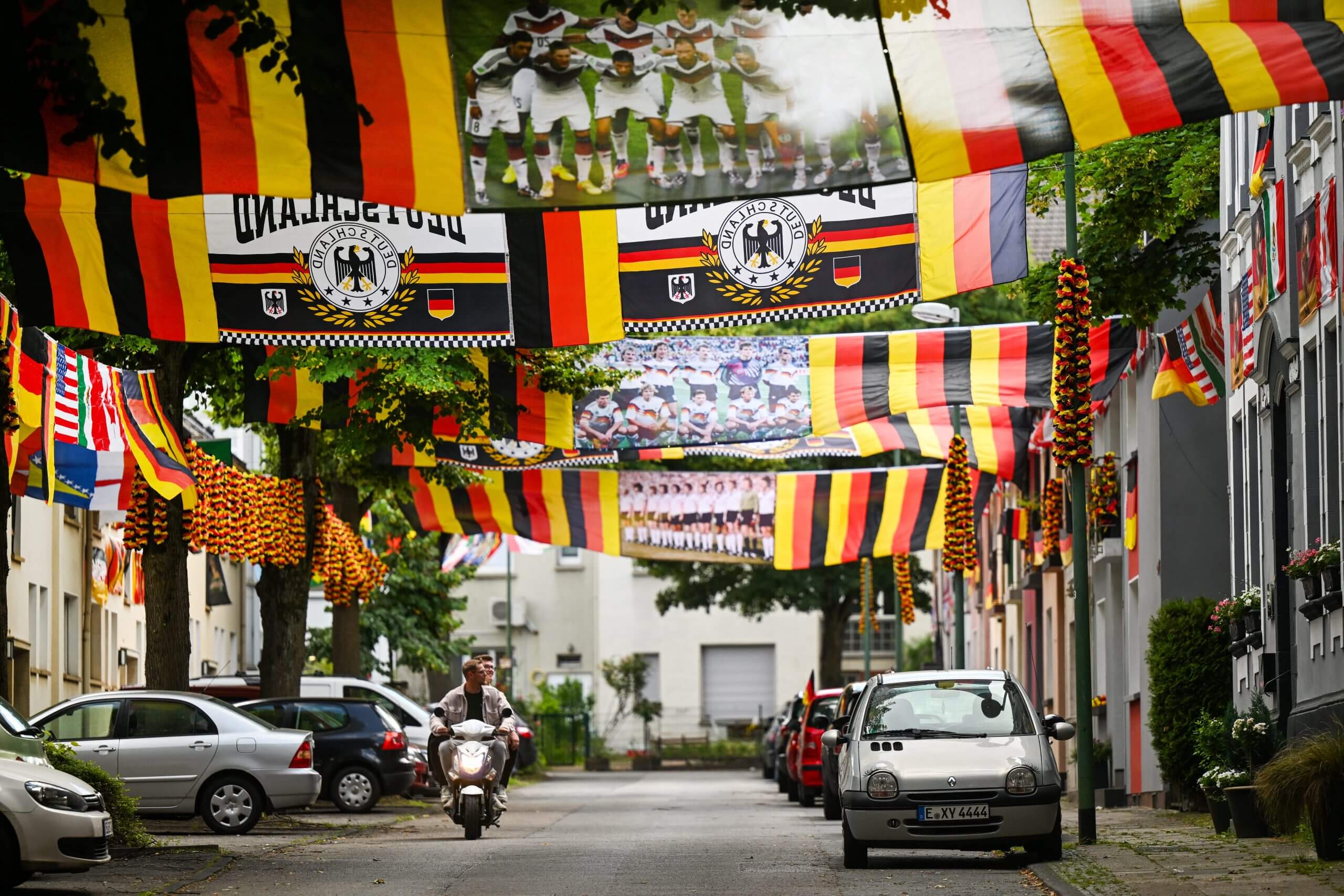
This time, the engagement is there. Red, black and gold flags are flying from car bonnets and fluttering on balconies, especially on matchdays. Outwardly, the country’s relationship with its national team seems healthier. Whereas during those weeks in November and December 2022, there were few signs a World Cup was even taking place, current daily life here is full of reminders; the shops are full of tournament-related tat, children have painted faces.
And yet to describe the mood as optimistic would be disingenuous. Between the players on the pitch, the coaches, the pundits and the public, there seems to be a muddle of agendas.
One German football fan, Achim Klimmeck, has decked out his local street in Essen (Ina Fassbender/AFP via Getty Images)
Even before a game was played, Klopp, in his punditry role, managed to annoy almost everybody within the German Football industrial complex by suggesting that Nagelsmann should drop Bayern Munich’s Musiala and play Stuttgart’s Deniz Undav instead. Klopp was not necessarily wrong. Musiala has not played well since recovering from the ankle fracture he suffered at the Club World Cup this time last year, but his place in the team has become a third-rail topic of sorts and Klopp stepped on it.
The 59-year-old then made things considerably worse in trying to dismiss the controversy. Not to worry, he said, because Nagelsmann was the coach… for now.
For now? What did that mean?
At best, it was a silly comment for which Klopp rightly apologised. Still, the original basis for his remark — the Undav issue — has stalked Nagelsmann ever since. But here again, there is background.
Back in April, after the Stuttgart forward scored a winning goal against Ghana in a friendly, Nagelsmann was asked whether Undav might have a claim to a starting place at this World Cup. The head coach was clumsy in his response, saying — in effect — that he was better suited to being an impact substitute and taking advantage of tiring defenders.
Nagelsmann expressed himself poorly in that post-Ghana press conference and in a way that sounded as if he was having a dig at Undav’s conditioning. After asking his wife for a second opinion, he wisely phoned Undav to apologise.
The saga just will not go away. Mimicking the memes that have stalked Brazilian head coach Carlo Ancelotti through the tournament, which make fun of his reluctance to pick Endrick, thousands of German social media users have done the same with Nagelsmann and Undav. They were doing it before the World Cup. Now, with the tournament in full swing, it’s become an epidemic.
Here’s one of the less risqué among them:
Undav: „Ich brauch dringend Mitfahrgelegenheit für das nächste Spiel!”
Nagelsmann: pic.twitter.com/1WvA7OOya6
— RobiN™ 📨 (@_RB1N_) June 22, 2026
And another:
Undav: „Ich hab Asthma bitte nicht in meiner Nähe rauchen“
Nagelsmann:
— Jay (@_JayFC) June 21, 2026
The trouble is that, however badly Nagelsmann may have expressed himself three months ago, he was still making a valid point. Undav’s two goals in a relief role against Ivory Coast proved it. His first, the equaliser at 1-1, showed him at his instinctive best, eight minutes after coming off the bench. His second, from a gorgeous first touch and lightning-quick shot, was one of the most predatory finishes of the entire tournament.
Why Deniz Undav of Germany is this World Cup’s super sub
Amy Lawrence
It showed what a fantastic goalscorer he can be. It demonstrated perfectly how he can take advantage of lapses in tiring defences. But when Undav was not rewarded with a start against Ecuador, it fed the beast; the memes continue to multiply.
There is a similar issue around Leroy Sane, only the reverse. Sane’s place in this squad is controversial. To some, his selection in the team is unfathomable and is now being used to portray Nagelsmann as stubborn or unwilling to react to performances. Whether that’s fair is another matter, but the noise alone adds to an atmosphere which is not wholly positive.
There was yet another incident after the Ecuador defeat.

Sane got Germany’s opening goal in just the second minute against Ecuador (Alexander Hassenstein/Getty Images)
German punditry can be forthright. The landscape is full of former players with gigantic egos and presenters who, sometimes, ask questions in confrontational ways. After the loss on Thursday, Johannes B. Kerner, a veteran TV personality who is anchoring part of Magenta’s coverage, questioned whether the group situation, with Germany already qualified in first place, had impacted the players’ desire.
“Stop with this nonsense,” Nagelsmann replied. “Honestly, why wouldn’t the boys give everything?”
The problem was not necessarily what Nagelsmann said, but how he said it. It was an overreaction to a fair, standard question and it did not come across well, or offer much reassurance after what, objectively, had been a poor performance.
It did not help either that, when asked what went wrong, Joshua Kimmich and Undav said in other interviews that Ecuador’s players had “wanted it more”.
There’s been some willful misinterpretation by the media in response. Nagelsmann was really making a point about taking risks with the ball and chance creation, while Kimmich and Undav each made broader points about technical improvements that need to be made before Monday. But that’s not really how headlines work, and those who were critical of Nagelsmann before the tournament have another reason to be so.
It’s another off-beat moment in a tournament which, so far, has been out-of-tune. Germany are through, but they are having a strange time.