| As Hong Kong’s economic boom faded and manufacturing moved to China, some long-established, family-run companies preserved their traditions as others innovated to survive. In our new series, HKFP documents the craftsmanship and spirit behind the goods that are still proudly “Made in Hong Kong.” |
The three co-founders of Purelifehk are unusual entrepreneurs.
Unlike typical stories where entrepreneurs turn a deep-rooted passion into a business, the trio – all born in the 1980s – did not have much knowledge about tea when they started brewing oolong six years ago.

“I can say that, for the many projects we have worked on, we never studied them beforehand,” Andy Lee, one of the trio, told HKFP in Cantonese. “We often feel good about an idea, then we look for more information. We don’t really do things out of the belief that they would work someday.”
The idea was simply to “do something,” said Adrian Ng, another co-founder. “We didn’t think too much about whether we would make a fortune. We only felt that it would be better to have something than nothing.”
“We wanted to mount a challenge to the big brands,” he added, referring to the handful of companies that dominate Hong Kong’s beverage market.

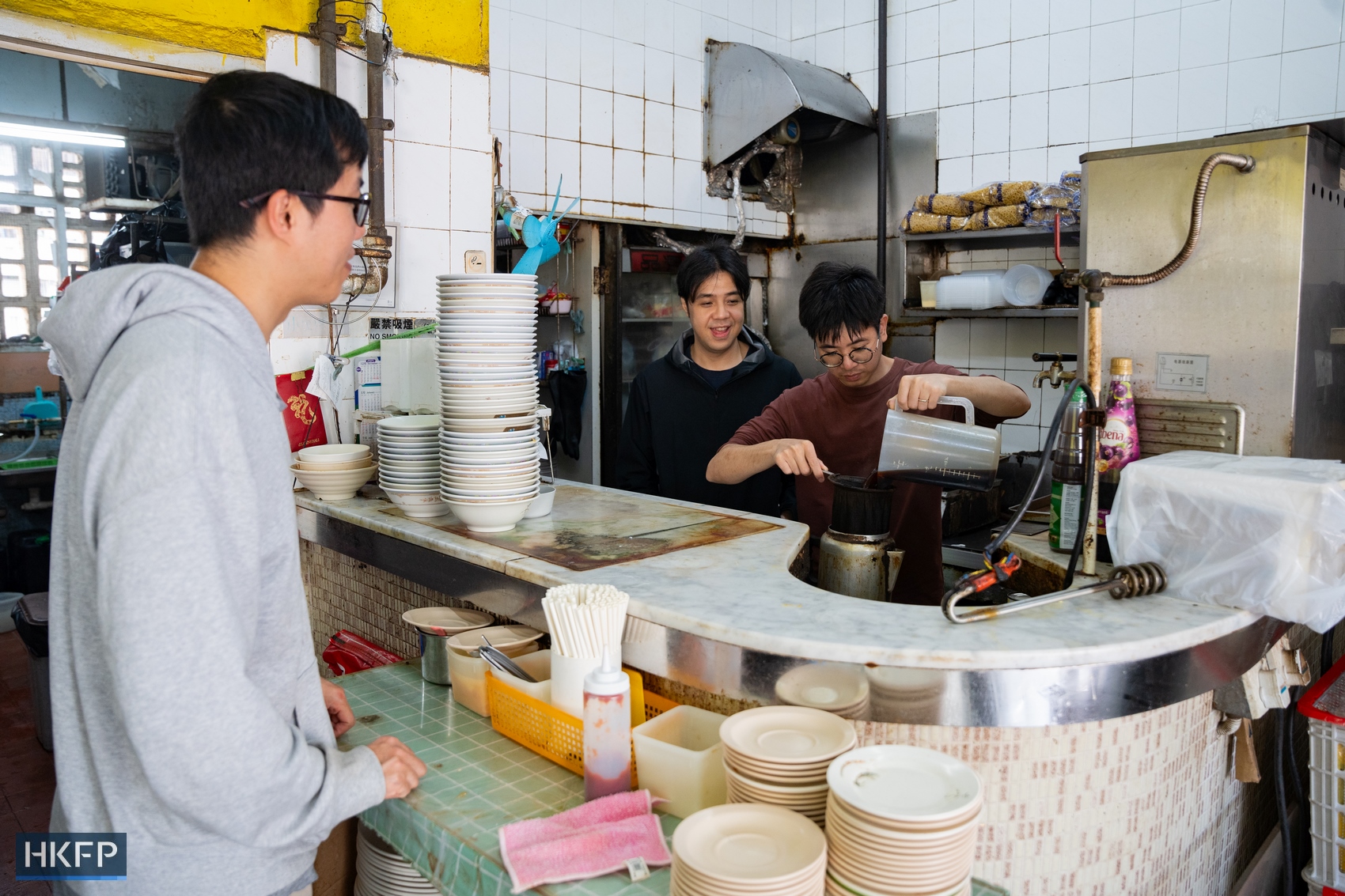
The pair, alongside Jan Mui, started Purelifehk in early 2020 with only one product in their inventory – a hand-brewed, bottled oolong tea they billed as having a lasting, sweet aftertaste with no sugar added.
It encapsulates the motto of the start-up – what the trio calls “the Hong Kong spirit of enduring hardship before experiencing sweetness.”
Launched during the Covid-19 pandemic, the firm relied entirely on its three founders for roughly two years; they handled all research and development, marketing, manufacturing and delivery themselves.

They earned no salary, and every dollar of income was either saved or reinvested into the company. “First the bitter, then the sweet,” Andy said. “We have always had this mindset when we do things.”
Six years on, Purelifehk has experienced some moments of sweetness. It has grown in size and expanded its catalogue, offering Hongkongers’ favourite beverages such as milk tea and iced lemon tea, and even venturing into producing nutritious soup for postpartum care.
But the company has also been tied to the ebb and flow of residents’ appetite for locally made products.

During the pandemic, the company benefited from a thriving network of small local businesses and consumers consciously seeking out made-in-Hong Kong goods. It then took a hit when Hongkongers began travelling north to mainland China for holidays after pandemic curbs were lifted, which triggered a wave of shop closures.
More recently, geopolitical crises including the Iran war and rising trade barriers have threatened supply chains and pushed operating costs upward.

“The bigger picture is not looking good for business,” Ng said. “Our way out is to make unique and good-quality products that can match the price of made-in-Hong Kong goods.”
Bitter start
The three were working in different sectors and had little savings when they decided to give Purelifehk a shot in 2020.
Having met online over a decade ago, the trio became friends and at times discussed the prospect of starting a business together. Ng, who worked in media, already had experience launching start-ups and set his sights on hand-brewed tea.

“My previous failures taught me that inventing a tea product could be relatively low cost,” he said.
“And I really wanted to do it because growing up we only had Vita or Tao Ti,” he added, referring to two prominent beverage brands in Hong Kong.
After developing an oolong tea that carried the sweet aftertaste they were seeking, the trio had a chance to take over a licensed food factory within their modest budget at the start of the Covid-19 pandemic.
They saw an ad for a food factory, including equipment and licence but excluding rent, on sale for HK$80,000. Taking over a food factory typically costs between HK$200,000 and HK$300,000, they said.

They pooled together HK$80,000 and signed the contract.
Ng was the first to quit his job to commit to the start-up full-time. Lee and Mui, the other two co-founders, joined him full-time roughly a year later.
When they were still working at their previous jobs, Lee and Mui would come to the factory every day after work, and the three would brew oolong tea and hand-fill each bottle. Sleep was a luxury.

“At that time, I didn’t think it was tough. I only thought that we would have our breakthrough if we endured,” Lee said. “After starting the business, every day just passed by with so many matters to handle.”
In the beginning, the three went to the city’s local eateries unsolicited to promote their oolong tea. Always lurking behind to observe people’s reactions, Lee once saw their hand-brewed tea thrown away soon after they left.
Some were sceptical of the value of hand-brewed oolong tea. “We were once told, ‘I can make oolong tea myself,’” Ng recalled.
Rediscovery of Made in Hong Kong
The trio got their first big break when a small restaurant in Sai Wan Ho took an interest in the tea and offered to be a vendor. Purelifehk subsequently gained a reputation among eateries by word of mouth, and orders began to come in.

“At that time there were a lot of small local shops, while people had to spend their money locally during the pandemic,” said Mui. “More people were buying locally produced goods.”
With hindsight, Ng said his start-up rode the wave of a rediscovery of made-in-Hong Kong products during the pandemic. “The atmosphere provided momentum to made-in-Hong Kong [goods]. We were newly established, so there was a sense of freshness,” he said.
“If other brands talk about made-in-Hong Kong now, I think they may not gain as much traction,” he added.

The trio said their company gained its footing thanks to the flourishing of a network of independent local shops during the pandemic.
“There were lots of local brands and small shops emerging at that time, and they tended to avoid big brands – instead, they looked for homegrown products like ours,” said Lee.
At its peak, Purelifehk was supplying beverages to more than 100 independent eateries, but the good times did not last.

The lifting of Covid-19 curbs dealt a heavy blow to small businesses, as residents opted for overseas trips or increasingly travelled to neighbouring Shenzhen for holidays.
Lee observed that, since the border reopened in early 2023, many eateries have reduced their orders of the company’s products, while others quietly went out of business.

“Once small businesses close, they rarely come back,” he said. “And the new ones opening nowadays have a different vibe. Before, we helped each other out; now, they opt for big brands instead.”
Geopolitical crisis
The start-up hit a low point in 2023, prompting them to seek other avenues of revenue. They sought to secure space on supermarket shelves, a strategy that has paid off. Today, the brand’s products can be found at major grocery stores like ParknShop and Wellcome.

But more recently, Purelifehk has felt the pinch of rising prices for imported ingredients driven by global geopolitical tensions.
Speaking to HKFP in March, weeks after the US and Israel began striking targets in Iran, which sent oil prices skyrocketing, Lee noted that the cost of imported ingredients surged almost immediately. For example, a box of condensed milk rose to more than HK$400, up from a pre-war level of around HK$320.
“Basically, all our raw materials went up in price,” he said, adding that a weak US dollar – to which the Hong Kong dollar is pegged – has also driven up the costs of imported goods from other regions.

Ng also noted that it was difficult to switch to cheaper alternatives because their beverage formulas are precise. Using milk tea as an example, he said: “The taste of the tea has to match the flavour of the milk; it changes everything if you change [the brand].”
Long game
With the local business environment worsening, Purelifehk has sought to develop new products. One of its recent ventures is producing scorpionfish soup, a dish traditionally considered restorative for women after childbirth due to its high nutrient content.
The idea to make soup stemmed partly from the identity of the start-up, which Ng described as making products “derived from water.” It also coincided with milestones in the founders’ personal lives, as two of them recently welcomed newborns into their families.

When asked to reflect on the start-up’s six-year journey, Lee said it had been fulfilling.
“I did not understand the value of made-in-Hong Kong before… but once I committed myself to it, I realised how much effort goes into creating local products,” he said.
However, the trio also noted how challenging it is to start a business in the current climate, jokingly adding that they would discourage young people from pursuing entrepreneurship.
With Purelifehk, they intend to play the long game.
“We must first secure our ground in this environment,” Ng said. “The world is changing. We need to find ways for made-in-Hong Kong products to go further and stay longer.”