2
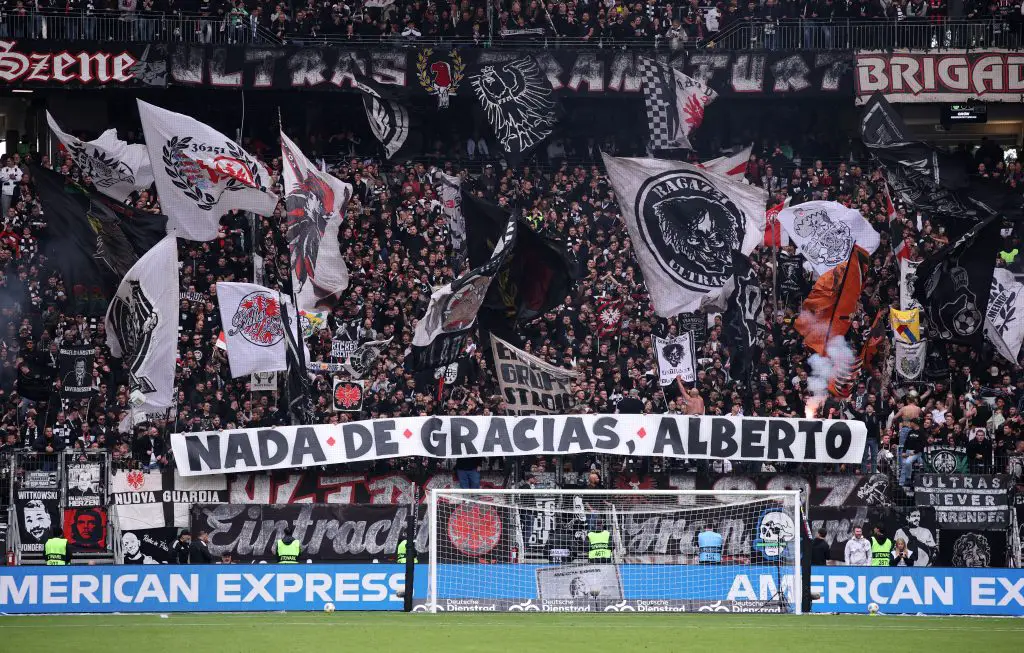
Eintracht Frankfurt’s decision to replace Albert Riera with Adi Hütter represents far more than a conventional summer coaching change. It constitutes an almost perfect reversal of the experiment attempted only six months ago, one that ended with supporters of the Bundesliga club protesting Riera’s appointment with banners and atmosphere boycotts.
As examined in a January Get German Football News editorial, Riera arrived in Frankfurt without prior experience of German football and possessing little knowledge of the German language. Eintracht entrusted a talented but combustible young coach with learning the league, the club, the locker room, the media environment and the language simultaneously.
The point was never that every Bundesliga coach must speak fluent German. Communication nevertheless still matters in the Bundesliga. Frankfurt’s emotional supporters expect a trainer capable of articulating a recognizable identity. Players require clear instructions. German journalists demand answers that survive interpretation rather than becoming lost in translation.
Mario Götze and Jonathan Burkardt came to embody Riera’s problems
Riera’s initial work appeared promising. Following a 3-0 win over Borussia Mönchengladbach in February, Mario Götze praised the Spaniard’s progress and claimed that Frankfurt had learned a great deal within a short period.
That early optimism did not last.
Götze gradually disappeared from Riera’s plans before being omitted from the matchday squad against Mainz. When German journalists asked about the decision, Riera responded with a confrontational press-conference monologue in which he challenged reporters to name another player he should have dropped instead.
Jonathan Burkardt’s situation followed a similarly uncomfortable trajectory.
Burkardt remained Frankfurt’s leading Bundesliga scorer despite missing 12 league fixtures through injury. In his long-awaited Bundesliga comeback against Bayern Munich, the German international came off the bench, scored his ninth league goal of the campaign and demonstrated why Frankfurt’s attack still depended heavily upon him.
Riera nevertheless publicly challenged Burkardt’s commitment during the closing stages of the season. The striker responded professionally, returned to the starting XI and recorded an assist against Hamburg, but the episode prompted another extraordinary Riera press-conference controversy.
By then, the original concerns about linguistic and cultural barriers were impossible to ignore. Riera was no longer merely struggling to produce results. Two important German players had become central figures in unnecessary public disputes between their coach and the surrounding media.
Adi Hütter’s departure and return
Hütter could hardly provide a greater contrast. The Austrian speaks the language, knows the Bundesliga and understands Eintracht’s internal structures. More importantly, he already knows precisely what kind of football excites Frankfurt supporters.
His return nevertheless required reconciliation.
In March 2021, amid speculation linking him with Borussia Mönchengladbach, Hütter publicly insisted that he would remain in Frankfurt. Less than two weeks later, Gladbach confirmed that he would take charge following the conclusion of the campaign.
The timing generated considerable resentment. Frankfurt were pursuing Champions League qualification and eventually finished fifth after surrendering their position inside the top four. Hütter’s decision to join a direct Bundesliga rival consequently overshadowed three otherwise successful years that included a Europa League semi-final and some of the most exhilarating football in the club’s recent history.
Hütter lasted just one season with BMG.
Hütter subsequently acknowledged that he handled his departure poorly. He expressed regret ahead of his first return to Frankfurt in 2022 and conceded that the situation should have been resolved differently. Upon rejoining Eintracht in 2026, he again apologized.
Five years later, the response to his return suggests that the relationship has been repaired. Approximately 2,000 supporters attended his first training session back in charge.
Frankfurt have not forgotten what happened.
They have seemingly chosen to forgive it.
Burkardt already flourishing under Hütter
Pre-season victories obviously offer no guarantee of competitive success. Frankfurt’s first two performances under Hütter still provide early evidence that the reunion can restore some of the energy missing under Riera.
Eintracht opened their preparations with a 7-1 victory over FC Gießen. Burkardt scored twice during the first half, including a spectacular Rabona finish. He then found the net again as Frankfurt defeated Turkish Cup winners Trabzonspor 3-0.
Three goals in two friendlies do not erase Burkardt’s difficult previous campaign. They nevertheless offer a striking response from a player whose commitment Riera publicly questioned only a few months ago.
The difference is not merely that Burkardt is scoring. Hütter has immediately placed the striker at the centre of a recognizable attacking concept. Frankfurt are pressing aggressively after losing possession, playing forward with greater urgency and attempting to reproduce the intensity associated with Hütter’s first tenure.
Götze’s words make the contrast even sharper.
The veteran initially supported Riera and publicly praised his early coaching work. By the end of the campaign, however, Götze had become a subject Riera appeared increasingly reluctant to discuss. Under Hütter, Götze is again speaking enthusiastically about a clearly communicated footballing philosophy.
“Yes, I have a very positive impression [of him],” Götze told members of the assembled media at a Friday press event. “He’s precisely the man needed here for Frankfurt, for us as a team, and for the fans. The way we’re [going to play football] is really good and we’re excited about it.
“Much is coming together,” Götze continued. “We have a clear coaching philosophy. We want to play with energy and enthusiasm again. That wasn’t working the last few months.”
Frankfurt seek a return to familiar virtues
“None of us were satisfied with last season and, at the end, the type of football we were playing,” SGE attacker Ansgar Knauff remarked on Friday. “The fans didn’t want to watch it anymore. We didn’t get the sort of atmosphere that we were used to at home games. That’s why it’s about getting back to basics; the basic virtues of intensity and spirit.
“[Last year], we naturally expected much more,” Knauff answered when asked if escaping the end of last season amounted to the team pulling themselves out of a ‘vortex’. “A confluence of things led to it. It wasn’t one single thing. It didn’t work. The plug was pulled. Now it’s a new beginning for us both as a team and individuals.”
“[Adi Hütter] has a big impact on the [team] atmosphere,” Swedish midfielder Love Arrhov said at a separate media session after the Trabzonspor match. “He brings some new energy into the team.”
Hütter’s own assessment of the Trabzonspor performance emphasized precisely the qualities Götze, Knauff and Arrhov identified.
“I really liked it,” Hütter said. “In the beginning, when we lost the ball, we remained active and attentively sought to win balls back. I liked what I saw in the opening 10, 15 minutes. Tactically there were some issues, but I don’t want to dwell on them. We can take a lot out of this game.”
“I think we should head into the season prepared to play variably,” Hütter continued. “I think we should have [a variable] back three/back four. [On the front two attacking axes] a 1-2/2-1. That’s what I’d like to introduce as I can tell that this team needs to remain flexible.”
Riera arrived needing to discover what Eintracht Frankfurt meant.
Hütter has returned already knowing.