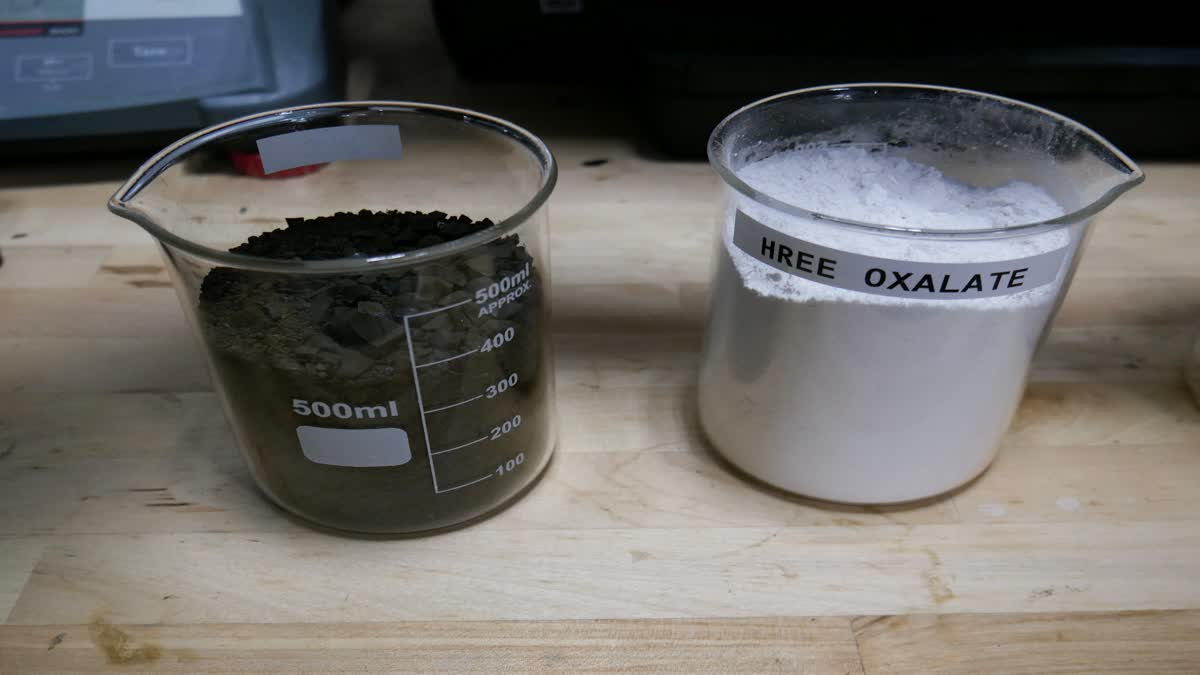
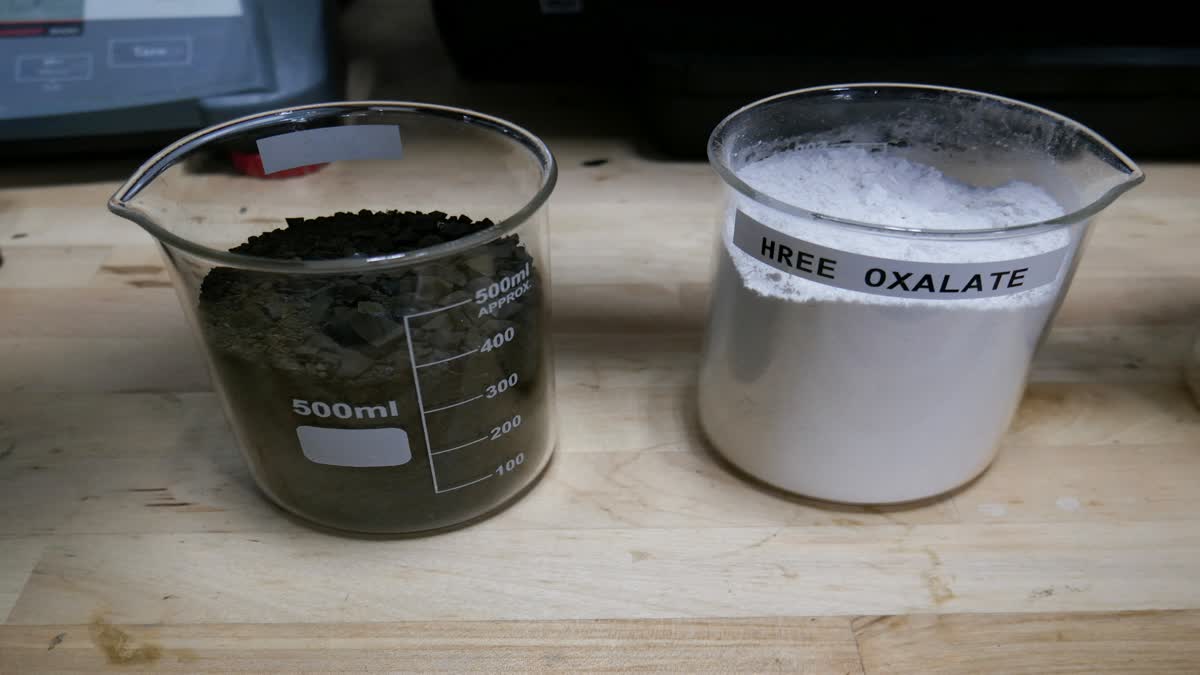
Vials containing rare earth concentrates extracted from acid mine drainage are seen at West Virginia University’s pilot plant in Mount Storm, West Virginia, on August 12, 2026. (AFP)
New Delhi: Prime Minister Narendra Modi warned against weaponising critical minerals and technology at the BRICS Summit, in the presence of Chinese President Xi Jinping.
The warning comes as China and the US are locked in a battle for supremacy and use their dominance as a strategic tool against each other.
China controls around 90 per cent of global rare earth processing, while the US has technological supremacy in areas like Artificial Intelligence and advanced semiconductor chips.
The two countries have used export controls and bans, with India among countries caught in the middle of this rivalry.
Sharing my concluding remarks during BRICS Session on ‘Resilience, Innovation, Cooperation and Sustainability: Shaping the Future for Inclusive Global Growth.’ https://t.co/4E8aBDksfK
— Narendra Modi (@narendramodi) September 13, 2026
This has underlined the growing importance for emerging economies to strengthen domestic capacity and build partnerships with other like-minded countries to develop indigenous tech capacities, and prevent dependence on any one country.
The critical minerals race
The intertwined battle over technology and critical minerals has cast a wide shadow globally.
Critical minerals are acquiring importance because they are a critical part of energy transitions, with lithium used in electric vehicle batteries. They are also used in products like smartphones, which contain indium and germanium.
In 2023, the world got a rude wake-up call when China imposed export restrictions on critical minerals like gallium and germanium and rare earth elements like gadolinium and lutetium.
The decision by China to restrict exports was preceded by the US restricting Chinese access to advanced semiconductor chips and other technologies.
China also gave it a national security angle, maintaining that these minerals have dual use, meaning they can be used for both critical and military purposes and that it was restricting exports to prevent them from being used in weapons systems.
This has impacted not just the US, the intended target, and Western economies but also other countries, underscoring the danger of over-reliance on a single supply chain.
Prime Minister Narendra Modi with Russian President Vladimir Putin and Chinese President Xi Jinping on the sidelines of the 18th BRICS Summit, in New Delhi. (PTI)
China’s dominance in critical minerals is now viewed widely with concern.
According to the International Energy Agency, China controls most of the world’s supply, refining and manufacturing of critical minerals and rare earth elements essential for electronics, electric vehicles, and military equipment.
The Global Critical Minerals Outlook 2025 showed that for 19 out of 20 important strategic minerals, China is the leading refiner, with an average market share of 70 per cent.
Apart from using its own reserves, China has also expanded its acquisition of critical minerals overseas.
According to the Africa Centre for Strategic Studies, China has acquired major African mining assets, like lithium mines in Mali.
Chinese restrictions on critical minerals exports have highlighted supply chain vulnerabilities, given the overdependence on one country.
The technology race
The critical minerals battle is connected to the technology battle in that the West and China are leveraging their dominance in one over the other.
China uses export controls on critical minerals and rare earth minerals; the US uses export bans to put advanced semiconductor chips and AI out of China’s reach.
The US, which has dominance in technology and is home to the dominant tech companies, and China are locked in a battle of dominance in Artificial Intelligence, microchips and digital infrastructure.
While the US has the technology advantage, China has been working to boost its capabilities, like rolling out cost-effective Artificial Intelligence.
China’s President Xi Jinping during the BRICS Summit 2026 session on ‘Inclusive Global Governance and Strengthening Multilateralism’, at Bharat Mandapam, in New Delhi. (PTI)
The US dominates areas like advanced microchips, apart from AI development, as American firms like OpenAI and Anthropic set industry standards.
But Chinese tech firms are now promising cheaper AI alternatives, particularly attractive for the Global South, intensifying the technology race.
The Stanford University AI Index Report showed that China is gaining on the US, with the performance gap between top US and Chinese artificial intelligence models narrowing.
In February 2025, DeepSeek-R1 briefly matched the top US model, and as of March 2026, Anthropic’s top model leads by just 2.7 per cent, the report said. It, however, underlined that the US still produces more top-tier AI models.
Where does India stand in all this?
Prime Minister Narendra Modi at the BRICS Summit underlined the challenge facing all other countries, including India, amid the US-China rivalry, saying the “weaponisation of technology and critical minerals can hinder our shared progress.”
He noted, “pandemics, climate disasters, and supply-chain disruptions have shown that in today’s interconnected world, no crisis remains confined to a single region.”
For India, the challenge is to reduce reliance on any one country and build its own technology and semiconductor capabilities.
In critical minerals, India has been seeking to expand collaboration with other countries even as it has sought to boost its own domestic capacity through the National Critical Mineral Mission, which was allocated ₹34,300 crore for exploration, refining, and recycling.
To boost critical mineral cooperation with other countries, India is increasingly including critical mineral cooperation in Free Trade Agreements. The FTA with Chile, under negotiation, has a dedicated chapter on critical minerals.
India is also in dialogue with other countries to access critical minerals and, earlier this year, also signed Pax Silica, a US-initiated initiative focused on semiconductors.
In AI, the US and other countries see India’s strength in its large talent pool. The IndiaAI Mission was set up to build sovereign infrastructure, indigenous models, and talent.
But for India, like other countries, the bigger question is whether it can build indigenous capacity with speed, and faster than the intensification of the rivalry between the US and China.
Also Read

![[Press Release] Asia Fruit Logistica 2026 Closes on Record High in Hong Kong](https://news.charm-retirement.com/wp-content/uploads/2026/09/2026090720AFL_2.jpg)