Australia’s latest VFACTS and EVC data confirms what we’ve been charting all year: EV sales are multiplying, ICE is slowly losing control of the market, and the power EV dealers are supplying is genuinely electrifying.
China now dominates as the source of those vehicles, while grease and petrol and diesel look so “last century” with every monthly update.
As Tim Minchin might put it, the sun is finally coming out on Australia’s electric age – and this time it’s science, not faith, doing the work.
The May 2026 figures show another big jump for battery electrics.
Tesla’s Model Y has topped the national sales charts, while BYD remains the leading EV brand on year-to-date volumes, and Zeekr has emerged as the fastest-growing new player.
EV sales overall are up more than 110 per cent year-on-year, a doubling that reflects both rising demand and a rapidly widening model mix. Every month, more Australians discover that the supposed compromises of EVs were mostly theatre; the weekend, it turns out, was never really at risk.
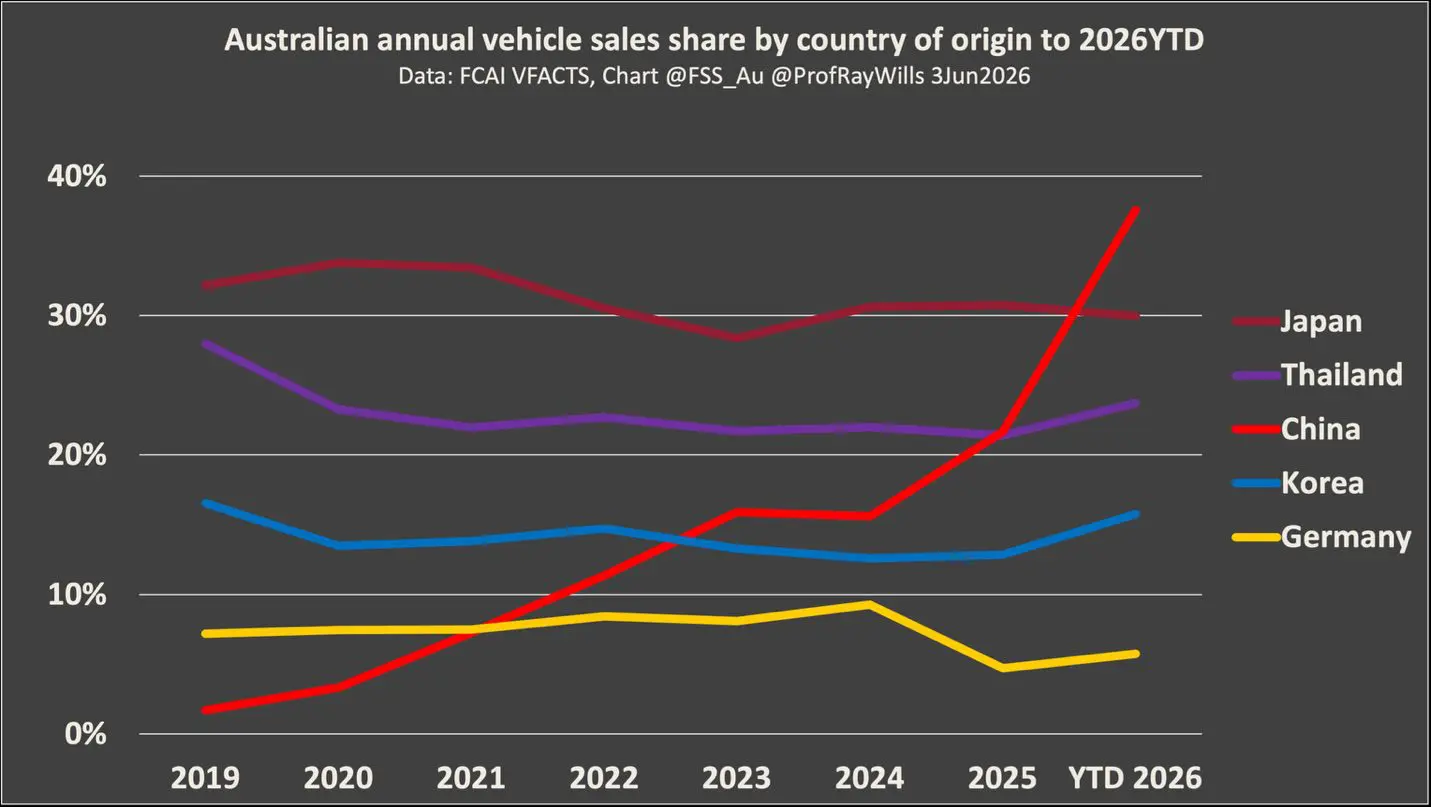
Country-of-origin data reinforces the point.
China is now firmly the number-one source of new vehicles in Australia, well ahead of Japan and pulling further away.
A growing share of EVs on Australian roads – and a fair number of hybrids and even some ICE models – are built in Chinese factories, whether they carry BYD, Zeekr, MG, GWM, Volvo or Tesla badges.
For a country that doesn’t build cars, we are being swept along an S-curve largely designed in Shanghai and Shenzhen.
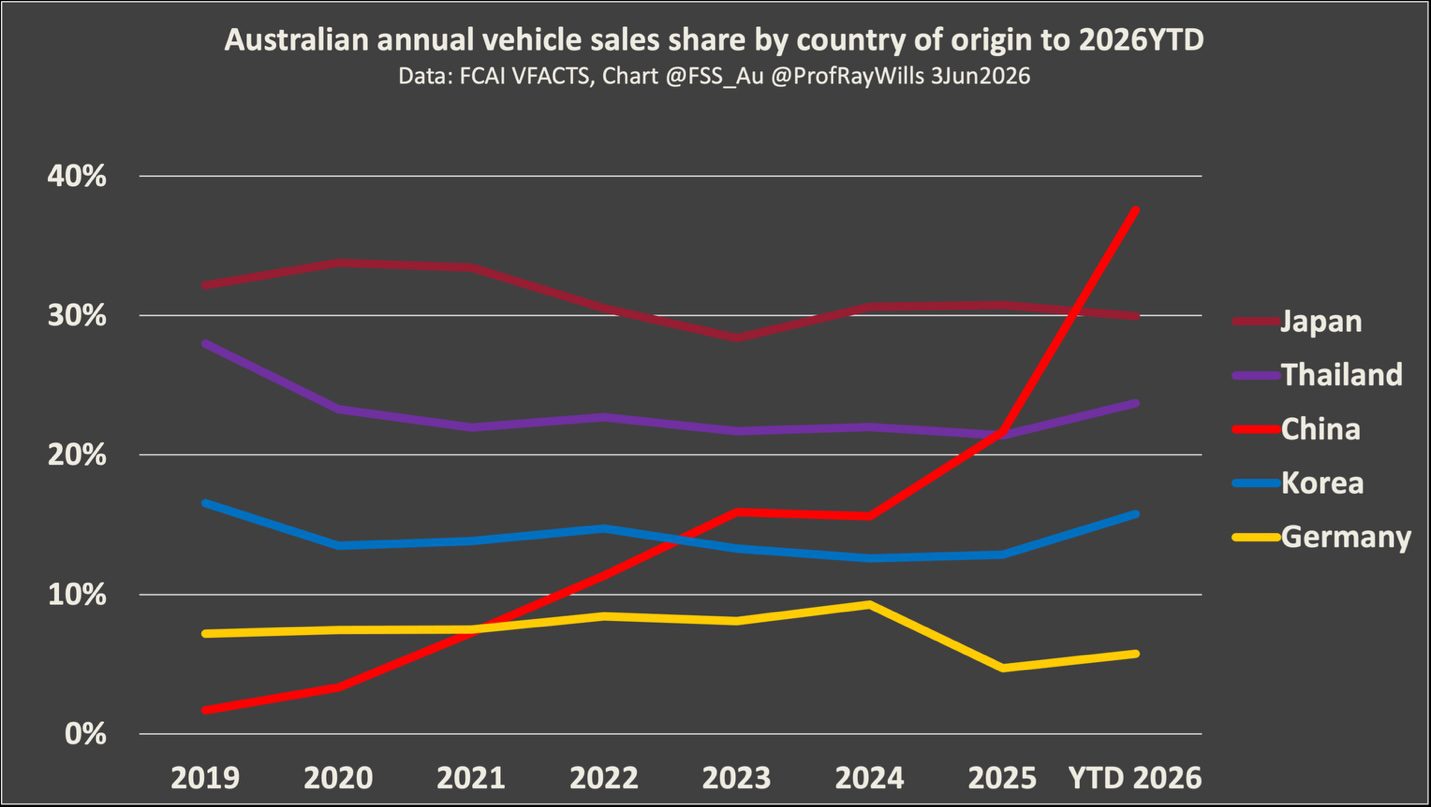
Australian vehicle sales share by country of origin – last data point reports 2026 year to date.
Since the post‑COVID bounce in 2021, petrol and diesel volumes have been sliding on a clear downward trend, punctuated by the familiar EOFY “dead cat” jumps seeking moonlight.
Even those June bounces in 2023 and 2025 only delivered lower plateaus afterwards, as buyers shifted into hybrids, plug‑ins and BEVs. BEV sales are now close to overtaking the combined hybrid sales including PHEVs, as they first tried to do in 2022.
The old oil era is fading into the twilight, even as the solar‑powered sun finally rises over the showroom, tomorrow.
The long-run picture is no summer fling; combustion is in a decidedly not slow fade-out to the horizon.
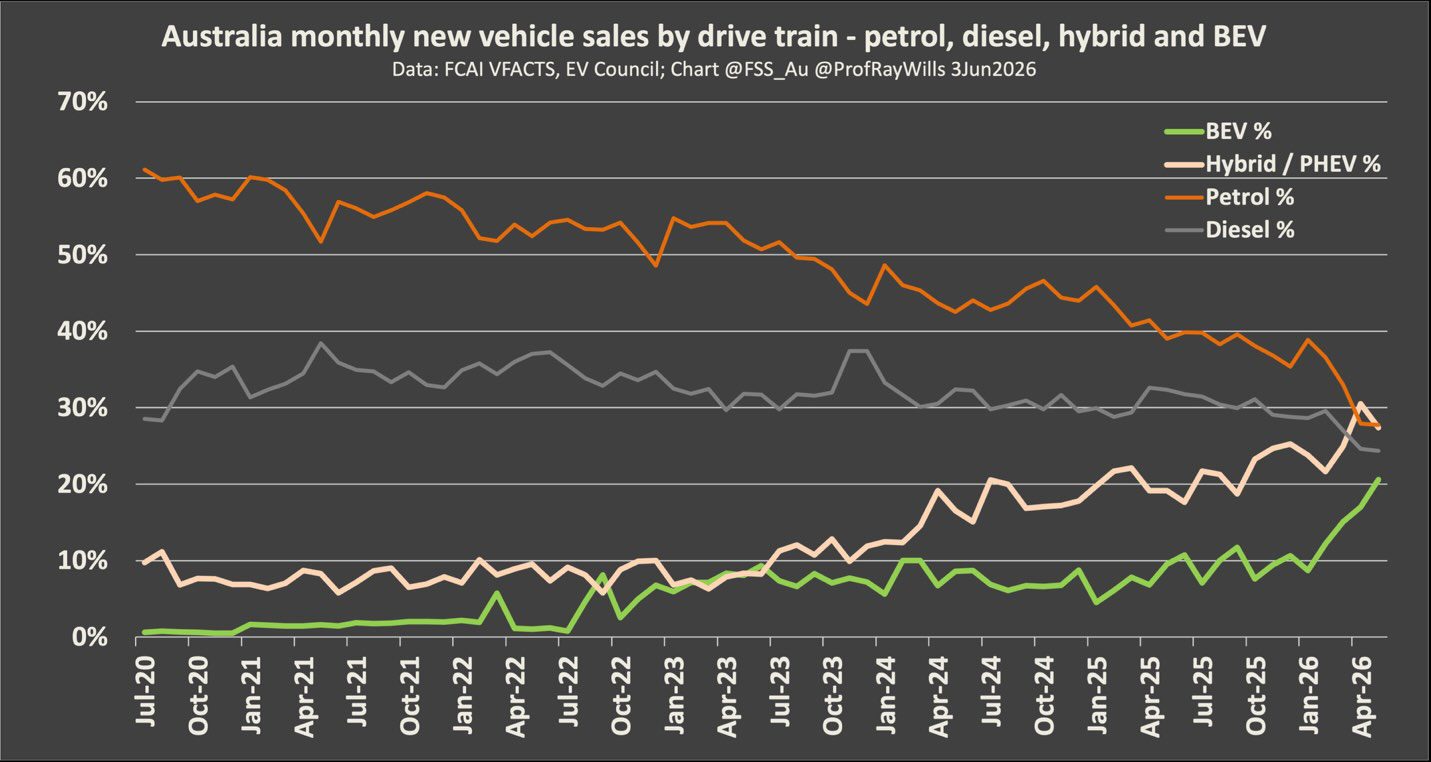
Australia monthly new vehicle sales by drive train – petrol, diesel, hybrid + PHEV, and BEV
By contrast, the electrified side of the ledger is all upward motion. Hybrids first inched into the mainstream, then PHEVs began to appear in meaningful numbers, and BEVs have recently shot to one in five sales in market share.
In the last few months, the BEV line on our charts has started to look like those classic S-curve graphs from EV-heavy Europe and China – and Singapore and Indonesia. This is what the steep part of the transition feels like: one record month after another, as more households and fleets decide they’ve had enough of fuel-price roulette.
Policy and geopolitics are both amplifying the trend.
The New Vehicle Efficiency Standard is only in its early stages, but it is already nudging manufacturers to push low- and zero-emission models harder and to clear older, higher-emission stock.
At the same time, the world’s fourth oil crisis has reminded Australians how fragile the “cheap fuel forever” story really is. Each time global tensions flare and servo price boards jump, a few more drivers decide they’re ready to unplug from oil altogether.
That’s why this moment matters.
For decades, petrol and diesel were the unquestioned kings of Australia’s car market. Now, almost quietly, they are becoming the legacy option. ICE-only is still more than half of new sales, but that share is shrinking, and the trend has momentum.
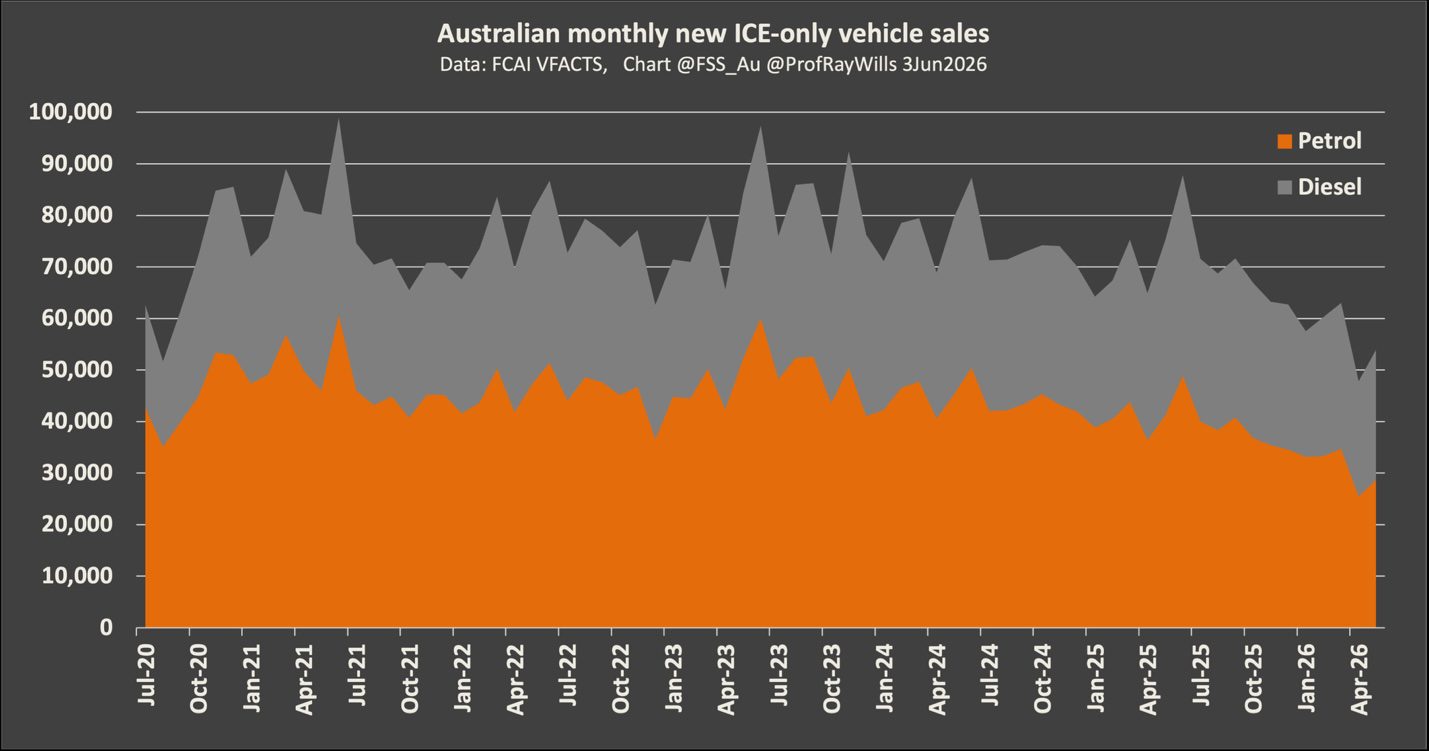
Australian monthly new ICE-only vehicle sales
The old soundtrack of the market is fading under the hum and whirr of motors powered from the grid and, increasingly, from rooftop solar.
So yes, Grease is so last century – at least for Australia’s car fleet.
EVs are no longer a side show; they’re the main act, stepping into the spotlight as the headliners from the age of oil shuffle offstage.
For all the noise and scare campaigns, the data say, the future turns up slowly, then all at once, like the sun coming out after a long, cloudy morning.
And from what the latest VFACTS data shows, this is one number that’s only going to keep building, key change after key change, as electrified vehicles take over the chorus line.
See The Driven’s detailed EV sales data here: Australian electric vehicle sales by month in 2026; by model and by brand.
Sign up for The Driven’s free daily newsletter and get the latest EV news and analysis delivered straight to your inbox.