EV Lighting Market
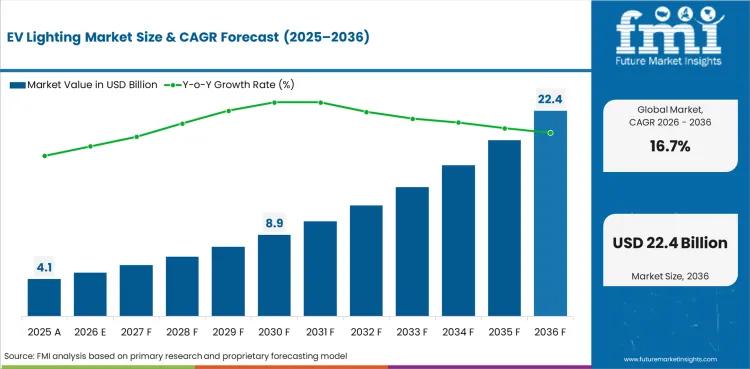
According to the latest analysis by Future Market Insights, the global EV lighting market is entering a high-growth phase as electric vehicle manufacturers accelerate the adoption of advanced lighting systems across passenger and commercial platforms. According to the latest analysis, the market is valued at USD 4.10 billion in 2025 and is projected to reach USD 22.42 billion by 2036, expanding at a CAGR of 16.7%. The sector is expected to generate an incremental opportunity of USD 17.63 billion over the forecast period.
This growth reflects a structural transformation in automotive lighting architecture, where LED and adaptive lighting technologies are becoming standard specifications across next-generation electric vehicles.
Get detailed market forecasts, competitive benchmarking, and pricing trends:
https://www.futuremarketinsights.com/reports/sample/rep-gb-16571
Featured Snippet: Key Market Answer
Q: What is driving the growth of the EV lighting market?
A: Growth is driven by rising global EV production, increasing OEM integration of LED and adaptive lighting systems, and growing demand for energy-efficient, design-oriented automotive lighting technologies.
Quick Stats
• Market Size (2025): USD 4.10 billion
• Forecast (2036): USD 22.42 billion
• CAGR (2026-2036): 16.7%
• Incremental Opportunity: USD 17.63 billion
• Leading Light Type Segment: LED (72.0%)
• Leading Vehicle Type Segment: Passenger Cars (63.0%)
• Leading Sales Channel Segment: OEM (68.5%)
Market Overview: Transition Toward Smart and Energy-Efficient EV Lighting
The EV lighting market is defined by the development and integration of advanced lighting systems for electric vehicles across passenger cars, commercial vehicles, and two-wheelers. Demand is being reshaped by four core forces:
• Rapid global expansion of EV production
• OEM adoption of LED and adaptive lighting technologies
• Increasing use of lighting as a vehicle design differentiator
• Emergence of aftermarket replacement demand for aging EV fleets
Together, these factors are accelerating the transition from conventional automotive lighting toward intelligent, energy-efficient lighting ecosystems.
Key Growth Drivers
1. Expansion of Global EV Production
Every newly manufactured electric vehicle requires integrated headlamps, taillamps, fog lamps, and interior lighting systems. Rising EV production volumes are directly increasing demand for OEM-installed lighting technologies.
Passenger cars remain the largest demand category as consumer EV adoption continues to accelerate globally.
2. LED and Adaptive Lighting Adoption
LED technology has become the preferred lighting standard due to:
• Superior energy efficiency
• Longer operational lifespan
• Lower heat generation
• Greater design flexibility
Adaptive and matrix LED systems are increasingly being adopted across mid-range and premium EV models to improve visibility and enhance vehicle differentiation.
3. Vehicle Design and Brand Differentiation
EV manufacturers are using distinctive lighting signatures to strengthen brand identity. Dynamic daytime running lights, illuminated grilles, and animated lighting sequences are becoming important competitive differentiators.
This trend is increasing the value content of lighting systems per vehicle.
4. Growth of EV Aftermarket Demand
As first-generation EVs from 2018-2022 move beyond standard replacement cycles, aftermarket demand for replacement LED modules, headlamps, and taillights is beginning to emerge as a secondary growth channel.
Speak to Analyst: Customize insights for your business strategy:
https://www.futuremarketinsights.com/customization-available/rep-gb-16571
Market Trends Shaping the Industry
• Rise of Adaptive Lighting: Matrix LED and intelligent beam systems are gaining OEM adoption
• Premiumization of EV Platforms: Higher-end lighting systems are becoming standard across premium EVs
• Expansion of OEM Contracts: Long-term direct supply agreements are strengthening revenue visibility
• Integration of Smart Features: Sensor-linked and software-controlled lighting technologies are expanding rapidly
• Growth of Exterior Signature Lighting: Automakers are investing heavily in lighting-based vehicle identity systems
Segment Insights
Light Type Leadership: LED (72.0%)
LED lighting dominates the market due to:
• High energy efficiency for battery-powered vehicles
• Reduced maintenance requirements
• Compatibility with adaptive lighting technologies
• Enhanced styling flexibility for EV manufacturers
Adaptive LED lighting is emerging as the fastest-growing sub-segment.
Vehicle Type Segment: Passenger Cars (63.0%)
Passenger cars lead demand due to:
• Rapid global consumer EV adoption
• Higher EV production volumes
• Increased OEM focus on premium vehicle styling
Commercial vehicles and electric two-wheelers continue to contribute incremental growth.
Sales Channel Segment: OEM (68.5%)
OEM channels dominate because lighting systems are increasingly integrated during vehicle manufacturing through long-term supplier agreements.
Direct OEM relationships provide stable procurement pipelines for major lighting manufacturers.
Regional Insights
Top Growth Markets (CAGR 2026-2036)
• South Korea: 7.9% – Supported by domestic EV manufacturing and lighting innovation
• EU: 7.8% – Driven by EV production mandates and established automotive supplier ecosystems
• USA: 7.6% – Expansion of domestic EV manufacturing capacity
• Japan: 7.5% – Strong automotive lighting technology leadership
• UK: 7.2% – EV adoption targets and automotive manufacturing investments
Emerging Regional Outlook
• Asia-Pacific: Leading in manufacturing-driven demand growth due to expanding EV production ecosystems
• Europe: Strong demand supported by regulatory EV transition mandates and premium automotive brands
• North America: OEM localization and EV assembly expansion continue to support lighting procurement volumes
Exhaustive Market Report: A Complete Study
https://www.futuremarketinsights.com/reports/ev-lighting-market
Competitive Landscape
The market is moderately consolidated, with competition increasingly centered on technology integration, OEM relationships, and adaptive lighting innovation.
Key Players
• Denso Corporation
• Hella GmbH
• Hyundai Mobis
• Koito Manufacturing
• Koninklijke Philips N.V.
• Osram GmbH
• Robert Bosch GmbH
• Stanley Electric Co.
• Valeo
• ZKW Group
Competitive Differentiation Factors
• LED and adaptive lighting technology capabilities
• OEM integration expertise
• Product portfolio breadth
• Global manufacturing footprint
• Regulatory compliance and certification support
Recent Developments
• Expansion of adaptive matrix LED product portfolios for premium EV platforms
• Increased OEM partnerships for integrated lighting systems
• Investment in software-controlled and sensor-enabled lighting technologies
• Growth in smart exterior lighting systems for vehicle personalization
Expert Insight
The EV lighting market is transitioning from a conventional automotive component segment into a strategic technology layer within electric vehicle design and performance architecture. As EV manufacturers prioritize energy efficiency, brand differentiation, and advanced safety systems, lighting technologies are becoming increasingly integrated into core vehicle platforms.
Manufacturers that combine advanced LED innovation, OEM integration capability, and intelligent lighting software are expected to capture disproportionate market share during the forecast period.
FAQs
1. What is the future outlook for the EV lighting market?
The market is expected to reach USD 22.42 billion by 2036, growing at a CAGR of 16.7%, driven by rising EV production and LED technology adoption.
2. Which segment dominates the EV lighting market?
LED lighting leads with a 72.0% market share due to its energy efficiency, longevity, and compatibility with advanced EV lighting systems.
3. Why are EV manufacturers adopting adaptive lighting systems?
Automakers are using adaptive and matrix LED systems to improve safety, enhance brand identity, and differentiate premium EV platforms.
4. What are the main challenges in the market?
• High development costs for advanced lighting systems
• Complex OEM integration requirements
• Dependence on semiconductor and electronic component supply chains
• Regulatory compliance across global markets
5. Which regions offer the highest growth potential?
South Korea and the European Union lead growth, while Asia-Pacific remains the strongest manufacturing-driven demand region globally.
Conclusion
The EV lighting market is positioned at the intersection of electric mobility expansion, intelligent vehicle design, and advanced automotive electronics innovation. With strong momentum across OEM integration, adaptive lighting technologies, and smart vehicle architecture, the market represents a major growth opportunity within the broader EV ecosystem.
As electric vehicle platforms continue to evolve, advanced LED and intelligent lighting systems are expected to become standard components in next-generation mobility solutions.
Browse More Industry Reports :
EV Charging Cable and Connector Durability and Safety Test Equipment Market
https://www.futuremarketinsights.com/reports/ev-charging-cable-and-connector-durability-and-safety-test-equipment-market
EV Charging System Test and Certification Equipment Market
https://www.futuremarketinsights.com/reports/ev-charging-system-test-and-certification-equipment-market
EV Powertrain-in-the-Loop (P-HIL) Test Benches Market
https://www.futuremarketinsights.com/reports/ev-powertrain-in-the-loop-p-hil-test-benches-market
Future Market Insights Inc.
Christiana Corporate, 200 Continental Drive,
Suite 401, Newark, Delaware – 19713, USA
T: +1-845-579-5705
For Sales Enquiries: sales@futuremarketinsights.com
Website: https://www.futuremarketinsights.com
Future Market Insights, Inc. (FMI) is an ESOMAR-certified, ISO 9001:2015 market research and consulting organization, trusted by Fortune 500 clients and global enterprises. With operations in the U.S., UK, India, and Dubai, FMI provides data-backed insights and strategic intelligence across 30+ industries and 1200 markets worldwide.
This release was published on openPR.