The Eurozone’s trade balance swung into deficit in May as imports surged while exports remained broadly flat, highlighting the growing impact of higher import costs on the region’s external accounts. Eurostat’s preliminary estimates showed a EUR 7.8 billion deficit in goods trade with the rest of the world, a sharp reversal from the EUR 15.0 billion surplus recorded a year earlier. Exports edged up just 0.1% yoy to EUR 243.6 billion, while imports jumped 10.0% yoy to EUR 251.4 billion, leaving import growth far outpacing export gains.
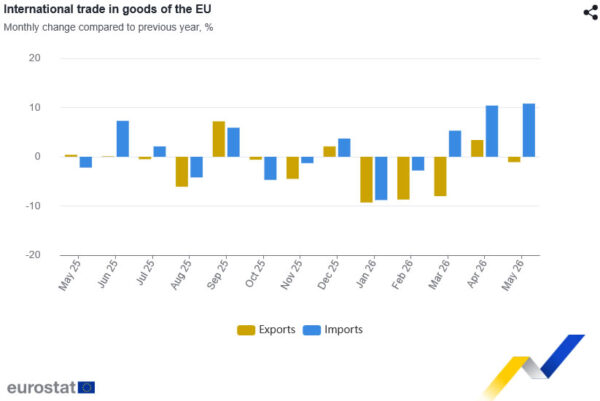
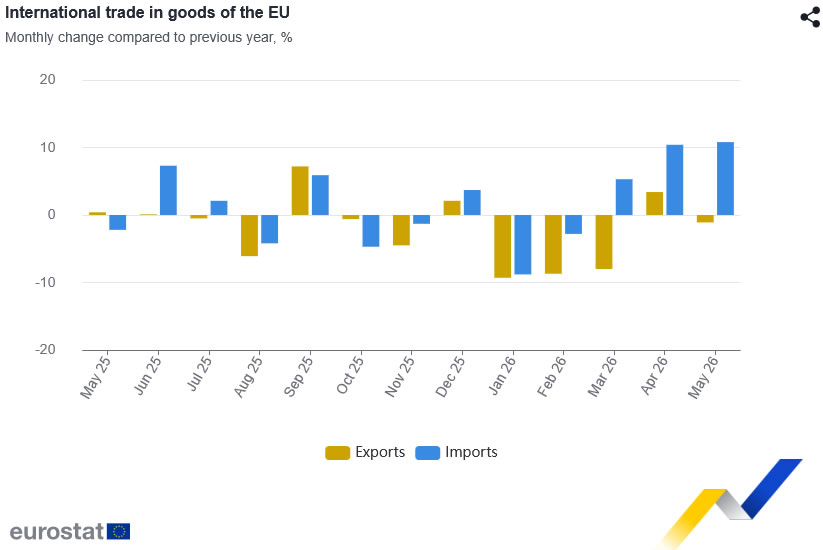
The broader European Union recorded a similar deterioration. The EU posted a EUR 12.1 billion trade deficit in May, compared with a EUR 12.7 billion surplus in the same month last year. Extra-EU exports slipped -1.1% yoy to EUR 215.7 billion, while imports climbed 10.8% to EUR 227.8 billion.
Trade by partner also highlighted diverging trends for the EU. Exports to the United States fell -12.3% yoy, reducing the EU’s trade surplus with its largest export market to EUR 7.9 billion from EUR 18.4 billion. By contrast, exports to Switzerland rose 14.8% and shipments to India increased 19.2%, partly offsetting weaker demand from the US, Japan and Türkiye. Imports strengthened across several major partners, including the United States, China, Norway and Brazil, reflecting robust demand as well as higher prices for imported commodities.
The figures suggest the deterioration in Europe’s trade balance was driven more by the sharp rise in imports than by any broad collapse in exports. The resilience of outbound shipments despite a difficult global backdrop points to continued external demand for European goods, but that strength was more than offset by rising import bills.
Economic Data
| Indicator | Actual | Previous |
|---|---|---|
| Eurozone Trade Balance (May) | -EUR 7.8B | EUR 15.0B |
| Eurozone Exports YoY | 0.1% | — |
| Eurozone Imports YoY | 10.0% | — |
| EU Trade Balance (May) | -EUR 12.1B | EUR 12.7B |
| EU Extra-EU Exports YoY | -1.1% | — |
| EU Extra-EU Imports YoY | 10.8% | — |
Main Trading Partners (EU)
| Partner | Exports YoY | Imports YoY | Trade Balance (EUR Bn) |
|---|---|---|---|
| United States | -12.3% | 17.1% | 7.9 |
| China | -4.5% | 4.9% | -30.8 |
| United Kingdom | 2.1% | 12.1% | 15.4 |
| Switzerland | 14.8% | -1.5% | 7.4 |
| Norway | 10.5% | 30.4% | -4.2 |
| India | 19.2% | 5.3% | -1.9 |
| Japan | -22.3% | -8.4% | -0.1 |
Key Takeaways
- The Eurozone swung from a EUR 15.0B surplus to a EUR 7.8B trade deficit in May as imports rose much faster than exports.
- Eurozone exports were virtually flat (+0.1% yoy), suggesting external demand remained relatively resilient despite a challenging global backdrop.
- Imports surged 10.0% yoy, indicating higher import demand and rising import prices were the main drivers of the deterioration in the trade balance.
- The broader EU also moved into deficit, with imports rising 10.8% yoy while extra-EU exports fell 1.1% yoy.
- Trade with the United States weakened noticeably, with EU exports falling 12.3% yoy, reducing the bilateral surplus to EUR 7.9B from EUR 18.4B a year earlier.
- Exports to Switzerland (+14.8%) and India (+19.2%) provided some offset, while stronger imports from the US (+17.1%), China (+4.9%), and Norway (+30.4%) widened the overall import bill.
- The figures suggest the deterioration in Europe’s external balance was driven more by surging imports than collapsing exports, leaving the trade outlook vulnerable if energy prices remain elevated.