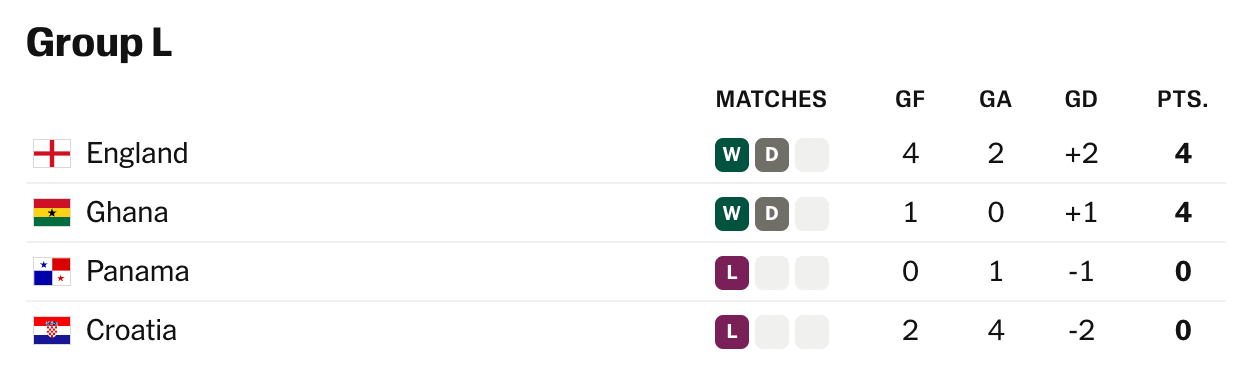
England struggled to a 0-0 draw against Ghana in their second match at this World Cup after wasting late chances at Gillette Stadium.
Thomas Tuchel’s side were excellent in their 4-2 win against Croatia in their opening match but created far fewer chances against a resolute Ghana defence.
The chance of the match came in the 86th minute when Nico O’Reilly’s header crashed against the crossbar before England captain Harry Kane blazed the rebound high over the crossbar from eight yards out.
The result means England and Ghana have four points after two matches in Group L, with Croatia facing Panama later in the day.
“We are in a very difficult group stage. We don’t need a wake up call, everyone is alert, fully committed, no doubt,” Tuchel said. “I can assure that to everyone, no over confidence in our game, not at all. If there was anything, that was maybe in some moments over-cautious, but we were never over-confident.
“It is what it is … we have four points out of two matches and still a match to play. Very important the highs don’t get too high and the lows don’t get too low. It’s not a low, it’s a difficult match of football, that can happen at any time.”
Jordan Campbell, Carl Anka, Stuart James and Anantaajith Raghuraman analyse the key talking points from Foxboro…
Why didn’t England shoot more?
England vs Ghana was the first match of the 2026 World Cup not to have a single shot on target in the first half.
It took until the 57th minute for the breakthrough, with Anthony Gordon managing a tame effort after exchanging passes with Djed Spence.
Much of the conversation around today’s game will centre on England. They’re among a handful of favourites to win the tournament, boast a world-renowned coach and were expected to waltz past a Ghana side several years removed from their own ‘golden generation’.
But England’s struggles in front of goal had more to do with a defensive masterclass from Ghana than anything else. Carlos Queiroz is best known in Europe for his two stints as Manchester United’s assistant manager, but it’s his work across his years in Egypt, Iran, the United Arab Emirates and Oman that drove the Ghana Football Association to hire him as head coach only 78 days before the World Cup.
Queiroz is a proponent of what is playfully referred to as ‘sufferball’, regularly setting up smaller footballing nations in deep defensive structures that leave very little room for opponents to enjoy themselves. Ghana played very little football in the first half — managing only 77 passes — but they didn’t want to.
Towards the end of the first half, three players threw themselves at Kane to block a shot from the England captain. Moments later, four Ghanaian players collapsed on Noni Madueke as he made a rare successful foray into the penalty area. Full-back Marvin Senaya locked up Gordon in nearly every one-vs-one duel, while Gideon Mensah reduced both Madueke and Reece James to making hopeful crosses.

Three Ghana players block Harry Kane’s shot (Reuters/Pilar Olivares)
England couldn’t shoot more because Ghana defended in a compact 4-5-1 that smothered all of the workable space through the middle. The timing of Ghana’s full-backs was excellent whenever they stuck in a boot.
It wasn’t until the closing stages that England fashioned some higher-quality chances, with O’Reilly’s header thumping against the crossbar and then Kane’s follow-up failing to hit the target.
Ghana knew a point or even a close defeat would help them get out of the group. They didn’t come to play football. Sufferball isn’t pretty, but when it works, it works.
Carl Anka
Is it time for Tuchel to drop Gordon for Rashford?
It is never an easy task breaking down a defence camping as deep as Ghana did, but it is the wingers who are expected to produce a bit of magic and find a way through.
Gordon failed to provide that spark.
Diagonal switches to Madueke and Gordon were a clear tactic from England in the first half to try to isolate Ghana’s full-backs in one-vs-one situations.
Gordon failed to capitalise on these moments and put in a ponderous display. He failed to make an impact in the opening game against Croatia and got little change out of Senaya on Tuesday.

It was another difficult game for Anthony Gordon (Imagn Images via Reuters/Winslow Townson)
He was slow to attack the full-back and opted to drive inside into traffic far more than he went down the line, resulting in him being wrestled off the ball with his back to goal.
England’s left flank looked even more lopsided with another right-footed player, Djed Spence, starting behind Gordon at full-back, exacerbating the problem.
Before he was substituted in the 65th minute, Gordon had one opening when he was presented with space at the end of the box but his shot was meekly placed straight at the goalkeeper.
Tuchel changed the dynamic on the left flank by switching Madueke sides and bringing on O’Reilly at left-back. Within a couple of minutes, Madueke drove to the line and dug out a great cross that Bukayo Saka headed over the bar.
Madueke can lack finesse but what he does offer is straightforward driving runs in both directions that cause chaos and keep teams guessing. Gordon’s ponderous dribbles inside lacked conviction and were easy to read.
Marcus Rashford will surely be given his chance to stake a claim for the left wing berth against Panama.
Jordan Campbell
Were Pickford and Konsa lucky?
England were frustrated by both their opponents and the referee as they laboured to a 0-0 draw with Ghana.
Yet the two big decisions of the night went England’s way, as Jordan Pickford and Ezri Konsa made rash challenges that on another day might have been punished with a red card and a penalty respectively.
Pickford rushed from his area…

(Mattia Ozbot/Getty Images)
Missed the ball…

(Patrick Smith/FIFA via Getty Images)
And made hefty contact with Prince Kwabena Adu, who could have been in on goal.

(Simon Stacpoole/Offside/Offside via Getty Images)
Honduran referee Said Martinez bizarrely awarded a free kick to England, which was the one decision that made no sense.
He could just about have written off the incident as a collision or ‘coming together’ and played on, but he should have penalised Pickford. Had the incident been at the other end, England’s current players on the pitch and former players in TV studios would have been demanding a red card for the Ghanaian keeper.
Sending off Pickford would have been harsh, as Marc Guehi was covering and appeared to be in possession of the ball once Prince hit the deck, but I am not convinced the video assistant referee (VAR) would have intervened had Martinez shown red.
Konsa was even more fortunate, as his challenge on Prince inside the area a few minutes later was clumsy and could easily have led to a spot kick. Martinez did not see it as an offence, but there was sufficient evidence for a VAR intervention.

Ezri Konsa dives in on Prince Adu (Marcel Bonte/Soccrates/Getty Images)
Overall, Martinez seemed out of kilter with his colleagues at the tournament. Before today, there had been an average of 22 fouls per game, down from 27 in Qatar, as referees have allowed more physical contact.
In this game there were 38 free kicks, which made the match hard to watch. Of course, the players must share responsibility, as there is an onus on teams to adapt to the referee’s tolerance level as the game goes on. But watching as a referee I wanted him to let more go so the game could breathe.
England’s next match is against Panama, which means the referee is likely to be from Africa or Asia, so there is a chance that they will face a similar challenge. So far, the European and American officials have been more tolerant, and their games have been better to watch as a result.
Graham Scott
Did we have four hydration breaks?
Two of them may have been unofficial but there were essentially four hydration breaks in Boston.
In the 21st minute, Reece James went down for treatment after clashing heads with Ghana captain Jordan Ayew.
Just a minute shy of the scheduled break, it seemed like an opportune time to bring the break forward. Especially given the temperature was 67F (19C) and rain had been in the air.
The players took it upon themselves to fetch a drink while physios attended to the players but less than a couple of minutes after the game resumed, the Lucozade advert appeared on the screen and the referee blew for the official three-minute hydration break.

Thomas Tuchel delivers instructions to Jude Bellingham during an official hydration break (Reuters/Pilar Olivares)
It meant that the first half felt even more fragmented than usual and led to six minutes of stoppage time when the break could have been condensed into one period.
There was enough flexibility to have the hydration break later than scheduled, so why not the flexibility to bring it forward and ensure there are not two such stunting breaks in quick succession?
The same issue occurred in the second half when a Ghana player needed treatment right before the scheduled hydration break in the 67th minute.
Once again, the play resumed before being stopped again in the 70th minute. It produced a chorus of boos from England fans inside the stadium, frustrated at how little football had been played.
Jordan Campbell
The Anthony Barry Show: what did we learn this time?
Half-time interviews aren’t supposed to be interesting. In fact, they were widely mocked as a waste of time when introduced during some televised Premier League games last season. But Anthony Barry, the assistant England coach, is forcing a rethink with his insightful, detailed analysis during the interval at the World Cup.
Tuchel, the England coach, joked that Barry had been the subject of some “banter” within the national team camp following his public critique of the first half against Croatia, when Barry described the performance as “complicated and confusing” and spoke about the players falling back into some “fearful patterns”.
It felt refreshing to hear a coach talking so candidly, especially halfway through a game, even if a part of you wondered whether Barry might be later told to rein things in a little.
Against Ghana, Barry admitted that Ghana were playing much deeper than England had anticipated. “Maybe 10-12 metres deeper than the last two opponents they played against,” he explained. “The spaces are really condensed between the lines. Then they have this incredible speed where they can also cover the spaces so it’s been difficult to break them down.”
It wasn’t as frank or as brutal as his half-time assessment of the Croatia match, but it didn’t need to be. Barry was honest enough to acknowledge that the extent of Ghana’s low block had taken England by surprise, even putting that into context by talking about the exact distance compared to previous games, and that was an interesting admission in itself.
Long may it continue.
Stuart James
