The American war on Iran has quickly become one of the most unpopular wars in United States history. At the beginning of March 2026, when the war started, 46 per cent of Americans opposed the conflict, according to pollster Nate Silver’s aggregator of polling data. Now that number has risen to 57 per cent.
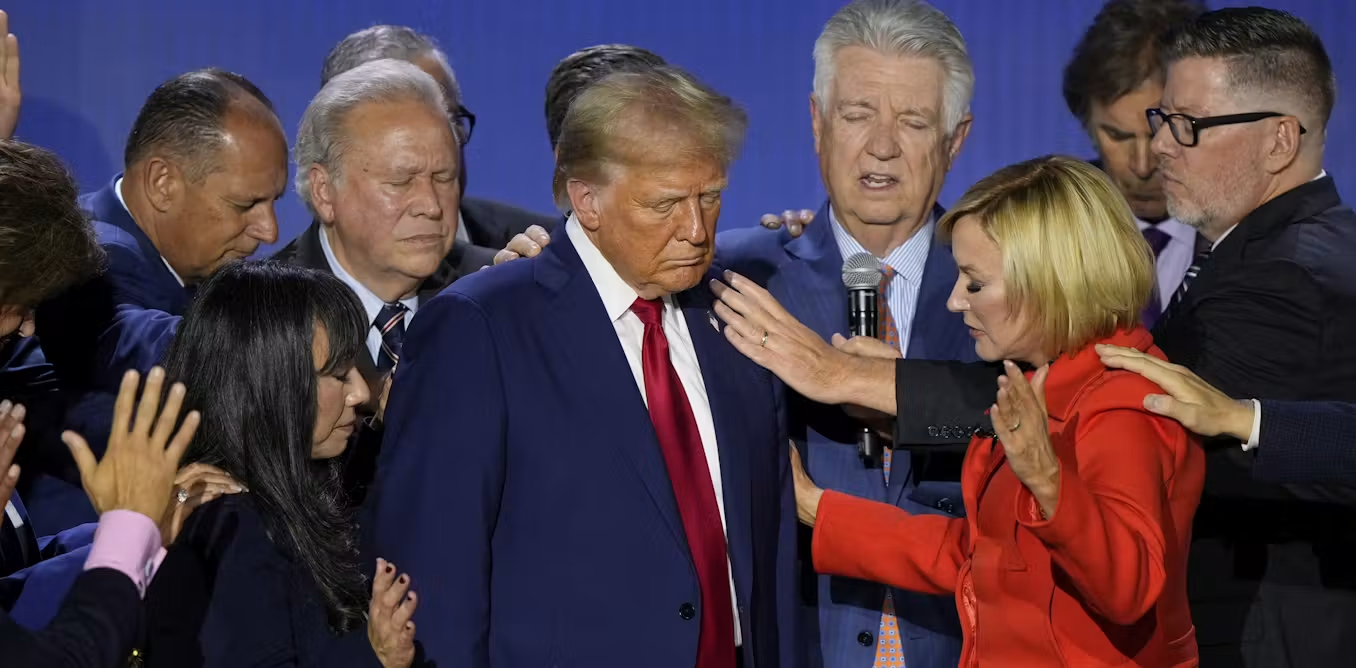
As a result, U.S. President Donald Trump is in urgent need of reliable support for the war effort. A group known as Christian Zionists consistently shows strong backing for his military actions.

(AP Photo/Jacquelyn Martin)
Foremost among these supporters are those who gathered for the Christians United for Israel (CUFI) annual conference recently held in Washington, D.C.
Led by the firebrand pastor John Hagee, CUFI has established itself as one of the most powerful lobbying groups within the Republican Party. With a membership of 10 million, it stands as one of Trump’s most reliable bases of support, particularly in terms of his war efforts.
At the recent conference attended by thousands of fervent supporters of close American-Israeli ties, as well as the Israeli ambassador to the U.S., Hagee opened the conference’s night to honour Israel event with the following statement about the Iranian regime:
“The issue is whether a regime that sponsors terror and threatens Israel should be permitted to exist… Israel has the right to stop a nuclear sword from being placed over the neck of the Jewish people.”
Dispensationalists, evangelicals
The doctoral project of one of the authors of this article, Jason Piché, focuses on Christian Zionism, dispensationalism and their impact on U.S. foreign policy. Dispensations are seen as distinct periods in history, believed to be ordained by God to govern and organize the affairs of the world. Dispensationalism functions both as a method for interpreting the Bible and as a framework for understanding its history.
Co-author André Gagné’s 2024 book American Evangelicals for Trump: Dominion, Spiritual Warfare and End Times addresses the role of American evangelicals in U.S. politics.
Christian organizations like CUFI exist solely to fervently support Israel. Yet Christian Zionism has been a crucial aspect of some American Protestant groups since the late 19th century, and its influence has only increased since the creation of the state of Israel in 1948.
Christian Zionism began in tandem with a theological idea known as premillennial dispensationalism in the mid-19th century.

(Palais Eynard à Genève)
During a tour of the U.S., Bible scholar John Nelson Darby promoted the belief that God had divided the history of the world into seven dispensations. The final dispensation, according to Darby, would see the return of Jesus Christ and the beginning of his millennial reign.
Darby believed that Jewish people would play a crucial role in this final dispensation, as Jesus’s return could only occur if the Jews reclaimed their traditional homeland in Palestine and built a Third Temple.
Christian Zionists and dispensationalists have therefore become strong supporters of the state of Israel, viewing its security as being a fundamental aspect of their theology. As a result, they support joint Israeli-U.S. military operations against Iran and believe that America should take steps to promote Israeli interests in the region.
Read more:
When war looks like prophecy: How U.S. ‘end time’ narratives frame the war with Iran
Christian Zionism and U.S. foreign policy
Trump recently announced that negotiations with the Islamic Republic of Iran have resumed, which initially led to some pause in hostilities between the two countries. Now, Trump says the U.S. is only “semi-negotiating” with Iran.
For his Christian Zionist supporters, however, negotiations with the Islamic Republic pose an existential threat to Israel and, consequently, to American interests. During the recent CUFI Israel event, prominent pastor Russell Johnson expressed these concerns and was met with thunderous applause from the crowd:
“That is why I must say to our very own political leaders, finish the job! … Israel should not be restrained from permanently removing an existential threat simply because diplomats want a ceremony and politicians want a headline. If you want America to be strong and to be free, America must remain a friend to Israel.”
For Trump’s most loyal supporters, the American-Israeli war with Iran is seen as an existential struggle that encompasses both material and spiritual dimensions.
They believe the U.S. and Israel must neutralize Iran to guarantee Israel’s long-term security. Such actions not only empower Israel and solidify its position within the dispensationalist framework of the end times, but also benefit America, as they believe it aligns with God’s promise in Genesis 12:3 to bless those who support his covenant people.
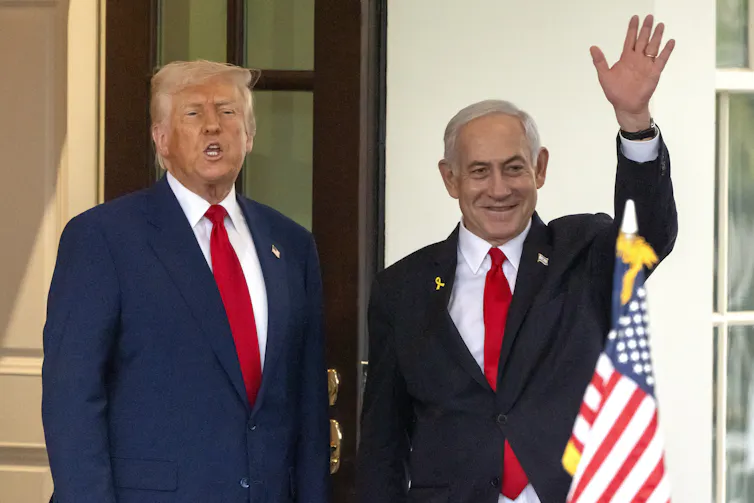
(AP Photo/Mark Schiefelbein)
Trump’s conundrum
Trump is in a difficult position. With an approval rating of merely 38 per cent, ending the war could alienate his most ardent supporters, while continuing it could further distance him from the majority of Americans who disapprove of the conflict.
His approach of vacillating between largely inconsequential airstrikes, cataclysmic threats and unsuccessful peace negotiations is unlikely to satisfy any of his key constituencies.
What is clear is that if he decides to escalate the war, Christian Zionists will be at the forefront of those supporting him.