Key Points
Elon Musk and Jamie Dimon are two of the most famous business leaders in the world.
Musk runs Tesla (NASDAQ: TSLA) and Space Exploration Technologies Corp. and is viewed as one of the most innovative founders developing technologies that could one day save the planet.
Missed Nvidia in 2009? This Rare Signal Is Flashing Again. In 2009, a “Double Down” signal flashed for a little-known chipmaker called Nvidia. For the first time in years, that same “Total Conviction” signal is flashing for a company 1/100th the size of Nvidia. Continue »
Dimon, on the other hand, runs the U.S.’s largest bank, JPMorgan Chase (NYSE: JPM), and is lauded for his years of experience and wisdom. He successfully steered JPMorgan through the Great Recession and the COVID-19 pandemic and continues to deliver solid returns for investors.
Has Tesla or JPMorgan Chase stock performed better during the past five years and which should you buy today?
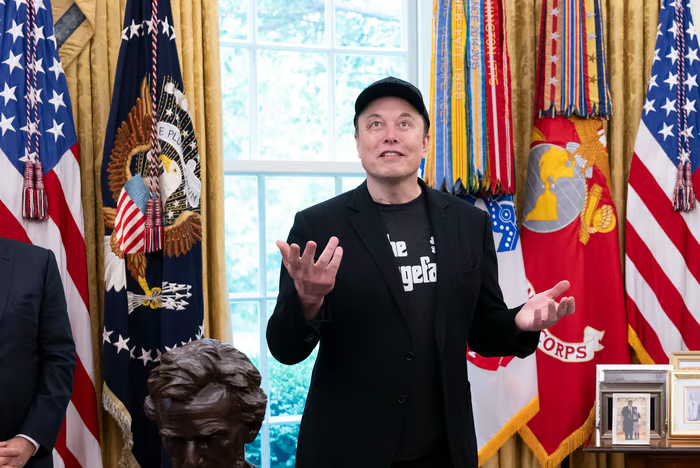
Image source: The White House.
Two different businesses on two different paths
Investors should understand that Tesla and JPMorgan are two very different businesses.
Tesla, although now one of the world’s largest companies, still operates as a high-growth, artificial intelligence-driven company. Sure, the company’s electric vehicle business is mature, but its valuation now depends more on its emerging self-driving robotaxi fleet and future humanoid robotics business.
Both of these businesses are still developing, and Tesla is as strongly positioned as anyone to hit these markets first.
But I still think they are show-me stories right now. The market believes they now have a credible path not only to bringing these products to market but also to quickly grabbing significant market share.
JPMorgan Chase is an entirely different animal. It’s a traditional blue chip stock, not only operating a mature business but also in a mature industry.
JPMorgan will certainly be able to leverage artificial intelligence (AI) to make its operations more efficient, but at the end of the day, large banks are heavily regulated, and their returns are somewhat constrained by the need to maintain regulatory capital.
Furthermore, JPMorgan is too big to go on an acquisition spree because it already controls more than 10% U.S. deposit market share, a regulatory limit that means the company isn’t allowed to buy other banks. So growth must be organic.
However, JPMorgan continues to put up industry-leading returns quarter after quarter. During its last five quarters, JPMorgan has only once generated a return on tangible common equity (ROTCE) of less than 20%. Management has forecast a long-term 17% ROTCE through the cycle.
Furthermore, JPMorgan returns substantial capital to shareholders through stock buybacks and a growing dividend.
Which has generated a better return for investors during the past five years?
Tesla is the more popular stock across the market, which is why it may surprise investors to learn that JPMorgan has crushed Tesla stock since mid-2021.

There are a few reasons to explain this. Banks have performed well in recent years.
Part of this may have to do with investors adding some diversification beyond artificial intelligence. The yield curve has also steepened, which is generally favorable for banks that borrow at short-term interest rates and lend at longer maturities.
Additionally, large, too-big-to-fail banks like JPMorgan have done well since the Silicon Valley Bank crisis because the government simply can’t afford for them to fail, leading to an inflow of deposits from businesses worried about deposit runs at smaller banks.
For Tesla, I think it’s simply a matter of investors getting ahead of themselves. The stock trades at an incredible 180 times forward earnings.
Even if you believe Tesla will succeed with robotaxis and humanoid robots, it’s very rare for investors, especially institutional, to essentially assume revenue in new businesses before there is real evidence that it will materialize.
Although robotaxis have launched, many hurdles remain. Humanoid robots have only just begun production. So Tesla still seems like a gamble at this valuation.
Regardless, JPMorgan stock is a good one to own if you are less risk-averse and looking for steady growth and capital returns over time. Tesla is for more aggressive investors with a longer runway ahead. It may turn into a big investment, but it’s no guarantee.
If robotaxis and robots stumble, the shares could get hit hard.
Don’t miss this second chance at a potentially lucrative opportunity
Ever feel like you missed the boat in buying the most successful stocks? Then you’ll want to hear this.
On rare occasions, our expert team of analysts issues a “Double Down” stock recommendation for companies that they think are about to pop. If you’re worried you’ve already missed your chance to invest, now is the best time to buy before it’s too late. And the numbers speak for themselves:
- Nvidia: if you invested $1,000 when we doubled down in 2009, you’d have $564,953!*
- Apple: if you invested $1,000 when we doubled down in 2008, you’d have $60,985!*
- Netflix: if you invested $1,000 when we doubled down in 2004, you’d have $440,710!*
Right now, we’re issuing “Double Down” alerts for three incredible companies, available when you join Stock Advisor, and there may not be another chance like this anytime soon.
*Stock Advisor returns as of September 1, 2026.
JPMorgan Chase is an advertising partner of Motley Fool Money. Bram Berkowitz has no position in any of the stocks mentioned. The Motley Fool has positions in and recommends JPMorgan Chase and Tesla. The Motley Fool has a disclosure policy.