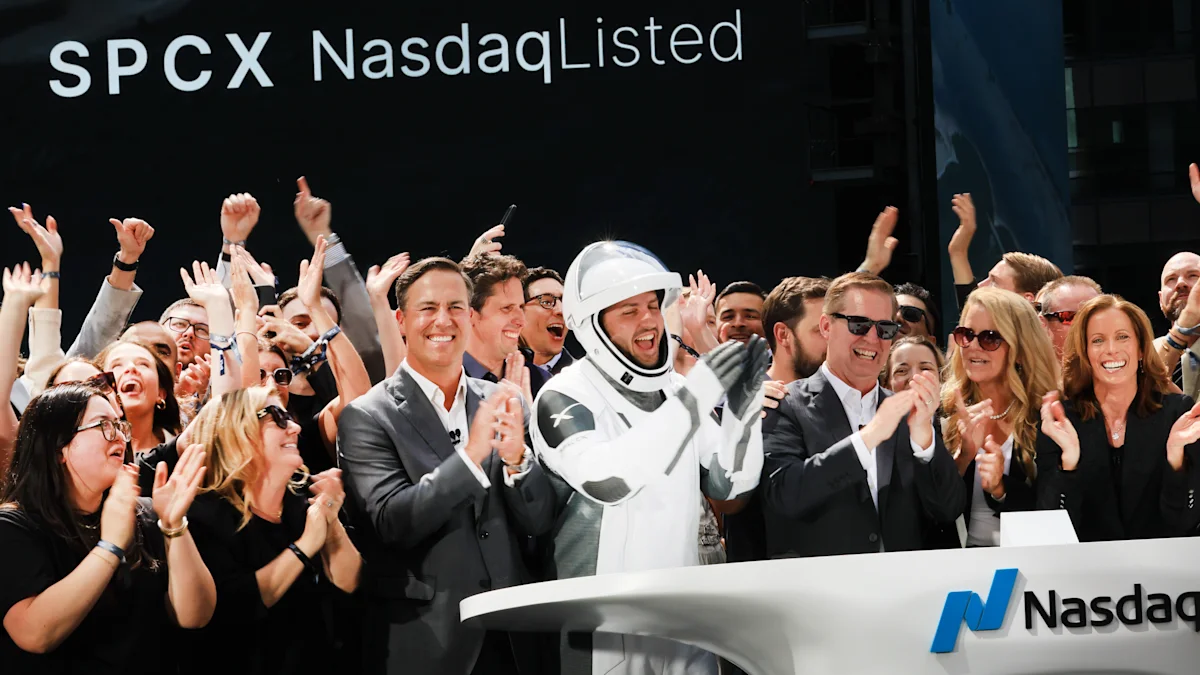
If you asked your brokerage for a piece of the SpaceX initial public offering (IPO) last week, you probably got one, just not the size you were hoping for.
That alone makes this deal strange. On a typical hot IPO, an estimated 95% of the shares go to large institutions such as banks, leaving everyday investors to buy in only after trading opens, often at a higher price (1), according to estimates from Jay Ritter, a University of Florida finance professor who tracks new listings (2).
Must Read
This time, every eligible customer who put in a request through Robinhood, Charles Schwab, Fidelity and SoFi got at least one share of SpaceX’s record $86.2 billion offering (3).
SpaceX set aside up to 30% of the deal for retail investors worldwide — well above the 5-10% (4) that usually reaches individuals (5). But “at least one share” is doing a lot of work in that sentence. Demand for the shares ran past $100 billion, so most retail investors came away with just a handful of shares.
Now that the stock has popped, many investors may be tempted to buy more on the open market. Whether that’s smart comes down to a few things first-day buyers tend to skip.
How much retail investors actually got
Robinhood gives the clearest picture. A total of 855,424 of its customers requested shares through its IPO Access platform, and the firm filled every request. That’s small for a brokerage with 27.7 million funded accounts at the end of May, and the people who got in didn’t necessarily get much.
And it wasn’t just in the U.S. In the U.K., retail buyers asked for nearly $1 billion of stock and received about $364 million. In the end, the final retail share was about 20%, so even in an IPO built to be friendly to regular investors, most people walked away with less than they asked for (3).
The price action explains the FOMO. SpaceX priced at $135 a share on Thursday night and opened at $150 on Friday, an 11% jump (6). It rose as much as 30% during the day before closing up 19% at $160.95, valuing the company at about $2.1 trillion (7) — the largest U.S. IPO on record, surpassing Alibaba’s $21 billion debut in 2014 (8). It shot to a new high of 218.76 on Tuesday, June 16, but came back to Earth quickly. As of midday Wednesday, it was trading around $190 and falling.
The 19% closing number isn’t as dramatic as it looks. From 1980 through 2025, new U.S. stocks have popped by an average of 19% on their first day of trading, based on Jay Ritter’s data, so SpaceX’s 19% is right at the historical average (1).
What Jim Cramer says about buying in now
Jim Cramer, host of CNBC’s “Mad Money,” says it’s not too late to buy, but with one condition. Treat SpaceX as “a different kind of stock, not a short- or even medium-term investment,” he said, and “you’ve got my blessing (9).”
Cramer’s only recommending this if you’re buying to hold long-term. “If it comes down, then you should buy more because the upside is conceivably unfathomable,” Cramer said. He also praised lead banks Goldman Sachs and Morgan Stanley for balancing institutional and retail demand and avoiding a messier first-day spike.
The catch is the price you’d pay to follow that advice. Buying now means paying nearly 50% more than IPO investors did, for a company whose prospectus shows a $41.3 billion accumulated deficit and a $4.27 billion loss in the first quarter of this year. A smooth debut doesn’t necessarily mean the stock is cheap.
Read More: About 1 in 5 Americans over 50 has zero retirement savings. Here’s why it’s not too late
What this means for your money
If you got IPO shares and you’re tempted to sell into the jump, read your broker’s fine print first. Robinhood treats a sale within 30 days as “flipping” and can lock you out of its IPO Access program for 60 days (10), and Fidelity flags sales within 15 calendar days, and will ban you permanently after a third flipping (4). SoFi uses 30-day windows too, and it also imposes a permanent ban after a third violation (11).
If you sell too early, you can lose your spot at the next hot listing — like OpenAI and Anthropic, which are both expected to go public soon (12). The one exception is Charles Schwab, which has no anti-flipping rule.
If you want to buy more on the open market, there’s one thing that could help push the price up soon. Nasdaq changed its rules so SpaceX can join the Nasdaq-100 after just 15 trading days instead of waiting the usual three months (13). That means index funds will have to buy SpaceX’s shares, which could bump up the price temporarily. But this is a one-time well-telegraphed event, so it’s not a reason to over-pay. You should also know that S&P declined to fast-track SpaceX in (14) — the S&P 500 won’t admit a company until it’s profitable, and SpaceX saw a net loss of $4.9 billion last year (15).
Cramer’s advice is simple. If you’re willing to hold SpaceX for years and see price drops as a chance to buy more, then it makes sense. But if you’re trying to catch the pop and sell, you’re fighting against both the high price and possibly your broker’s rules.
You May Also Like
Join 250,000+ readers and get Moneywise’s best stories and exclusive interviews first — clear insights curated and delivered weekly. Subscribe now.
Article Sources
We rely only on vetted sources and credible third-party reporting. For details, see our ethics and guidelines.
CNBC (1), (5), (7), (9), (14); University of Florida Warrington College of Business (2); Yahoo Finance UK (3); Fidelity Investments (4); Yahoo Finance (6); Renaissance Capital (8); Robinhood (10); SoFi (11); Reuters (12); Morningstar (13); Wealth Professional Canada (15)
This article originally appeared on Moneywise.com under the title: Elon Musk’s SpaceX has been on a wild ride post-IPO. Should you try to get on?
This article provides information only and should not be construed as advice. It is provided without warranty of any kind.