If spending 13 hours on a plane to get to Hong Kong sounds like too much of an ordeal, do we have some good news for you.
A megarocket by Elon Musk is promising future travellers that it can soar some 6,000 miles to the city from London in just 34 minutes.
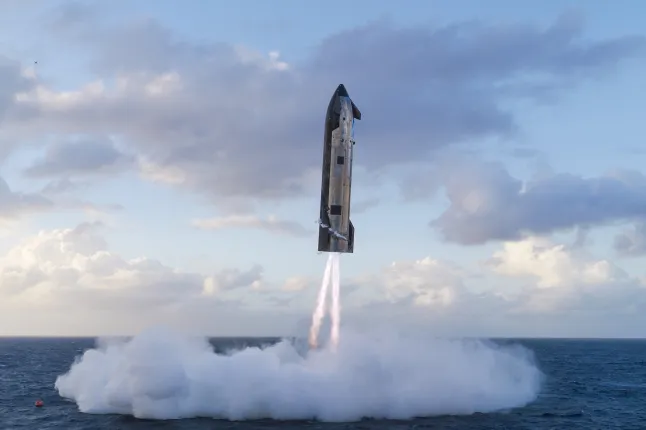
Starship V3, by the billionaire’s rocket company SpaceX, exploded at the end of the model’s 12th test flight over the Indian Ocean on Friday.
Unlike some of the company’s previous launches, this explosion was very much planned – it was part of its controlled splashdown.
Towering at 408 feet, Starship is the largest and most powerful rocket ever built, and the launch saw it travel halfway across the world from Texas.
The giant rocket was meant to lift off on Thursday but was postponed when a technical glitch happened only 40 seconds left on the countdown.

Just before it was coated in pink, gooey plasma on re-entry, the ship released 22 dummy Starlink satellites.
Musk described it as an ‘epic’ hour-long trip. ‘You scored a goal for humanity,’ he told his team via his social media platform, X.
While Starship is part of the Tesla owner’s ambitions to get humanity to Mars, it’s long been touted as Earthly transport more than anything.
SpaceX president Gwynne Shotwell compared it to a hypersonic aeroplane that could make journeys like New York to Paris in 30 minutes.
Starship’s Earth-to-Earth journeys would involve visiting low Earth orbit, the part of the sky that’s 1,200 miles above your head.
The rocket is made up of two chunks: an upper-stage craft where passengers would sit inside, called Ship, and a powerful booster stage with 33 engines, known as the Super Heavy.
Starship is meant to be reusable – giant mechanical arms at the launch pads catch the returning rocket stages.
Yet the rocket has suffered multiple setbacks. In January 2025, during the seventh test, the older Starship V2 disintegrated as it headed into space.
The eight trial runs failed, the ninth ended with yet more disintegration, this time raining down wreckage over the Atlantic after re-entry.
In a post on its website, SpaceX said it has upgraded the towering rocket’s Raptor engine, thermal protection and even plumbing.

But even the company knows that offering people one-hour journeys to one side of the world and back is a tall order.
In stock launch documents filed on Wednesday, SpaceX said that ‘restrictions on supersonic flights over land in certain regions due to sonic booms, and the economic feasibility of shorter routes’ are the biggest challenges.
Still, it insisted: ‘We believe we are strategically positioned to take share of the terrestrial logistics and transportation market.’
Get in touch with our news team by emailing us at webnews@metro.co.uk.
For more stories like this, check our news page.
MORE: Elon Musk ‘backs Restore Britain’ as party vows to ‘destroy establishment’
MORE: Donald Trump and Elon Musk reunited during China summit with world’s tech CEOs
MORE: Major solar flare to ‘brush past’ Earth tomorrow – could it cause power outages?