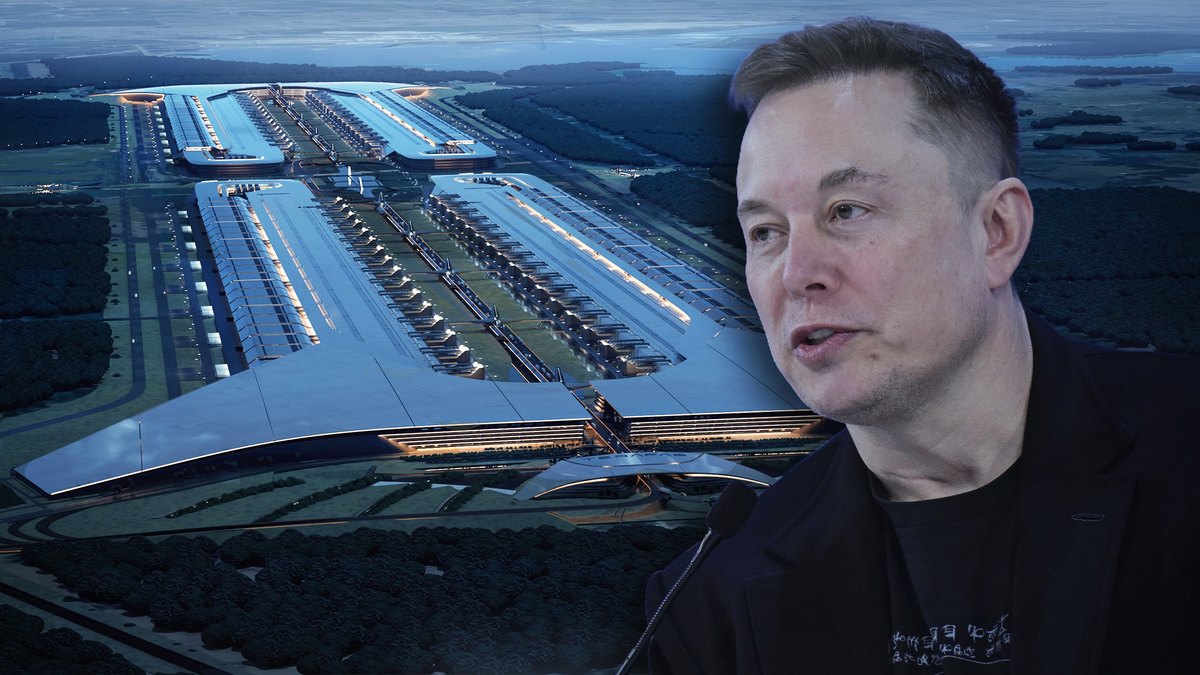
Elon Musk has never been shy about his ambition. The trillionaire SpaceX and Tesla CEO’s latest project, Terafab, aims to be the largest building on the planet—a semiconductor fabrication center that Musk describes as “a chip factory built for Earth and orbit.” But neighbors of the project in Grimes County, TX, are not happy about it.
The Terafab factory would supply chips for Musk’s self-driving cars and Optimus robots, and the complex would also include “natural gas-fired power plants, and artificial intelligence facilities to be used in conjunction with the manufacturing process,” according to a tax abatement agreement the firm signed with Grimes County.
Musk touted his plan to build the 100-million-square-foot facility on X earlier this month, calling it “the largest and most valuable building on Earth by far.” For comparison, the average Target or Costco store is the size as 2.5 football fields. Musk’s plant would be equivalent to 2,300 football fields.
Meanwhile, residents of Grimes County are concerned about the impact such a massive project will have on their community. They’ve formed the Grimes County Citizens for Responsible Development (GCCRD) to make sure their concerns are heard.
Headed by Marie Egyed, the GCCRD aims to hold Musk and others accountable for their large-scale development projects in the area.
Grimes County, with a population of about 30,000, is about 100 miles east of Austin and 70 miles northwest of Houston. Egyed moved to Grimes County from Houston eight years ago with the aim of “trying to live out a nice, peaceful rural life.”
She says she learned about Musk’s Terafab plans in March after attending a local council meeting.
“They put on the agenda that they were going to discuss a conversation that the mayor had with the county judge and a developer of a possible data center going to our area,” she says.
Less than two months later, says Egyed, Musk announced he wanted to put a semiconductor manufacturing facility in the area—and not just any facility, but the largest factory ever built.
Last week, Texas Gov. Greg Abbott lauded the project as a “significant expansion of [Musk’s] advancement in our great state” and praised its promise to bring about 3,000 jobs to the county. That same week, Abbott halted new data center approvals, calling for an audit of data center impact on the Texas power grid.
Musk already has a strong footprint in Texas. SpaceX’s flagship testing site is in Boca Chica, and Tesla’s corporate headquarters, known as Giga, is located in Austin. Musk’s drilling company, The Boring Company, is based in Bastrop.
In Boca Chica, a group of residents has sued SpaceX, claiming the company’s rocket launches have cracked their homes’ foundations and caused structural issues. The environmental nonprofit Surfrider Foundation also filed a lawsuit against the Federal Aviation Administration, alleging that the FAA failed to properly assess the Boca Chica facility’s environmental impact on the local ecosystem.
In Grimes County, Egyed says she’s aware it’s no longer possible to stop the project from going forward—and she and many others are not intrinsically against development in the community. They just want proper oversight and transparency—and a seat at the table.
“We’re not going to stop it. But maybe we can minimize the negative impact,” she says. “We are going into an era where the corporations are more powerful than the government. We are seeing that transition right now.”
The GCCRD has put forth a 12-point initiative of “areas that we want our county to instill absolute, measurable protections for any data center or related infrastructure that comes to our county,” says Egyed.
“It’s protecting our water, our EMS, our roads. Also protecting our county by making sure that our county has adequate legal representation when sitting across the table and negotiating with companies like SpaceX.”
Egyed says that while the project is being touted as an economic boon for the community, she and others are concerned about how it’ll affect the cost of living and quality of life in Grimes County.
Musk has already begun clearing land in the area, prompting some residents to make difficult decisions about whether they’ll stay or go.
Danny Cross has lived in the county for 22 years. His 31-acre property abuts the Terafab site and shares about 4,000 feet of fence with Musk’s land. As he’s watched the clearing take place over the past several weeks, Cross and his wife have made the difficult decision to sell their home.
“We were building what we thought was our forever house,” he told local news station KTBX. “Money doesn’t replace that, those memories, you know?”
Egyed believes that many of her neighbors are weighing a similar choice. They don’t want to leave, but they’re not happy with the direction the community is headed.
“All of us are going to have to deal with the traffic, the road construction, the thousands of construction workers that will converge on our area. The RV parks, you know, the gas stations that are going to have to go up, all the changes that we are going to endure, not to mention the people who have to sell because they can’t stay where they’re at.
“What about our dreams?” Egyed asked. “We saved up our entire lives to buy this property out here to live out in the country.”