Key Points
Elon Musk has been one of the biggest sources of good news for Nvidia (NASDAQ: NVDA) investors in recent months, and that continued on Friday (Sept. 25). In a post on his “X” platform, formerly Twitter, Musk gave an update on Colossus 2, SpaceX’s (NASDAQ: SPCX) xAI unit’s artificial intelligence (AI) computing cluster. He said the massive AI training supercomputer could double the number of Nvidia graphics processing units (GPUs) deployed by year-end.
In the post, Musk noted that Colossus 2 currently has 110,000 Nvidia GB200 chips and 440,000 GB300s. An additional 220,000 GB300 chips are set to come online next week, with another 220,000 GPUs set for November. He added that he hopes to get another 220,000 GB300s in late December, “if we get lucky.”
Missed AI’s “Act 1”? Act 2 Could Be 15x Bigger. Most investors think they missed the AI boat because they didn’t buy Nvidia in 2005. But according to our analysts, we’re only at the end of “Act 1″—the R&D phase. “Act 2” is the global rollout. Continue »
SpaceX’s original goal was to scale to 1 million GPUs by the end of 2026, so it looks like it will surpass this if the orders are completed. According to reports, xAI spent around $18 billion on its initial 550,000 GPUs. This order could be worth even more given that it consists of more of its newer GB300 GPUs.
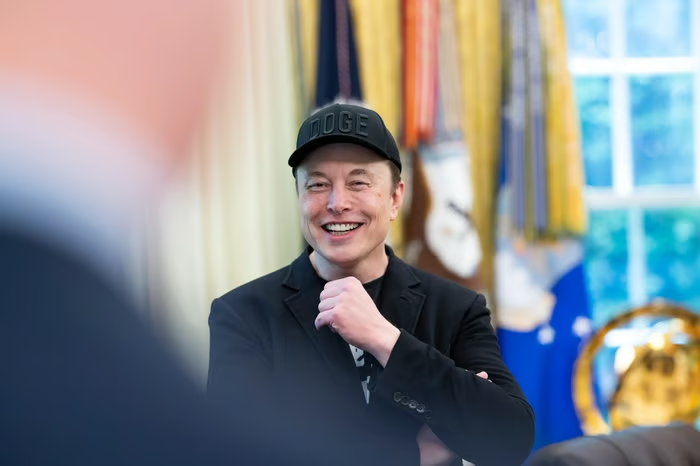
Image source: Getty Images.
Nvidia and SpaceX are becoming close partners
This update follows comments from Elon Musk earlier this month that SpaceX would exclusively use Nvidia chips moving forward. The Tesla and SpaceX CEO called Nvidia’s Vera Rubin platform the best architecture out there and said it valued its partnership with the chipmaker. At the time, Musk said SpaceX would end the year with around 2 gigawatts of computing power, while it is looking to end 2027 with closer to 10 gigawatts than 5 gigawatts. One gigawatt of compute power costs about $50 billion to $60 billion, with chips and other Nvidia components making up about $35 billion of that total cost.
In addition to helping expand xAI’s computing capacity, Nvidia and SpaceX also announced a partnership to develop GPUs for the company’s planned future orbital data centers. Cosmic radiation can affect current chips, flipping bits from a 0 to a 1 or vice versa, causing significant computational errors. Worst of all, there is currently no way to flip it back, and it’s difficult to detect without a redundant system to check it against. In a post on X, Musk said the two companies have designed a Vera Rubin NVL72 system optimized for use in space. It plans to launch the system into orbit toward the end of 2027 and then start scaling it in 2028.
Is Nvidia stock a buy?
SpaceX has some of the biggest ambitions in the entire AI sector, so having it as an anchor customer that exclusively uses its chips is a major coup for Nvidia. And of course, Nvidia’s strengths extend well beyond SpaceX and its budding relationship with Musk.
While competition is increasing, particularly in the inference market, Nvidia remains the dominant player in AI infrastructure. Its GPUs are the primary chips used in AI model training, and its CUDA software platform still provides a wide moat in this area. Meanwhile, the company’s acquisition of “Groq” and its language processing unit (LPU) technology, which it has incorporated into its CUDA ecosystem, gives it a high-end differentiated approach to the fast-growing inference market.
Its ARM-based Vera CPUs are also gaining strong traction with agentic AI. In August, Nvidia announced that SpaceX will use its Vera central processing units (CPUs) for its agentic AI workloads. While the CPU market isn’t nearly as large as the GPU market, this is still another nice win.
Nvidia is no longer just a GPU company, but a complete AI infrastructure provider that is also starting to stack on some important software layers following acquisitions of SchedMD and Hugging Face (pending). With the stock trading at a forward price-to-earnings ratio of just 14 times fiscal 2028 (ending January 2028), Nvidia is a buy.
Should you buy stock in Nvidia right now?
Before you buy stock in Nvidia, consider this:
The Motley Fool Stock Advisor analyst team just identified what they believe are the 10 best stocks for investors to buy now… and Nvidia wasn’t one of them. The 10 stocks that made the cut could produce monster returns in the coming years.
Consider when Netflix made this list on December 17, 2004… if you invested $1,000 at the time of our recommendation, you’d have $383,680!* Or when Nvidia made this list on April 15, 2005… if you invested $1,000 at the time of our recommendation, you’d have $1,382,954!*
Now, it’s worth noting Stock Advisor’s total average return is 937% — a market-crushing outperformance compared to 214% for the S&P 500. Don’t miss the latest top 10 list, available with Stock Advisor, and join an investing community built by individual investors for individual investors.
*Stock Advisor returns as of September 27, 2026.
Geoffrey Seiler has no position in any of the stocks mentioned. The Motley Fool has positions in and recommends Arm Holdings, Nvidia, and Tesla. The Motley Fool has a disclosure policy.