Key Points
-
Although Elon Musk hasn’t indicated it’s inevitable, he certainly hasn’t ruled the possibility out.
-
Musk-led SpaceX and Tesla are both already working together on multiple fronts.
-
Since the stocks have a great deal of overlap in ownership, any buyout-based merger isn’t likely to occur at a premium price.
- 10 stocks we like better than Space Exploration Technologies ›
Anybody who’s been wondering if electric vehicle maker Tesla (NASDAQ: TSLA) will merge with Space Exploration Technologies (NASDAQ: SPCX) — better known as SpaceX — is still wondering. The question has been posed several times, and when CEO (of both companies) Elon Musk was asked earlier this month at the All-In Summit of influential thinkers, founders, and business leaders, he replied, “Who can imagine what action one might take when there’s so much close collaboration [between the two companies] in so many areas.”
That answer, or lack thereof, speaks volumes. Somehow, it leans in the direction of “yes,” or at least “more likely sooner than later.”
Missed AI’s “Act 1”? Act 2 Could Be 15x Bigger. Most investors think they missed the AI boat because they didn’t buy Nvidia in 2005. But according to our analysts, we’re only at the end of “Act 1″—the R&D phase. “Act 2” is the global rollout. Continue »
Here’s what shareholders should do in the meantime.
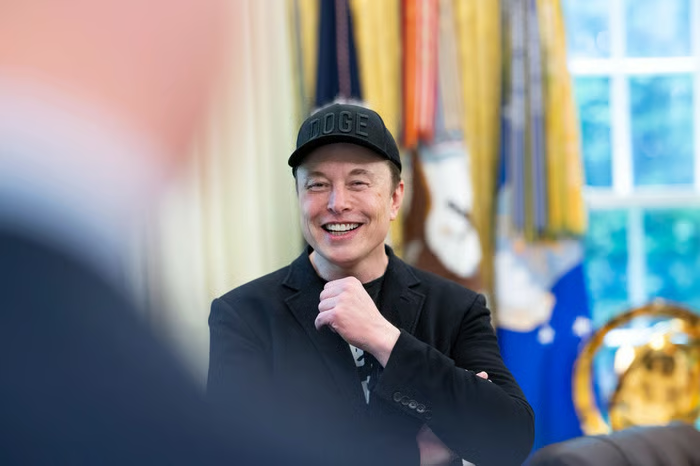
Tesla and SpaceX CEO Elon Musk. Image source: The White House.
The lines between Tesla and SpaceX are already blurred
There’s the Tesla you know. That’s the maker of electric vehicles.
That’s far from all that Tesla is, however. Solar panels and battery storage are also profit centers. The company’s Cybercab robotaxi business is also showing promise, with its fleet recently surpassing 1 million miles of unsupervised, fully autonomous driving. Although the service is only offered in Austin, Texas, right now, expansion should come quick.
Perhaps the most notable venture that Tesla is working on, though, is the one that Musk suggests could be “the biggest product ever.” That’s its AI-controlled humanoid robot called Optimus, capable of handling a variety of household chores and other physical tasks. He still contends these robots could be mass-produced and mass-delivered by the end of next year.
As for SpaceX, it, too, is so much more than an orbital launch service provider. SpaceX also owns X (formerly Twitter), which means it also developed X’s built-in artificial intelligence assistant, called Grok. This is the company that’s also behind satellite-based broadband service Starlink, which is currently supported by more than 11,000 orbiting satellites.
As for the collaborations Musk was referencing, the most important one right now is a microchip foundry called Terafab, which will serve both Tesla and SpaceX. That being said, Starlink-connected Cybercabs, the use of Tesla-made battery-storage tech at SpaceX facilities, and the co-development of artificial intelligence capabilities are all on the table if not already underway. Somehow Tesla’s solar panel know-how seems to factor in with Musk’s vision of putting people on the moon — or even Mars — as well.
Connect the dots. These two companies are very familiar with each other. A pairing could be relatively seamless.
Doing nothing is also a choice
Great. But, what (if anything) does this mean current shareholders of either or both outfits should do now?
The answer is a decisive “nothing.”
Don’t misunderstand. Merging these two companies would clearly change both. Not merging these two companies could also affect the prices of both stocks. Speculation about the matter in the meantime is also pushing and/or pulling on investors’ perceptions of these two distinct organizations.
Just don’t attempt to predict what might happen. The fact is, nobody knows what these two companies’ futures hold.
And this touches on an important reality all investors should embrace. That is, you should never own a particular stock just because you feel it’s an acquisition candidate. It may well be. But the market tends to predict far more buyouts than ever actually materialize.
Rather, you should own a stock first and foremost because the underlying company is one with proven and promising growth and/or income prospects. If it’s worth owning for that reason, a potential suitor may well eventually make a bid. If not, it’s unlikely another company will be interested enough to make an acquisition.
In either scenario, though, you can still never truly predict how such things will pan out. The only thing you can control is your decision to own a company, which should strictly be based on its long-term potential. Or as Warren Buffett brilliantly put it, “Only buy something that you’d be perfectly happy to hold if the market shut down for 10 years.”
Nothing to speculate about
It’s an admittedly unsatisfactory situation for some. Nevertheless, that’s arguably the best answer.
If you’re simply unable to avoid taking some sort of speculative action on a tie-up between these two companies, though, consider this: It’s unlikely one company would be making a bid at a premium price for the other. Not only does Musk lead both, but the major shareholders of one are also apt to be significant shareholders of the other. There’s no need or interest in a premium for one at the expense of the other. Indeed, with Musk effectively in control of both companies’ boards of directors, he could easily meld the two organizations into one regardless of either company’s stock price. In many respects, it’s already happened, which is certainly reflected in their respective stock prices.
In other words, if you like SpaceX, own SPCX shares. If you like Tesla, own a stake in TSLA. Feel free to own both, too. Just don’t get distracted by the complicated and confusing buyout prediction game. Nobody knows how that might end, and speculating how you think it could will usually do you more harm than good.
Should you buy stock in Space Exploration Technologies right now?
Before you buy stock in Space Exploration Technologies, consider this:
The Motley Fool Stock Advisor analyst team just identified what they believe are the 10 best stocks for investors to buy now… and Space Exploration Technologies wasn’t one of them. The 10 stocks that made the cut could produce monster returns in the coming years.
Consider when Netflix made this list on December 17, 2004… if you invested $1,000 at the time of our recommendation, you’d have $384,839!* Or when Nvidia made this list on April 15, 2005… if you invested $1,000 at the time of our recommendation, you’d have $1,385,657!*
Now, it’s worth noting Stock Advisor’s total average return is 936% — a market-crushing outperformance compared to 213% for the S&P 500. Don’t miss the latest top 10 list, available with Stock Advisor, and join an investing community built by individual investors for individual investors.
*Stock Advisor returns as of September 24, 2026.
James Brumley has no position in any of the stocks mentioned. The Motley Fool has positions in and recommends Tesla. The Motley Fool has a disclosure policy.