Electric Vehicle Supply Equipment Market Size
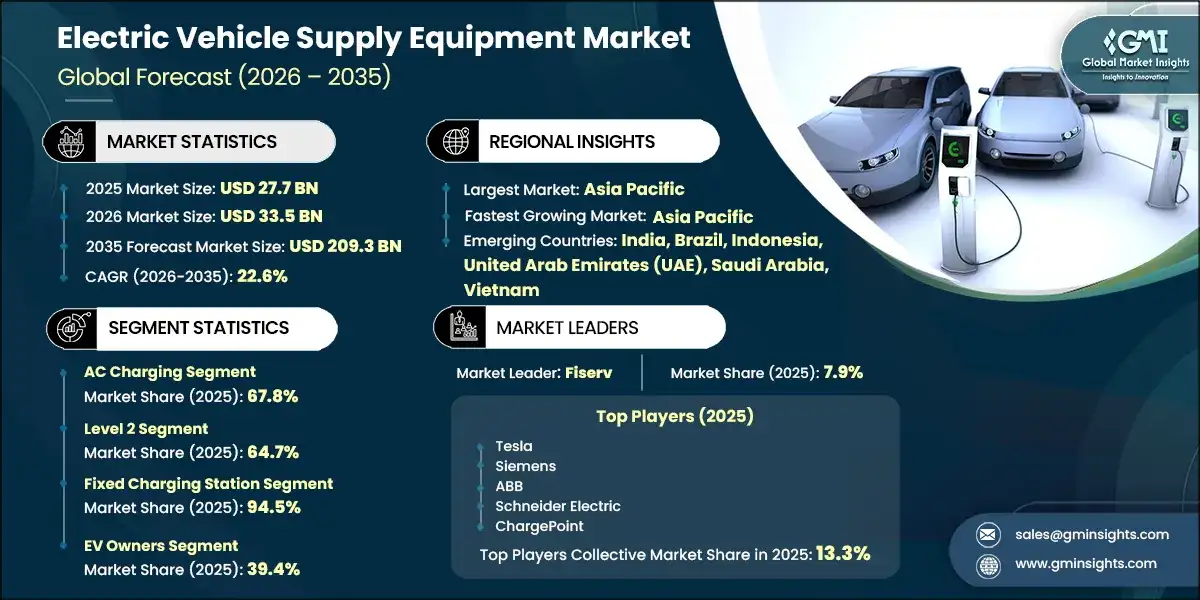
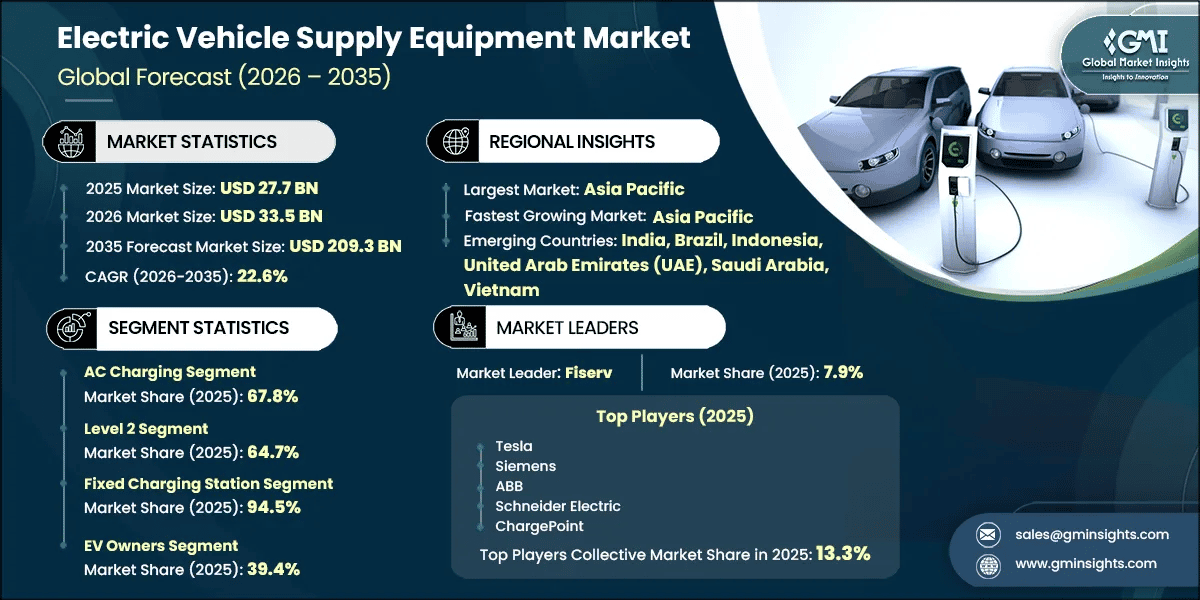
The global electric vehicle supply equipment market was estimated at USD 27.7 billion in 2025. The market is expected to grow from USD 33.5 billion in 2026 to USD 209.3 billion in 2035, at a CAGR of 22.6% according to latest report published by Global Market Insights Inc.
Electric Vehicle Supply Equipment Market Key Takeaways
2025 Market Size
$ 27.7 Billion
2026 Market Size
$ 33.5 Billion
2035 Forecast Market Size
$ 209.3 Billion
Regional Dominance
Largest Market
Asia Pacific
Fastest Growing Region
Asia Pacific
Key Players
-
Market Leader: Fiserv led with over 7.9% market share in 2025.
-
Leading Players: Top 5 players in this market include Tesla, Siemens, ABB, Schneider Electric, ChargePoint, which collectively held a market share of 13.3% in 2025.
Key Market Drivers
- Rising EV Adoption and Electrification of Transportation
- Government Incentives and Supportive Charging Infrastructure Policies
- Expansion of Public and Highway Fast-Charging Networks
Opportunity
- Expansion into Emerging and Developing EV Markets
- Integration of Renewable Energy with Charging Infrastructure
Challenges
- High Installation and Infrastructure Development Costs
- Grid Capacity Limitations and Power Distribution Challenges
Get Market Insights & Growth Opportunities
Download Free PDF
The market is being driven by the accelerating adoption of electric vehicles (EVs), expanding government incentives for clean transportation, and the rapid development of charging infrastructure across residential, commercial, and public environments. This baseline growth is further supported by the global push toward decarbonization, stricter emissions regulations, and the increasing investments from utilities, automakers, and energy companies in large-scale charging networks.
EVSE enables the delivery of electricity from the grid to electric vehicles through hardware and software systems such as AC chargers, DC fast chargers, charging stations, and network management platforms. This infrastructure allows EV owners and fleet operators to charge vehicles conveniently at home, workplaces, retail locations, and highway corridors. As a result, companies are rapidly deploying EV charging solutions to reduce range anxiety, improve accessibility, and support the mainstream adoption of electric mobility.
The increasing integration of smart charging and connected infrastructure is a key growth driver of the EVSE market. Businesses and operators are incorporating features such as mobile app-based charging, remote monitoring, dynamic pricing, and energy load balancing into charging networks. This trend is particularly strong in urban mobility, logistics fleets, and retail destinations, where EV charging is becoming a value-added service and competitive differentiator. The growing demand for reliable and fast charging, especially DC fast charging along highways and commercial hubs, is further accelerating infrastructure deployment.
Leading EV charging ecosystem players such as ChargePoint, Tesla, and ABB are expanding their charging networks and hardware capabilities globally. At the same time, utilities and oil-and-gas companies are entering the market through strategic partnerships and acquisitions, intensifying competition and improving infrastructure coverage. However, high installation costs, grid capacity constraints, and standardization challenges remain key considerations for large-scale deployment.
To get key market trends
Download Free PDF
Electric Vehicle Supply Equipment Market Trends
The EVSE market is increasingly focused on deploying fast and ultra-fast charging solutions to reduce vehicle downtime and improve user convenience. This shift is essential for supporting long-distance travel and accelerating mainstream EV adoption. Charging operators are prioritizing high-capacity stations along highways, urban centers, and commercial hubs. As charging speeds improve, consumer confidence in electric vehicles continues to strengthen.
A key trend is the integration of EV charging infrastructure with smart grid technologies to optimize electricity distribution. This includes dynamic load management, real-time monitoring, and demand-response capabilities. Such integration helps balance energy consumption during peak hours and improves overall grid stability. It also enables better coordination between renewable energy sources and charging demand.
There is rapid growth in public charging infrastructure across residential, commercial, and transportation corridors. Governments and private players are heavily investing in expanding access to charging stations to support EV adoption. At the same time, fleet operators in logistics, mobility, and delivery services are transitioning to electric vehicles, increasing demand for dedicated charging solutions. This dual expansion is making EV charging more widely available and operationally critical.
The EVSE market is evolving into a software-enabled ecosystem where digital platforms play a central role. Charging networks are increasingly using cloud-based systems for monitoring, billing, and maintenance. Interoperability between different charging networks is also improving through standardized communication protocols. This is enhancing user experience by enabling seamless access to multiple charging points through unified platforms.
Electric Vehicle Supply Equipment Market Analysis
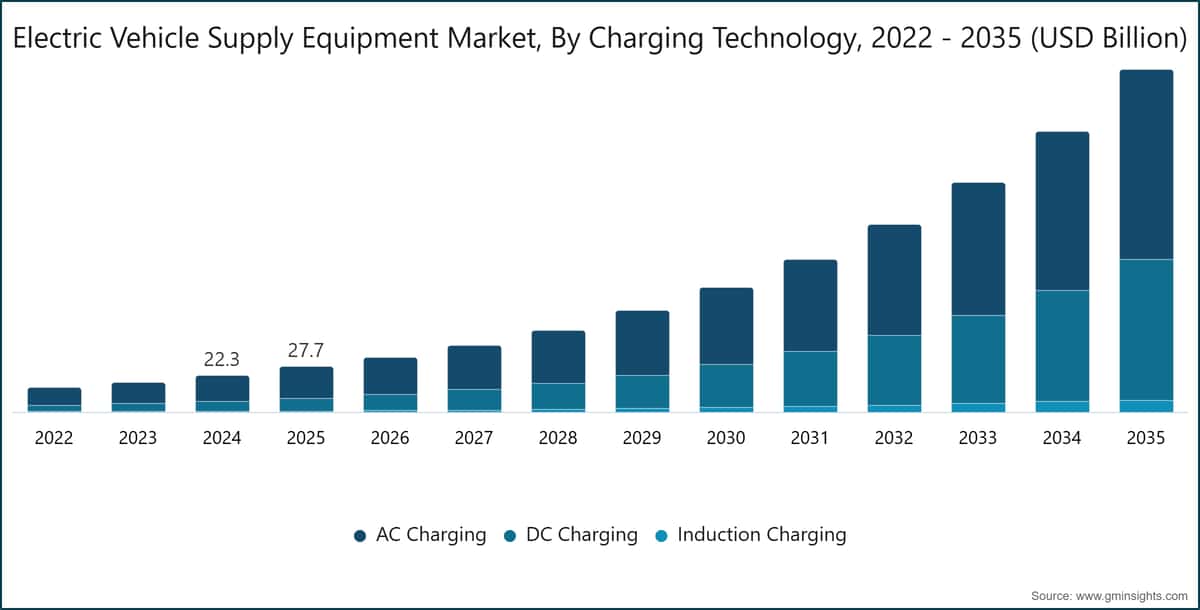
Based on charging technology, the electric vehicle supply equipment market is segmented into AC charging, DC fast charging, and inductive charging. The AC segment dominates the market with 67.8% share in 2025, and the segment is expected to grow at a CAGR of 19.9% from 2026 to 2035.
- The DC fast charging segment holds the largest market share due to its ability to deliver high-power charging in a significantly shorter time compared to other technologies. It is widely deployed along highways, commercial hubs, and high-traffic urban areas where quick turnaround is essential. The growing need for long-distance EV travel and fleet electrification is further strengthening its dominance.
- The AC segment accounted for the majority of EVSE installations in North America, Europe, and residential-led markets in Asia Pacific through 2025, reflecting the cost efficiency and grid compatibility of AC charging hardware for standard behind-the-meter installation scenarios.[1] It is considered a convenient option for overnight charging where charging speed is less critical. However, its slower charging rate limits its use in high-demand commercial environments.
- Inductive charging, though still emerging, is gaining attention as a contactless and highly convenient charging method. The SAE J2954 standard, published by SAE International and adopted across major automotive OEM programs, defines interoperability requirements for wireless EV charging at power levels from 3.7 kW (WPT1) through 22 kW (WPT4) for passenger vehicles, with higher power classifications under development for commercial vehicle and heavy-duty fleet applications.[2] It eliminates the need for physical connectors, enabling automated and user-friendly charging experiences. The technology is being explored for applications in public transport systems and smart mobility solutions. However, high cost and efficiency limitations currently restrict its large-scale adoption.
- The overall market growth across all charging technologies is being supported by increasing investments in charging infrastructure and advancements in power electronics. While DC fast charging leads in deployment, AC charging continues to serve foundational needs, and inductive charging represents a future-oriented innovation segment with long-term potential.
Learn more about the key segments shaping this market
Download Free PDF
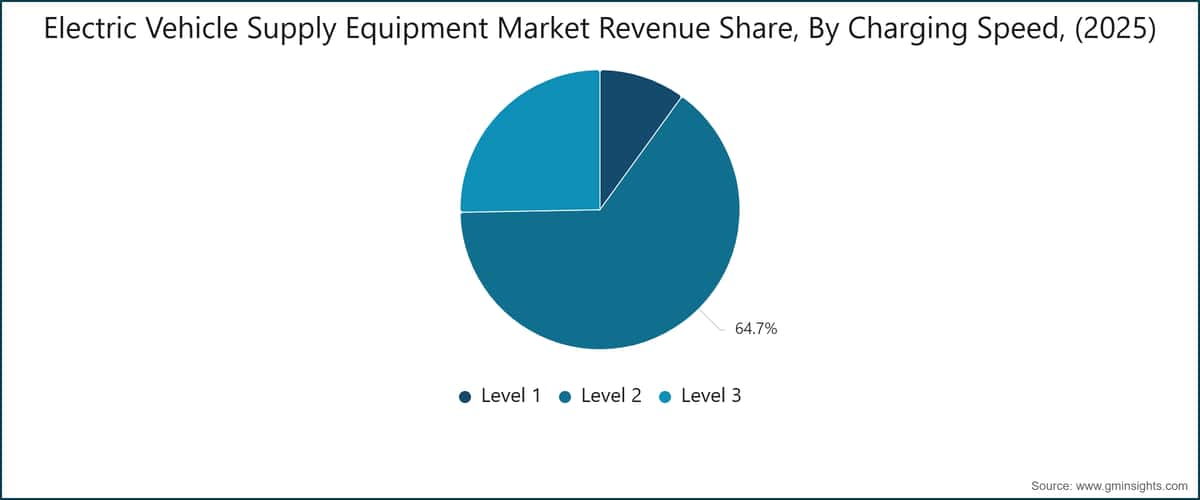
Based on charging speed, the electric vehicle supply equipment market is segmented into level1, level2, level3. The Level 2 segment dominates the market with 64.7% market share in 2025.
- The Level 2 charging segment holds the largest market share due to its ability to provide significantly faster charging than Level 1 while remaining more affordable and easier to install than high-power fast charging systems. It is widely used in homes, workplaces, and public parking facilities, making it the most versatile and scalable charging option. Its compatibility with both private and semi-public infrastructure further strengthens its dominant position.
- Level 1 charging is the most basic form of EV charging and is primarily used for residential purposes where users can charge vehicles using standard electrical outlets. It requires minimal installation cost and infrastructure, making it accessible for entry-level EV users. However, its very slow charging speed limits its practicality for daily high-usage or commercial applications. Several US utilities including Pacific Gas & Electric and Duke Energy have piloted managed Level 1 charging programs that provide incentives for off-peak charging and aggregate flexible load for grid services.[3]
- Level 3 charging represents high-speed DC fast charging technology designed for rapid energy delivery in a short time. It is mainly deployed in highway corridors, commercial charging hubs, and fleet operations where quick turnaround is critical. Despite its advantages in speed, higher installation costs and grid requirements restrict its widespread deployment compared to Level 2 systems.
Based on deployment, the electric vehicle supply equipment market is segmented into fixed charging stations and portable charging equipment. The fixed charging station segment dominates the market with 94.5% market share in 2025.
- The fixed charging stations segment holds the largest market share due to its ability to support high-capacity, reliable, and scalable charging infrastructure. These stations are installed in strategic locations such as highways, urban centers, workplaces, and retail hubs to ensure consistent access to charging services. Their integration with smart grid systems and payment platforms also enhances efficiency and user convenience, making them the backbone of EV infrastructure development.
- Portable charging equipment represents a flexible and emerging segment that caters to users requiring mobility and convenience. These solutions are typically compact and can be used in multiple locations without permanent installation, making them suitable for emergency charging or users with limited access to fixed infrastructure. However, lower power output and limited charging speed restrict their use to supplementary rather than primary charging solutions.
- The increasing adoption of electric vehicles is driving demand for both deployment types, but fixed charging stations remain the primary focus due to their scalability and ability to support fast and reliable charging. Governments and utilities are prioritizing permanent infrastructure development to build a stable and accessible charging ecosystem. Overall, the deployment segmentation highlights a strong reliance on fixed infrastructure as the foundation of EV charging networks, while portable solutions play a supportive role in enhancing flexibility and addressing niche use cases in the evolving EV ecosystem.
Based on end use, the electric vehicle supply equipment market is segmented into EV owners, fleet operators, charge point operators, utilities, and government and municipal authorities. The EV owners segment dominates the market with 39.4% market share in 2025.
- The EV owners segment holds the largest market share due to the increasing shift toward personal electric mobility and the strong demand for home and workplace charging solutions. Most EV users rely on a combination of residential charging and public infrastructure, making them the primary driver of EVSE demand. The expansion of affordable EV models and supportive policies further strengthens this segment’s dominance.
- Fleet operators represent a fast-growing segment, driven by the electrification of logistics, delivery services, ride-hailing platforms, and public transport fleets. These operators require high-utilization charging infrastructure with efficient scheduling and fast turnaround capabilities. As operational cost savings and sustainability targets become more important, fleet electrification is accelerating significantly.
- Charge point operators play a critical role in deploying, managing, and monetizing charging infrastructure across public and semi-public networks. They focus on optimizing station utilization, ensuring uptime, and integrating digital payment and monitoring systems. Their growth is closely tied to expanding EV adoption and infrastructure investments.
- Utilities are increasingly involved in the EVSE ecosystem as electricity demand from EV charging grows. They are investing in grid upgrades, load management systems, and smart charging technologies to maintain grid stability. Their role is becoming more important as EV penetration increases and energy demand becomes more dynamic.
- Government and municipal authorities are key enablers of EVSE expansion through policy support, funding programs, and infrastructure development initiatives. They are responsible for setting regulatory frameworks, deploying public charging networks, and ensuring equitable access to charging infrastructure. Their involvement is crucial for accelerating nationwide EV adoption and achieving sustainability targets.
Based on equipment, the electric vehicle supply equipment market is segmented into charging cables and connectors, power electronics, charging controllers, communication and networking equipment, smart charging systems, and others. The Power Electronics segment dominates the market with 30.3% market share in 2025.
- The charging cables and connectors segment holds the largest market share due to its fundamental necessity in every charging setup, regardless of charging speed or deployment type. These components ensure safe and efficient energy transfer and are required across residential, commercial, and public charging stations. Increasing standardization of connector types and rising EV adoption are further supporting sustained demand.
- Power electronics represent a critical segment responsible for converting and regulating electrical power during the charging process. These components enable efficient AC-to-DC conversion, voltage regulation, and energy optimization. As fast charging infrastructure expands, demand for high-performance power electronics is increasing significantly to support higher power outputs and system reliability.
- Charging controllers play a key role in managing the charging process, including communication between the vehicle and the charging station. They ensure safe charging by regulating current flow, monitoring battery status, and enabling authentication and billing functions. Their importance is growing with the rise of smart and connected charging systems.
- Communication and networking equipment is becoming increasingly important as EV charging infrastructure shifts toward digital and connected ecosystems. These systems enable real-time data exchange, remote monitoring, and integration with cloud platforms. They also support interoperability between different charging networks and service providers.
Based on application, the electric vehicle supply equipment market is segmented into residential charging, commercial charging, public charging infrastructure, and fleet charging. The residential segment dominates the market with 38.6% market share in 2025.
- The public charging infrastructure segment holds the largest market share due to its critical role in supporting long-distance EV travel and reducing range anxiety among users. It includes fast and ultra-fast charging stations installed in high-traffic locations such as highways, shopping centers, and city centers. Increasing government funding and private investment are further strengthening the expansion of public charging networks.
- Residential charging is a foundational segment driven by the convenience of home-based charging for individual EV owners. It typically involves overnight charging solutions that are cost-effective and easy to install. As EV ownership increases, especially in urban residential areas, demand for home charging infrastructure continues to grow steadily.
- Commercial charging is expanding rapidly across workplaces, retail spaces, hospitality venues, and corporate campuses. It is increasingly being used as a value-added service to attract customers and employees. Businesses are adopting charging infrastructure to support sustainability goals and enhance customer experience, making it a growing revenue-generating opportunity.
- Fleet charging is emerging as a high-growth segment driven by the electrification of logistics, delivery services, public transportation, and ride-hailing fleets. It requires high-capacity, reliable, and efficiently managed charging systems to support large-scale vehicle operations. The focus on reducing operational costs and meeting emissions targets is accelerating investments in dedicated fleet charging infrastructure. Fleet charging is the application segment with the highest average revenue per deployment within the EVSE market, driven by the combination of high aggregate power capacity per site (typically 200 kW to 5 MW+ for large fleets), sophisticated energy management software requirements, dedicated project engineering and commissioning services, and long-term operation and maintenance contracts that generate recurring post-sale revenue streams.[4]
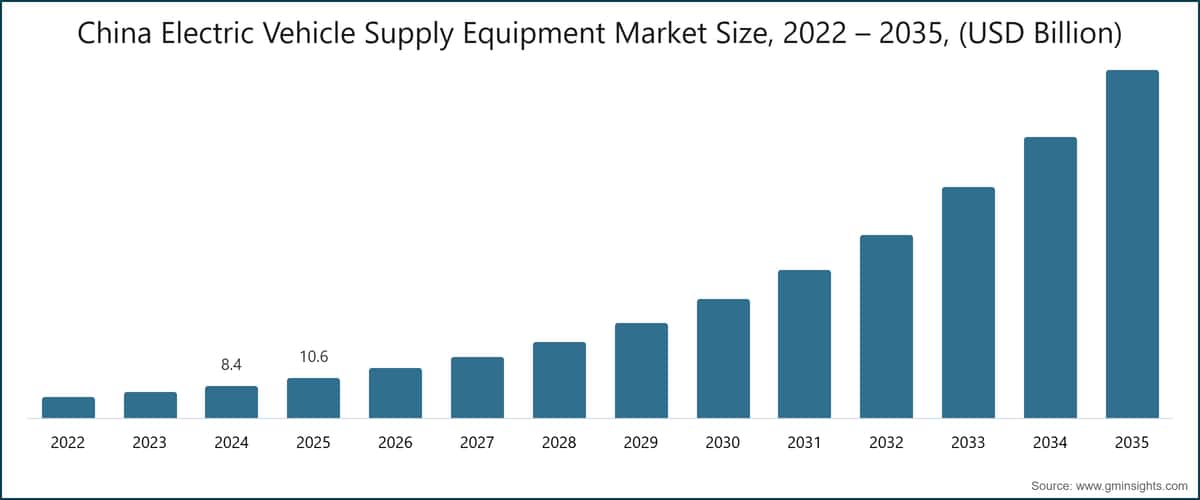
China dominates the Asia Pacific electric vehicle supply equipment market accounting for 74.5% and generating USD 1.8 billion in 2025.
- China’s EVSE market leadership is supported by its large-scale deployment of public and private charging infrastructure, particularly in urban centers and highway corridors. The country benefits from strong policy backing, national electrification targets, and integration of charging infrastructure with renewable energy systems. Continuous investments from both state-owned enterprises and private operators are accelerating the expansion of ultra-fast charging networks across major cities.
- India is the fastest-growing individual market in the Asia Pacific region, driven by rising EV adoption, supportive government schemes, and expanding urban mobility needs. The development of public charging infrastructure is being supported by national programs focused on electrification of transport and reduction of carbon emissions. Growing investments in fleet electrification and two-wheeler EV adoption are further boosting demand for EVSE solutions.
- Japan and South Korea contribute significantly to regional EVSE growth through advanced automotive ecosystems and strong technological capabilities. Both countries are focusing on high-efficiency charging systems, smart grid integration, and next-generation battery technologies. Increasing collaboration between automakers, utilities, and infrastructure providers is supporting the expansion of reliable and standardized charging networks.
US dominates North America electric vehicle supply equipment market, growing with a CAGR of 88.4% from 2026 to 2035.
- U.S. market is largely driven by public-private partnerships aimed at expanding national charging coverage under federal infrastructure programs. Investments are concentrated on highway fast-charging corridors, urban fast-charging hubs, and residential charging solutions. The growing electrification of passenger vehicles and commercial fleets is further increasing demand for scalable and high-speed charging infrastructure.
- The regulatory and funding environment in the United States is encouraging large-scale infrastructure deployment through incentives, tax credits, and state-level EV mandates. However, challenges such as grid capacity constraints, permitting delays, and standardization issues continue to shape market development. Despite these challenges, the U.S. remains the most advanced EVSE market in North America due to its mature automotive ecosystem.
- Canada represents a steadily growing EVSE market supported by national climate goals and strong policy alignment with zero-emission vehicle adoption targets. The country is investing in expanding cross-province charging corridors and increasing access to public charging stations in both urban and rural areas. Growing collaboration between utilities and private operators is improving network reliability and coverage.
Germany dominates the electric vehicle supply equipment market, showcasing strong growth potential, with a CAGR of 28.4% from 2026 to 2035.
- Germany’s EVSE market is supported by strong industrial policy and sustainability commitments, including ambitious decarbonization targets and restrictions on internal combustion engine vehicles. The expansion of high-speed charging corridors across autobahns is a key focus area, enabling efficient long-distance EV travel across Europe. Private sector investment is also playing a critical role in scaling infrastructure deployment.
- The broader European EVSE ecosystem is heavily influenced by regulatory frameworks that promote interoperability, standardization, and open access to charging networks. These policies ensure seamless cross-border EV mobility and encourage investment in pan-European charging infrastructure. Public funding programs are further accelerating deployment in underserved regions.
- The implementation of the Digital Operational Resilience Act (DORA)-aligned frameworks across Europe is also influencing EVSE operators to strengthen cybersecurity, data protection, and system reliability. This is particularly important as charging infrastructure becomes more digitally connected and integrated with energy and mobility platforms. Europe is also seeing rapid growth in smart charging, renewable energy integration, and vehicle-to-grid technologies. These advancements are helping balance grid demand while supporting the region’s transition toward clean energy and sustainable transportation systems.
Brazil leads the Latin American electric vehicle supply equipment market, exhibiting remarkable growth of CAGR 41.1% during the forecast period of 2026 to 2035.
- Brazil is the most advanced EVSE market in Latin America, supported by increasing EV adoption, government incentives, and expanding urban charging infrastructure. The country is focusing on improving public charging accessibility in major metropolitan areas and along key transportation routes. Rising investment from private mobility providers is also contributing to market expansion.
- Brazil’s EVSE growth is strongly supported by its expanding electric vehicle ecosystem, particularly in urban mobility, ride-hailing, and delivery services. The increasing use of EVs in commercial fleets is driving demand for scalable and cost-efficient charging infrastructure. Public-private partnerships are playing a key role in accelerating deployment. The country is also focusing on integrating renewable energy sources into its charging infrastructure, leveraging its relatively clean energy mix. This supports sustainable EV adoption and enhances the environmental benefits of electrification. Grid modernization initiatives are further improving the reliability of charging networks.
- Beyond Brazil, countries like Mexico and Chile are emerging as secondary EVSE markets in Latin America. These markets are gradually expanding their charging infrastructure, supported by foreign investment and regional sustainability initiatives. However, infrastructure density remains lower compared to Brazil. Overall, Latin America’s EVSE market is still in an early growth phase but is expected to expand steadily as EV affordability improves and governments strengthen clean transportation policies.
UAE witnessed substantial growth in the Middle East and Africa electric vehicle supply equipment market with CAGR of 18.4% from 2026-2035.
- The UAE EVSE market benefits from strong regulatory backing through national clean energy and smart city initiatives. Charging infrastructure is being deployed across urban centers, commercial districts, and highway networks to support growing EV adoption. Integration with smart city infrastructure is enhancing efficiency and user experience.
- Saudi Arabia represents a fast-growing secondary market in the region, driven by large-scale economic diversification efforts and mobility transformation programs. Investments in EV manufacturing, infrastructure, and clean energy are accelerating EVSE deployment. Regulatory reforms are also encouraging private sector participation in charging infrastructure development.
- Across the Middle East and Africa, EVSE adoption is still emerging but gaining momentum in urbanized economies. Expansion is being supported by international partnerships, sovereign wealth fund investments, and increasing awareness of sustainable transportation. However, infrastructure gaps and high upfront costs remain key challenges. Overall, the region is transitioning from early-stage adoption to structured EV infrastructure development, with strong long-term potential driven by urbanization and energy diversification strategies.
Electric Vehicle Supply Equipment Market Share
- The top 7 companies in the electric vehicle supply equipment industry include ABB, Siemens, Schneider Electric, Delta Electronics, ChargePoint Holdings, Tesla, and Engie, collectively accounting for a significant share of 16.1% in 2025. These firms dominate due to their strong manufacturing capabilities, advanced charging technologies, large-scale infrastructure deployments, and integrated energy and mobility solutions. Their dominance is supported by end-to-end offerings across hardware, software, grid integration, and charging network operations.
- ABB is a global leader in electrification and industrial automation, offering a comprehensive EV charging portfolio that includes AC and DC fast charging solutions. The company focuses on high-power charging infrastructure, grid integration, and scalable charging systems designed for commercial, fleet, and public applications. Its strong global presence and expertise in power systems make it a key player in large-scale EVSE deployments.
- Siemens is a major technology company providing smart infrastructure solutions, including EV charging hardware, software platforms, and grid-connected charging systems. In the EVSE market, it focuses on intelligent charging networks, energy management integration, and digitalization of mobility infrastructure. Its strength lies in combining charging technology with advanced grid and automation capabilities.
- Schneider Electric specializes in energy management and automation solutions, offering EV charging infrastructure integrated with smart building and grid systems. The company supports sustainable mobility through energy-efficient charging solutions, digital monitoring platforms, and power distribution systems. Its solutions are widely used in commercial buildings, fleets, and urban infrastructure projects.
- Delta Electronics is a leading provider of power and thermal management solutions with a strong presence in EV charging hardware. It specializes in high-efficiency charging systems, including AC chargers, DC fast chargers, and ultra-fast charging solutions. The company is known for its advanced power electronics and strong manufacturing capabilities supporting global EV infrastructure growth.
- ChargePoint is one of the largest EV charging network operators, focusing on connected charging solutions and cloud-based platform services. It provides a comprehensive ecosystem that includes charging hardware, software, and network management tools. The company plays a key role in expanding public and commercial charging networks across multiple regions.
- Tesla is a major player in the EVSE market through its integrated charging ecosystem and proprietary fast-charging network. It focuses on high-speed charging infrastructure designed to support its electric vehicle fleet while also expanding access to select external users. Its vertically integrated approach strengthens its position in both vehicle manufacturing and charging infrastructure.
- Engie is a global energy and utilities company actively investing in EV charging infrastructure and sustainable mobility solutions. It develops and operates public charging networks, fleet charging solutions, and energy-efficient mobility services. Its focus on renewable energy integration and large-scale infrastructure development supports its growing role in the EVSE ecosystem.
Electric Vehicle Supply Equipment Market Companies
Major players operating in the electric vehicle supply equipment industry:
- BYD Company
- Huawei Technologies
- ABB
- Siemens
- Schneider Electric
- Eaton
- Delta Electronics
- ChargePoint
- Tesla
- Engie
The electric vehicle supply equipment market demonstrates a rapidly evolving and moderately consolidated competitive landscape, where global electrical equipment manufacturers, energy solution providers, charging network operators, and technology-driven mobility companies compete to expand and operate charging infrastructure. These players are strengthening their positions through continuous innovation in fast-charging technologies, smart charging systems, grid integration solutions, and scalable charging network platforms designed to support the rapid growth of electric mobility.
Key companies are increasingly investing in advanced EVSE capabilities to meet the rising demand for efficient, reliable, and accessible charging infrastructure across residential, commercial, public, and fleet applications. This includes the development of ultra-fast DC charging systems, interoperable charging networks, cloud-based charging management platforms, and intelligent energy optimization solutions that improve load balancing, reduce charging time, and enhance user experience while aligning with evolving global sustainability and decarbonization goals.
In addition, leading players are focusing on expanding their technological infrastructure and strategic partnerships to support next-generation mobility services, including highway fast-charging corridors, fleet electrification solutions, renewable energy-integrated charging stations, and vehicle-to-grid (V2G) systems. Companies such as ABB Ltd., Siemens AG, Schneider Electric SE, Delta Electronics, ChargePoint Holdings Inc., Tesla, and Engie are enhancing their portfolios with high-power charging hardware, digital monitoring platforms, and integrated energy management systems to support large-scale EV adoption and grid modernization.
The market is also witnessing increasing collaboration between automotive manufacturers, utilities, governments, and charging infrastructure providers to build interconnected EV charging ecosystems. This ecosystem-driven approach is accelerating infrastructure deployment, improving interoperability across charging networks, and enabling seamless access to charging services globally. As a result, the EVSE market is evolving into a highly integrated energy and mobility ecosystem that supports the transition toward sustainable transportation across both developed and emerging economies.
Electric Vehicle Supply Equipment Market Report Attributes
| Key Takeaway | Details |
|---|---|
| Market Size & Growth | |
| Base Year | 2025 |
| Market Size in 2025 | USD 27.7 Billion |
| Market Size in 2026 | USD 33.5 Billion |
| Forecast Period 2026-2035 CAGR | 22.6% |
| Market Size in 2035 | USD 209.3 Billion |
| Key Market Trends | |
| Drivers | Impact |
| Rising EV Adoption and Electrification of Transportation | Increases demand for residential, commercial, and public charging infrastructure as the growing electric vehicle fleet requires accessible and reliable charging solutions. |
| Government Incentives and Supportive Charging Infrastructure Policies | Accelerates EVSE deployment through subsidies, tax incentives, grants, and regulatory mandates that encourage investment in charging networks. |
| Expansion of Public and Highway Fast-Charging Networks | Enhances charging accessibility, reduces range anxiety, and supports long-distance EV travel, driving higher EV adoption and infrastructure investment. |
| Growth of Fleet Electrification and Commercial EV Usage | Boosts demand for high-capacity charging infrastructure to support logistics, public transportation, ride-hailing, and delivery fleet operations. |
| Pitfalls & Challenges | Impact |
| High Installation and Infrastructure Development Costs | Increases capital expenditure for charging station deployment, slowing expansion in cost-sensitive and underserved regions. |
| Grid Capacity Limitations and Power Distribution Challenges | Creates constraints on large-scale fast-charging deployment, requiring grid upgrades and advanced energy management systems. |
| Opportunities: | Impact |
| Expansion into Emerging and Developing EV Markets | Creates significant growth potential as governments and private investors accelerate EV adoption and charging infrastructure development in emerging economies. |
| Integration of Renewable Energy with Charging Infrastructure | Enables sustainable and cost-efficient EV charging by combining solar, wind, and energy storage systems with charging networks while supporting grid decarbonization. |
| Market Leaders (2025) | |
| Market Leader | |
| Top Players |
Collective Market Share is 13.3% |
| Competitive Edge |
|
| Regional Insights | |
| Largest Market | Asia Pacific |
| Fastest growing market | Asia Pacific |
| Emerging countries | India, Brazil, Indonesia, United Arab Emirates (UAE), Saudi Arabia, Vietnam |
| Future outlook |
|
What are the growth opportunities in this market?
Download Free PDF
Electric Vehicle Supply Equipment Industry News
In May 2026, ABB E-mobility launched the OM X-Series, a megawatt-scale charging platform designed for public charging corridors, logistics hubs, transit depots, and commercial fleet applications. The solution features liquid-cooled charging technology, scalable power architecture, and integrated energy storage connectivity to improve charging efficiency, uptime, and grid performance for high-demand charging environments.
In February 2026, Siemens AG strengthened its eMobility portfolio by advancing smart charging infrastructure solutions integrated with renewable energy systems, dynamic load management, and grid-balancing technologies. The initiative supports efficient energy distribution and helps utilities and charging operators manage rising electricity demand associated with growing electric vehicle adoption.
In November 2025, ChargePoint Holdings Inc. introduced its next-generation ChargePoint Platform, a cloud-based charging management solution featuring AI-driven optimization, predictive maintenance, real-time network monitoring, and advanced energy management capabilities. The platform enhances charger uptime, interoperability, and operational efficiency across public, commercial, and fleet charging networks.
In 2025, Tesla accelerated the expansion of its global Supercharger network by deploying thousands of additional charging stalls and rolling out V4 charging technology across multiple regions. The expansion improves long-distance EV travel, increases charging accessibility, and supports the growing adoption of electric vehicles through a more extensive fast-charging ecosystem.
In April 2024, Schneider Electric SE introduced new eMobility solutions, including the EVlink Pro DC fast charger, Schneider Charge residential charging solution, and EcoStruxure EV Advisor platform. These innovations enhance charging infrastructure reliability, enable real-time monitoring, optimize energy consumption, and improve charging network management across residential, commercial, and public charging applications.
The electric vehicle supply equipment market research report includes in-depth coverage of the industry with estimates & forecasts in terms of revenue (USD Mn) from 2022 to 2035, for the following segments:
Market, By Charging Technology
-
AC Charging
- DC Fast Charging
- Wireless Charging
Market, By Charging speed
Market, By Deployment
-
Fixed Charging Stations
- Wall Mounted
- Pedestal or Standalone
- Overhead
- Portable Charging Equipment
Market, By End Use
-
EV Owners
- Fleet Operators
- Charge Point Operators
- Utilities
- Government and Municipal Authorities
Market, By Equipment
Market, By Application
-
Residential Charging
- Single Family Homes
- Multi Dwelling Units
- Commercial Charging
- Retail and Shopping Centers
- Workplace and Office Buildings and Campuses
- Public Charging Infrastructure
- Urban Public Charging
- Highway and Corridor Charging
- Government and Municipal Charging Networks
- Fleet Charging
- Logistics and Delivery Fleets
- Corporate and Employee Fleets
- Ride Hailing and Shared Mobility Fleets
The above information is provided for the following regions and countries
- North America
- Europe
- Germany
- UK
- France
- Italy
- Spain
- Russia
- Norway
- Netherlands
- Sweden
- Asia Pacific
- China
- India
- Japan
- Australia
- South Korea
- Singapore
- Thailand
- Indonesia
- Vietnam
- Latin America
- MEA
- South Africa
- Saudi Arabia
- UAE