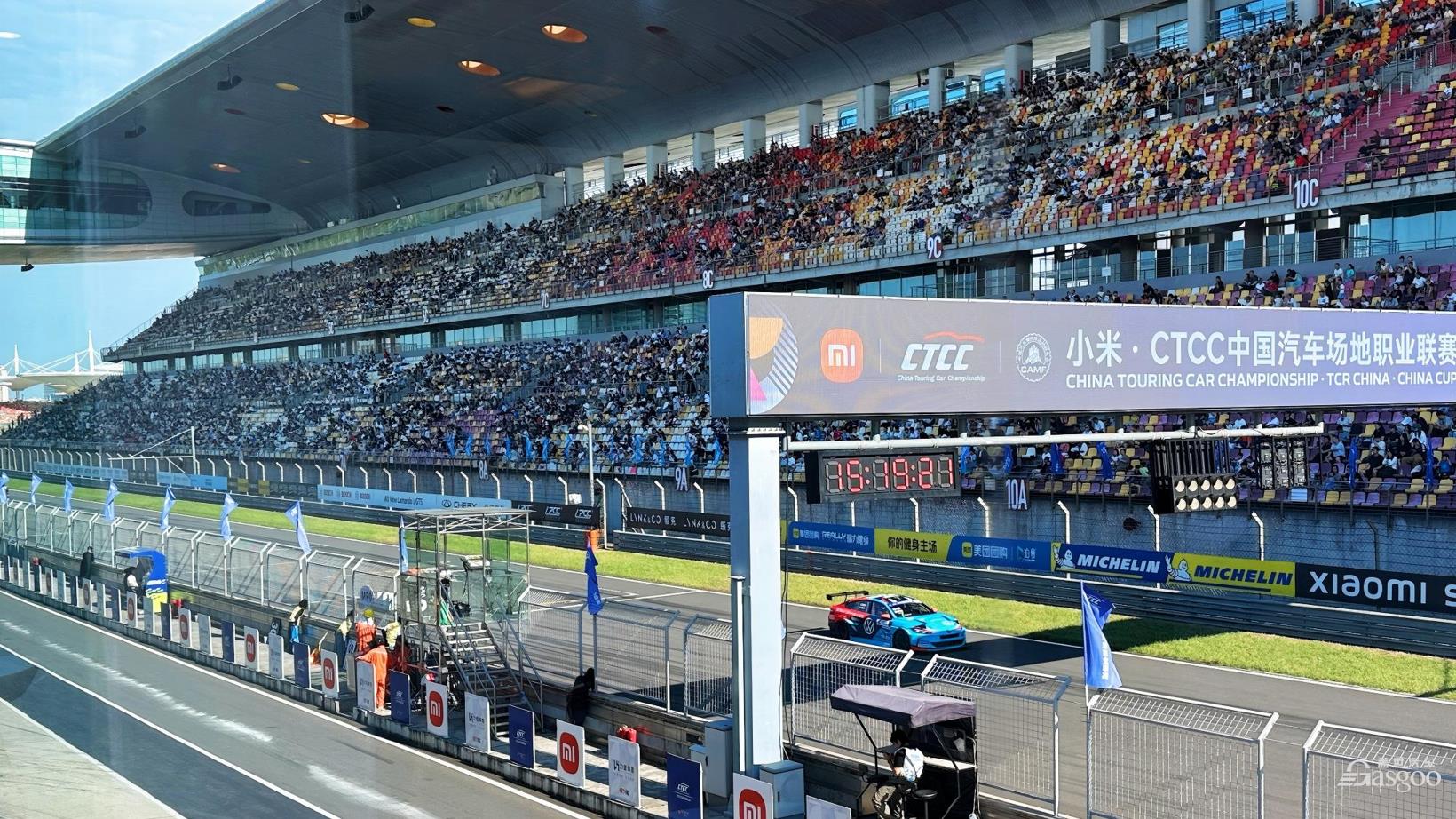
The Shanghai International Circuit in 2026 is a busy place.
March kicks off with the F1 Chinese Grand Prix, followed by the China GT season opener in April and the CEC endurance championship in May. By September, the calendar is packed again. It includes the fourth round of China GT, back-to-back CTCC and TCR China races, and the Shanghai 6-Hour Endurance Race closing out the month.

F1, GT, touring cars, endurance races — one after another. This past March, the F1 Chinese Grand Prix drew over 230,000 spectators across three days. A decade ago, people often claimed “China has no racing culture.” Saying that today feels out of touch.
But with more races, bigger crowds, and automakers stepping in, do we really have a racing culture?
Look deeper, and racing culture clearly isn’t just about what happens in the stands. It’s about whether people are willing to step down from the stands — and if there’s a path for them when they do. It’s about whether racing retains talent for the industry. It’s about whether a race leaves behind stories, experience, and rules. And when accidents happen, it’s about whether the system actually functions.
Stepping Down from the Stands, the Path Emerges
Whether Chinese people love racing is no longer the question that needs answering.
Pegasus brought rallying and co-drivers into the mainstream, while karting, sim racing, track days, and off-roading all have their own followings. The real bottleneck is what comes next: You watch F1 and think it’s amazing, so you want to try it — where do you go? Your first track day leaves you wanting more — who teaches you? You get your license — what race do you enter?
The problem with Chinese racing used to be that the ends were full, but the middle was thin. At the top, you had F1, CTCC, China GT, CRC, and the Tengger Desert Rally. Outside, there was no shortage of car enthusiasts. But the bridge from “I like racing” to “I’m actually going to race” remained out of reach.
Now, gaps are being filled.
BYD is tackling the first step: where to play. The Zhengzhou All-Terrain Circuit, opening in 2025, has turned track driving and gymkhana into paid public experiences. Its “New Track Plan,” launched with the motorsport federation, aims to get “a million people on the track.” Whether that million is realized remains to be seen, but for now, ordinary consumers can already buy a ticket and drive their own cars onto the circuit.
Lynk & Co is working a level up. For years, it has tried to connect license training, brand events, and professional racing. The Shanghai stop on September 13 offered a clear example. Wang Shiqi and Zhou Xi both underwent racing license training. Zhou Xi then competed in the 2025 Lynk & Co Cup before advancing to the CTCC China Cup.
This is more convincing than any driver development roadmap chart — at least someone has moved from training to brand events, and from there to national-level competition.
Still, the path remains narrow. A few hundred yuan buys a track experience, but once actual racing begins, tires, maintenance, transport, entry fees, and team services quickly drive up the bill. Racing naturally relies on venues, vehicles, and professional support.
Beyond money, there’s an easier hurdle to overlook: first-time track drivers often don’t even know how well they’re actually driving.
On September 13, Chen Peter, head of Bosch’s racing business in China, mentioned the Track Performance App (TPA) currently under development by Bosch Engineering. This software packages years of technical service experience, using vehicle and driving data to help amateur drivers assess their track performance and improve lines, cornering, and driving style.
In the past, a coach would tell you: you braked too early for that corner, you were late on the throttle there. Now, that knowledge—once held only by coaches, pro drivers, and engineers—is being coded into software.
Racing rules are shifting too. At an August CTCC technical meeting, organizers proposed allowing racing ABS in the future, partly to lower the barrier for gentleman drivers. It’s still just “under consideration” and far from official, but the question is on the table: does racing have to prove its professionalism by being difficult to drive?
Bosch is trying to lower the learning curve; CTCC is debating the driving barrier.
Racing Leaves Behind More Than Just Drivers
Those who truly enter racing don’t necessarily become drivers. The sport’s impact on the auto industry sometimes comes through a different door.
Fu Yuwu, former president of the Society of Automotive Engineers of China, was one of the founders of the China Formula Student Championship. In a previous interview with Gasgoo, he recalled that the event started with combustion cars. It added electric vehicles and driverless formula cars, with the content evolving alongside the industry’s technological shifts.
By the 2026 season, 39 university teams had signed up for the China Formula Student Championship: 19 pure electric, 16 internal combustion, and 4 hybrid — the first time all three powertrains competed together. Public data shows this system has cultivated over 90,000 industry talents.
Ninety thousand people don’t mean 90,000 industry leaders, but it proves this is no longer a niche hobby for a few schools. A Formula Student team is far more complex than “building a small car to chase lap times.” Some draw blueprints, others machine parts. There are those handling electronics, software, and testing, while others manage budgets, sponsorship, and operations. Everyone’s work converges on one goal: the car must be built, and it must run.
Fu Yuwu once described these teams as a “treasure trove” of automotive talent. Not because they produced many pro drivers, but because they trained a group of people who know “how to get a car built.”
Over the past decade, this system has produced a wave of industry professionals. Shu Qiang, former captain of Tongji University’s Yiracing team, founded Tongyu Automotive. Li Tianshu, first captain of Beihang’s AERO team, joined NIO as a senior vice president. Liu Di, from the Beijing Institute of Technology team, joined the Formula E technical team. Many others have moved into universities, autonomous driving, software, chassis control, and OEMs.
Of course, we can’t say their career success is solely due to Formula Student. Individual ability, professional training, and industry opportunity matter more. But racing did provide training classrooms struggle to match: limited budget, limited time, strict rules — and the car must be finished.
What they later brought to the auto industry wasn’t just vehicle engineering knowledge, but a “racing” work ethic — time doesn’t wait, problems must be solved, and the car must run.
People Move, Stories Must Stay
Formula Student is about how people move from racing into the industry. But people move on; stories need to settle. If these experiences scatter with the people, the industry struggles to form a culture.
China’s auto industry is good at remembering numbers. Monthly sales, annual exports, EV penetration rates, which brands cracked the global top ten — the data is always at hand. Who mass-produced a technology first, who broke a record — it’s easy news.
By comparison, the history of figures, models, engineering explorations, and events is far more fragmented. China has car museums, corporate histories, local chronicles, and oral histories. The problem isn’t “we have no automotive history,” but that much of it hasn’t yet become shared public memory, retold and accessible to many.
Racing is even more obvious. Before the first F1 Chinese Grand Prix in 2004, the CTCC’s predecessor — the National Circuit Racing Championship — was already competing at the Shanghai International Circuit. Twenty years is enough time for representative drivers, classic cars, and key races to emerge, yet many stories remain stuck in archives, old news reports, and the memories of veteran fans.
It’s the same for Formula Student. Those building cars on campus a decade ago now hold key positions in the industry. But we were used to listing them as “talent cultivation results,” rarely viewing those experiences as part of the auto industry’s own history.
Culture doesn’t just grow because you host more races. It requires someone to remember who came, what they drove, what happened, and why it mattered.
An industry that leaves behind only sales figures will struggle to leave behind a true culture.
The European car stories told repeatedly aren’t remembered because their specs are still advanced decades later, but because decades later, people still talk about a car, a driver, a victory, a failure. Chinese cars are moving fast enough; culture, conversely, requires looking back occasionally.
Looking back isn’t for nostalgia. It’s so those who come later know this road didn’t start today.
A World-Class Track ≠ A Well-Run National Race
Looking back also means not just remembering the champions.
On September 5, again at the Shanghai International Circuit. During the fourth round of China GT, a collision left Ollie Millroy’s No. 91 car in flames. What truly shook the industry were the next few seconds.
The first to stop and rush toward the fire wasn’t a professional rescuer, but another driver still in the race: Loek Hartog. He parked his car, found an extinguisher, and ran to help. Millroy later stated publicly that he didn’t see track marshals or fire crews in his line of sight in time, crediting Hartog with saving his life.
FIST Team AAI, the team involved, subsequently issued a statement accusing organizers of serious dereliction of duty in emergency response and safety support. They suspended participation in remaining China GT rounds until the organizers complete a “comprehensive, independent, and public” investigation and provide a formal response.
Yang Baijie, team owner and driver at TBC Racing, was even more direct. His No. 33 car collided with the No. 91. Afterward, he publicly questioned the race organization and announced his permanent withdrawal from China GT. Shortly after, AAI Motorsports also announced its exit, citing a “lack of safety systems.”
By this point, the controversy wasn’t just about assigning blame for the accident. Competitors were asking: Can I still trust this race system?
The China GT organizing committee issued a public apology the next day. They claimed overall personnel and vehicle configurations met national standards, yet admitted “detailed management needs improvement,” promising to review organization, support, emergency response, rescue, and medical protocols.
Put together, those two statements are jarring. Personnel can be sufficient, vehicles sufficient, equipment sufficient — but when things go wrong, the system doesn’t necessarily turn.
Racing safety ultimately tests not whether a rescue car is on the spec sheet, but whether it actually arrives in those critical seconds when a car is on fire.
Months ago, 230,000 people watched F1 on this same track. The track is undoubtedly world-class.
But a world-class track doesn’t automatically deliver world-class race operations.
The most visible parts of a race are the start, the overtakes, the podium. What truly determines its professionalism are often the off-camera moments after an accident. The true quality of racing culture is hidden precisely in these places.
So asking “Does China still lack a racing culture?” today, the answer can no longer be a simple “yes” or “no.”
There are plenty of fans, and races are getting denser. The real challenge is slowly retaining the interest, the professionalism, the people, and the stories.
Racing culture isn’t a full grandstand.
It’s about people willing to take the wheel. It involves people who know how to professionally run a race to the finish. It includes people who, long after the checkered flag, still remember what happened here.