SHANGHAI
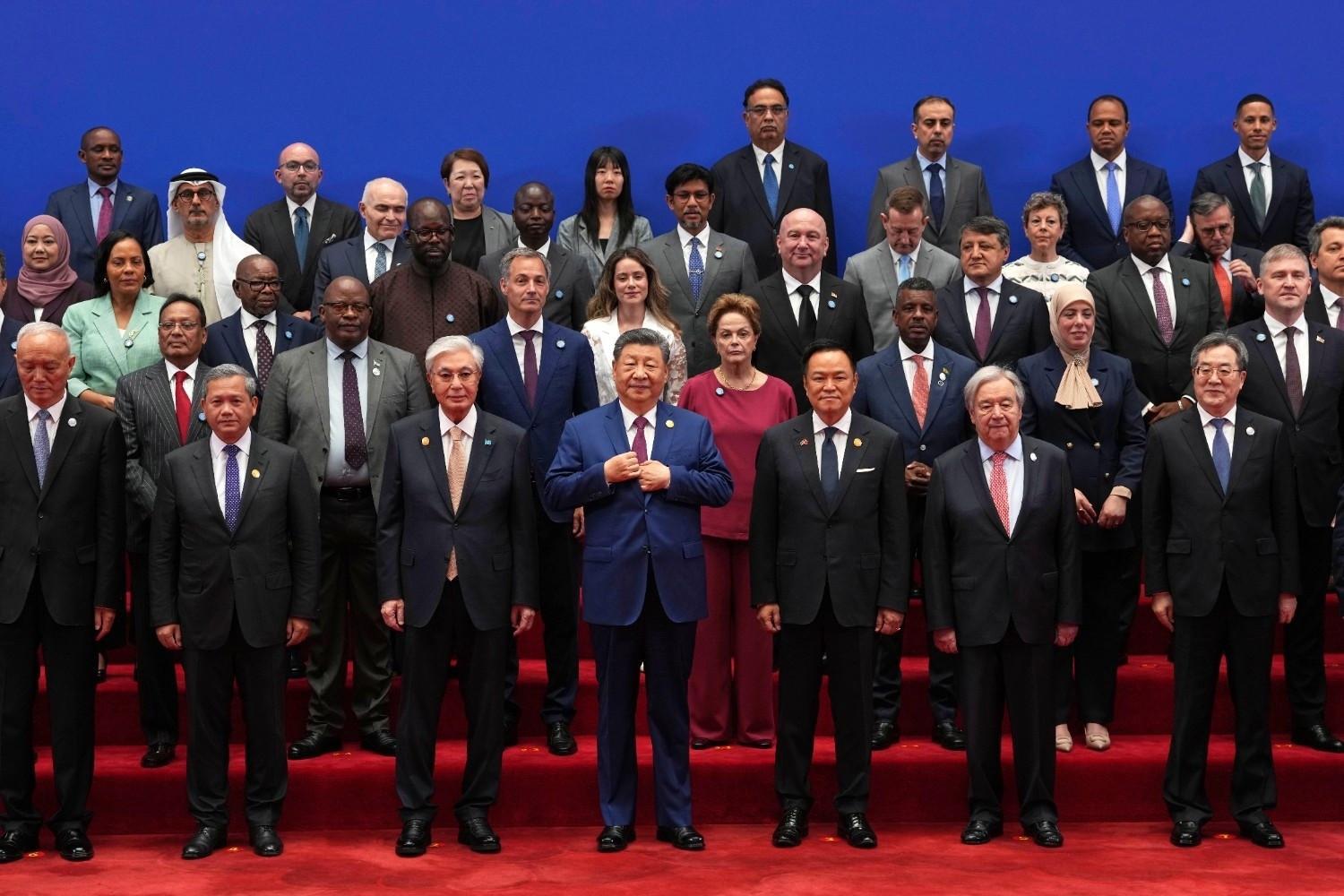
Chinese President Xi Jinping, center, poses for a group photo with other attendees before the opening ceremony for the World AI Conference in Shanghai, Friday, July 17, 2026. (AP Photo/Ng Han Guan, Pool)
Chinese President Xi Jinping called for international cooperation on artificial intelligence on July 17, saying no country should dominate its development and urging safeguards to keep the technology under human control.
“AI development should not be a solo performance by a single country but a symphony of international cooperation,” Xi told the opening of the World Artificial Intelligence Conference (WAIC) in Shanghai.
He also criticized what he called the overuse of national security arguments in AI and efforts to place one country’s security above that of others.
Washington has restricted exports of advanced chips and related technology to China on national security grounds.
Chinese developers, meanwhile, are seeking to close the gap with leading U.S. companies through lower-cost, open-source models.
“The United States retains a clear lead in advanced chips, frontier computing infrastructure and the most capital-intensive model development,” said Poe Zhao of the analysis publication Hello China Tech. But China was its “closest and most comprehensive competitor,” he added.
Xi called for laws and regulations, technological monitoring, early-warning systems and emergency-response mechanisms to manage AI risks.
He said development should follow a people-centered approach and ensure the technology remained “under human control.”
On July 16, 29 countries, including Russia, Pakistan and Indonesia, signed an agreement to establish the World Artificial Intelligence Cooperation Organization.
The independent intergovernmental body will be headquartered in Shanghai. U.N. Secretary-General Antonio Guterres attended the signing ceremony.
The four-day conference, which runs through July 20, has drawn more than 1,100 companies and features over 3,000 products.
Displays range from semiconductor systems for AI computing to smartphones equipped with autonomous agents.
Moonshot AI’s new Kimi K3 is among the models featured, while AI agents capable of managing software and carrying out complex tasks are a central theme.
Other highlights at this year’s WAIC are MiniMax’s M3 model, the first mass-produced phone equipped with an autonomous AI agent, and Huawei’s Atlas 950 “supernode,” an AI architecture for learning and reasoning.
China has made AI a pillar of its industrial policy, backed by state investment spanning chips, models and consumer products. Its core AI industry exceeded 1.2 trillion yuan in 2025, official figures show.
Daily AI token use in China has risen more than 1,000-fold in two years, officials said.
China-based inventors published over 43,000 generative AI patent families in 2024 and 2025, more than the country’s total in the previous decade, according to WIPO.