Global investor attention in artificial intelligence (AI) has largely centered on US, South Korean, and Taiwanese semiconductor leaders.
However, a quieter innovation cycle has been unfolding within Mainland China, particularly on the Shanghai Stock Exchange’s Science and Technology Innovation Board (STAR Market), where next-generation AI infrastructure and robotics companies are preparing to list.
Three upcoming initial public offerings (IPOs) stand out:
- Unitree, a global leader in humanoid and quadruped robotics
- ChangXin Memory Technologies (CXMT), China’s leading DRAM manufacturer
- Yangtze Memory Technologies (YMTC), a top global NAND flash producer
We believe these listings could reshape how global investors view China’s role in both global semiconductor innovation and the emerging physical AI ecosystem.
The STAR Market as a Gateway to China’s Innovation Economy
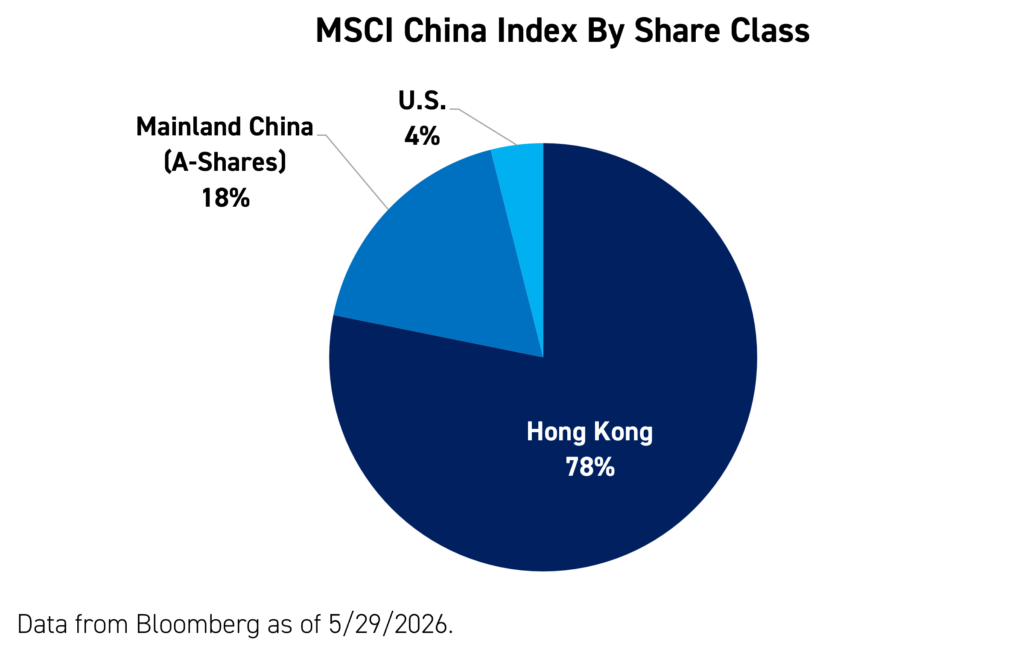
As we have highlighted in prior research, Mainland China’s onshore equity markets, Shanghai and Shenzhen, remain underrepresented in major global benchmarks despite their size and evolving sector composition.
The STAR Market has become a key listing venue for companies operating at the forefront of semiconductors, advanced manufacturing, and AI.
The upcoming IPOs of Unitree, CXMT, and YMTC underscore how China is moving up the value chain in both AI hardware and enabling infrastructure. As hyperscaler capital expenditures continue to drive global demand for compute and memory, China’s domestic champions are increasingly positioned to participate in, and potentially benefit from, this growth.
For investors seeking exposure to this innovation cycle, the KraneShares SSE STAR Market 50 Index ETF (KSTR) provides targeted access to many of China’s most advanced, R&D-driven companies listed on the STAR Market, including those aligned with China’s semiconductor self-sufficiency goals and next-generation automation.
Unitree Robotics (宇树机器人): Physical AI Moves from Concept to Commercialization
Unitree Robotics, founded in 2016 and headquartered in Hangzhou, has emerged as a global leader in 4-legged and humanoid robotics.1
Unitree commanded approximately 69.75% of the global quadruped robot market in 2023 and delivered over 5,500 humanoid robots in 2025, the highest shipment volume globally.1
Its product suite spans industrial quadrupeds used in inspection, firefighting, and agriculture, as well as humanoid robots designed for education, entertainment, and commercial applications. Unitree also develops critical robotic components, including dexterous hands, robotic arms, and LiDAR systems.
With reported 2025 revenue approaching RMB 2 billion and gross margins near 60%, Unitree stands out for its combination of scale and profitability in an emerging industry.1 Its partnership with Nvidia to integrate advanced AI capabilities further positions the company at the intersection of hardware and intelligence.
Unitree’s planned STAR Market listing highlights how China’s capital markets are enabling the commercialization of “physical AI,” a theme increasingly reflected in the types of companies eligible for inclusion in KSTR, where advanced manufacturing and robotics are key pillars.
ChangXin Memory Technologies (CXMT): Memory as the Backbone of AI Compute
ChangXin Memory Technologies (CXMT), founded in 2016 and based in Hefei, is China’s leading DRAM manufacturer and an increasingly important player in global memory markets.1
ChangXin produces a full suite of DRAM products, including DDR4, DDR5, LPDDR4X, and LPDDR5/5X, serving applications across servers, mobile devices, PCs, and automotive systems.1
Through a “leapfrog R&D” strategy, CXMT has scaled across multiple process generations and now ranks among the world’s largest DRAM suppliers by capacity and shipments. Its IPO filing comes as the company seeks to raise approximately RMB 29.5 billion on Shanghai’s STAR Market to expand production and support further technology development.1
Importantly, not all memory demand is being driven by the same end markets. As leading global memory companies increasingly focus on higher-margin, advanced memory products tied to AI workloads, a wider opening may be emerging in consumer electronics and other mainstream applications that rely on less advanced DRAM, where CXMT is already active.
That dynamic matters because it suggests CXMT’s opportunity may not depend solely on winning the most cutting-edge AI memory segment in the near term. Instead, the company may be able to build scale by serving demand in PCs, handsets, and other volume-driven categories, even as the broader AI buildout tightens global memory supply and reinforces the strategic importance of domestic chip production in China.
For KSTR’s investment framework, CXMT represents more than a single-company IPO story. It reflects the broader evolution of the STAR Market into a listing venue for companies supporting China’s semiconductor ecosystem, where memory remains a foundational layer of both AI infrastructure and everyday computing demand.
Yangtze Memory Technologies (YMTC): Advancing NAND Technology and Supply Chain Localization
Yangtze Memory Technologies (YMTC) is a leading global producer of 3D NAND flash memory and a key player in China’s push toward semiconductor self-sufficiency.
Yangtze’s proprietary Xtacking architecture, which separates memory cells and peripheral circuits into distinct wafers before bonding, enables higher performance and improved manufacturing efficiency.
YMTC operates two major fabrication facilities in Wuhan, with a combined monthly capacity of approximately 200,000 wafers, and a third phase is expected to begin production by the end of 2026.1 By early 2026, its global NAND market share had reached an estimated 13%–16%, making it the world’s fourth-largest producer.1
A notable milestone was YMTC’s licensing of its Xtacking technology to Samsung, marking a rare instance of a Chinese semiconductor company generating royalty revenue from a leading Korean chipmaker.
As NAND remains essential for data storage across AI, cloud, and edge applications, YMTC’s growth reflects China’s increasing relevance in global memory markets. Companies like YMTC exemplify the advanced semiconductor innovators that underpin KSTR’s investment thesis.
Evolving Opportunities in China’s Capital Markets
While exact IPO timing remains uncertain, Unitree has already received regulatory approval from the China Securities Regulatory Commission, suggesting a potential near-term listing. CXMT and YMTC are also progressing through the listing pipeline.
Together, these companies highlight a broader shift in China’s equity markets toward high-value, innovation-driven sectors. For global investors, this evolution may remain underappreciated due to the composition of benchmarks and limited onshore exposure.
Strategies such as KSTR are designed to capture this shift by focusing on STAR Market leaders across semiconductors, advanced manufacturing, and AI, areas that are increasingly central to both China’s economy and the global technology landscape
For KSTR standard performance, top 10 holdings, risks, and other fund information, please click here.
Citation:
- Data from Wind as of 6/8/2026.
Source link