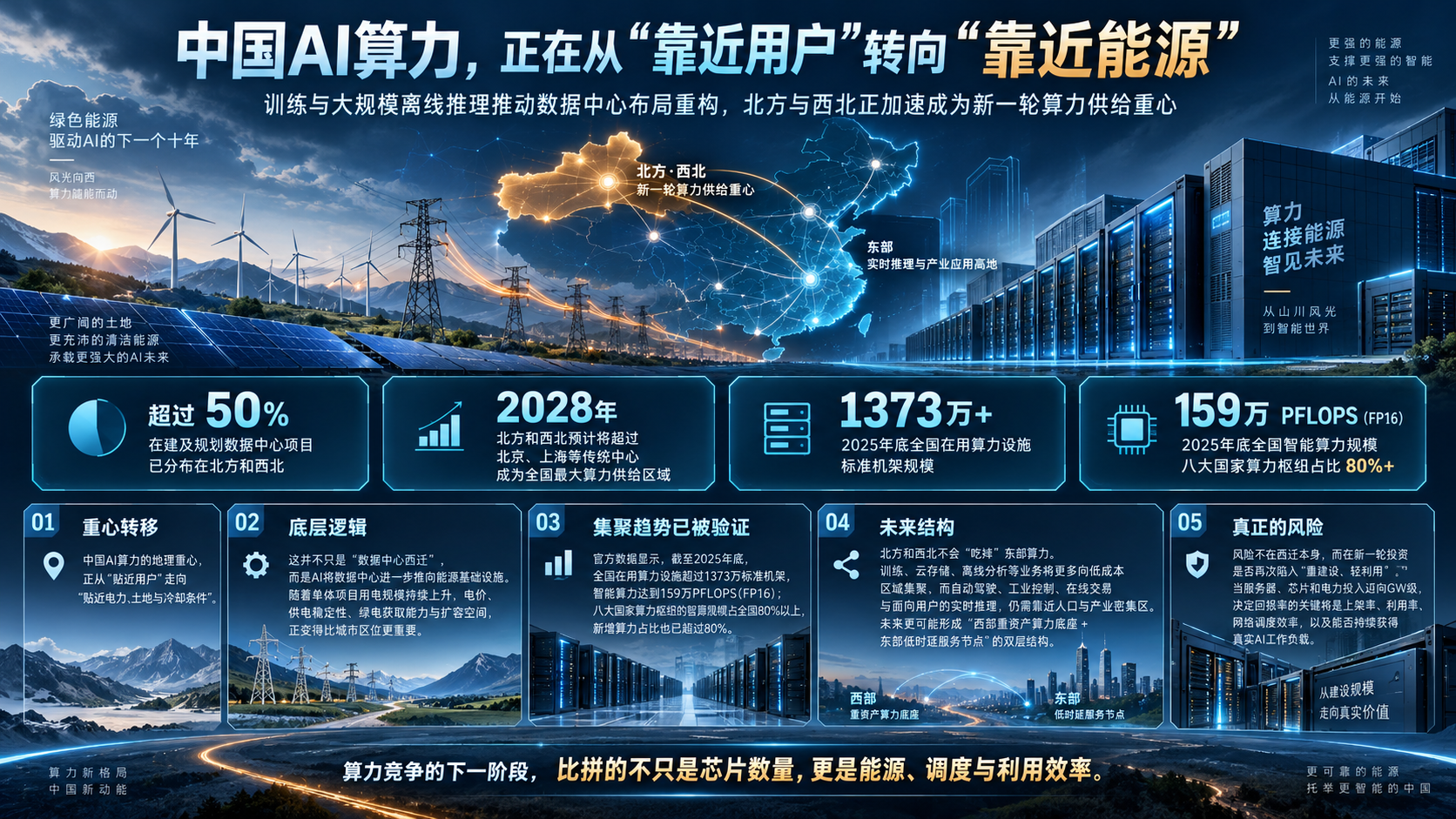
The geographic center of China’s AI computing power is shifting from being “close to users” to being “close to electricity, land, and cooling conditions.”
Article author, source: ME News

TL;DR
- The geographic center of China’s AI computing power is shifting from being “close to users” to being “close to electricity, land, and cooling conditions.” According to the latest statistics from BloombergNEF, more than half of the data center projects under construction or in planning are now located in the north and northwest regions; by 2028, these areas are expected to surpass traditional hubs like Beijing and Shanghai to become the nation’s largest computing power supply regions.
- This is not simply a “westward shift of data centers,” but rather AI driving data centers even closer to energy infrastructure. After model training and large-scale offline inference have increased the power consumption of individual projects, factors such as electricity pricing, power supply stability, access to green energy, and expansion capacity are becoming more important than urban location.
- Official data has confirmed the trend of concentration. By the end of 2025, more than 13.73 million standard server racks were in operation nationwide, with intelligent computing power reaching 1.59 million PFLOPS (FP16); the intelligent computing capacity of the eight national computing hubs accounted for over 80% of the national total, and new computing capacity in these hub regions also exceeded 80% of the national新增算力.
- The north and northwest will not “absorb” eastern computing power. Low-latency-sensitive tasks such as training, cloud storage, and offline analysis are better suited for long-distance migration, while autonomous driving, industrial control, online transactions, and real-time user-facing inference still require proximity to densely populated and industrialized areas. The future is more likely to form a two-tier structure: a heavy-infrastructure computing foundation in the west and low-latency service nodes in the east.
- The real risk is not the relocation itself, but whether this new wave of investment will once again prioritize construction over utilization. As server, chip, and power investments grow at a GW scale, the return on investment will depend on rack utilization rates, operational efficiency, network scheduling performance, and the ability to secure consistent AI workloads.
Why is China’s computing power landscape being redrawn at this moment?
For over a decade, the most natural locations for data centers in China have been cities with dense internet and financial industries, such as Beijing, Shanghai, Shenzhen, and Hangzhou, because traditional data centers primarily serve users and enterprises, where network latency, customer proximity, and cloud service ecosystems are more critical than electricity costs. However, generative AI is rewriting this location logic, as the core cost structure of AI training differs significantly from that of traditional internet businesses.
BloombergNEF’s latest research, disclosed on September 8, shows that more than half of China’s data center pipeline projects are located in the northern and northwestern regions, including Inner Mongolia. According to its projections, by 2028, these regions will surpass mature markets such as Beijing and Shanghai to become the nation’s largest computing power supply areas; by 2030, the operational IT capacity of data centers in the north and northwest could account for approximately one-third of the national total. Meanwhile, China’s actual operational IT capacity for data centers is expected to more than double over the next five years, with total electricity demand potentially rising by 151% by 2030 to reach 329 TWh, accounting for about 2.4% of the nation’s total electricity demand.
The significance of this shift goes beyond the realization of the “East Data, West Computing” initiative. More importantly, AI is causing data center location decisions to increasingly align with energy infrastructure. When a training cluster scales from tens of megawatts to hundreds of megawatts—and even up to 1 GW—companies must now prioritize questions not about proximity to users, but about where they can reliably secure sufficient power, where long-term, low-cost expansion is feasible, and where it’s easier to meet renewable energy targets and energy consumption benchmarks. For the first time, computing power is subject to energy constraints similar to those of heavy industry—except that what it produces are model parameters, inference results, and digital services.
The advantages of the north and northwest are essentially “power density advantages.”
It is no accident that Inner Mongolia has become the most watched sample. The region has relatively abundant land, a cold climate, and abundant wind and photovoltaic resources, while also being not far from Beijing. The low temperature helps reduce cooling loads, but more importantly, as AI clusters scale to hundreds of megawatts and beyond, the ability to simultaneously address large-scale power supply and continuous expansion has become a critical requirement for site selection.
According to the National Data Bureau’s “Digital China Development Report (2025)”, by the end of 2025, the total number of active computing facility racks nationwide exceeded 13.73 million standard racks, with 42 mega-scale AI computing clusters built, reaching an AI computing capacity of 1.59 million PFLOPS (FP16). More notably, over 80% of all new computing capacity nationwide has been deployed in the eight national computing hubs; the “National Data Resources Survey Report (2025)” also shows that the AI computing capacity of these eight hubs and ten clusters accounts for more than 80% of the national total. This demonstrates that computing concentration is no longer just a planning goal—it is now a realized structural reality.
Policy constraints have further reinforced this trend. The Opinions on the Implementation of the National Integrated Computing Power Network, released at the end of 2023, explicitly stated that, in principle, no new large or ultra-large data centers should be built outside national hub nodes, while promoting the migration of services such as model training, machine learning, video rendering, offline analysis, and data storage and backup to western regions. In other words, both the government and the market are jointly reordering the importance of production factors: where data centers once valued “proximity to customers” most highly, securing sufficient and stable electricity is now becoming increasingly costly.
After DeepSeek, AI companies are directly building “compute factories”
Corporate actions speak louder. By the end of July 2026, multiple media outlets cited Bloomberg reporting that DeepSeek plans to build an AI data center with a capacity of approximately 1 GW in Ulanqab, while also leasing capacity from other local operators, aiming to have at least some of its capacity operational by the end of 2027 or early 2028. For a company known for model efficiency, planning infrastructure at the gigawatt scale is telling: efficiency gains have not eliminated demand for computing power; rather, they may increase total demand due to more training cycles, expanded inference calls, and model iterations.
The case of Zhipu illustrates another shift. Public reports indicate that Zhipu’s Z.AI has built an AI data center with a capacity of approximately 1 GW and has begun partial operations, using domestically developed AI chips. However, current reports have not disclosed the specific location of this project, so it cannot be simply categorized as being in Inner Mongolia or the northwest. What truly matters is that independent large model companies are transitioning from “purchasing cloud computing power” to “directly controlling infrastructure”—computing power has evolved from a procurement issue for the technology department into a strategic matter on the company’s balance sheet.
This will also transform the customer base of the data center industry. In the future, large AI projects are increasingly likely to involve collaboration among model companies, cloud providers, energy enterprises, and local platforms. Only those who can simultaneously address chips, power, networking, liquid cooling, and long-term funding will qualify for the next round of infrastructure competition.
But “East Data, West Computing” will not become “No Computing Power in the East”.
Misinterpreting the rise of the north and northwest as a systematic obsolescence of eastern data centers would lead to an inaccurate assessment of the next phase of the landscape. According to BloombergNEF’s current competitiveness assessment, the Yangtze River Delta remains among the top regions, as network connectivity, industrial customers, talent, and digital service ecosystems are still concentrated in the east. Its challenges are not primarily a lack of demand, but rather higher electricity prices, tighter land availability, and stricter energy consumption constraints, making it unsuitable for unlimited scaling of large-scale training clusters.
The true clarity of future division of labor will emerge around “latency sensitivity.” Tasks such as large model pre-training, some post-training, cloud storage, backups, and offline analytics can tolerate higher network latency and are more easily migrated to resource-rich regions; whereas autonomous driving, industrial control, online transactions, and consumer-facing real-time inference must remain close to where data is generated and users are located. Even AI inference will not be entirely shifted westward, as inference itself has already formed distinct workload tiers ranging from real-time interaction to batch processing.
Therefore, China’s future computing infrastructure will resemble a “large power generation base + urban distribution grid”: the north and northwest will handle high-power, capital-intensive, centrally schedulable foundational computing, while the east will retain high-value, low-latency nodes close to applications, connected by high-speed networks and a unified scheduling platform. The goal of “East Data, West Computing” is not to move servers from location A to location B, but to reassign different computing tasks to the most economically optimal locations.
The next phase of the conflict will shift from “insufficient computing power” to “whether the computing power is effective.”
This is also the risk most commonly overlooked in current investments. The National Data Bureau disclosed that, as of March 2024, the overall rack utilization rate across ten national data center clusters was 62.72%, an increase of approximately 4 percentage points since 2022. Since then, construction scale has continued to expand, and the industry can no longer focus solely on “how many racks have been built,” but must instead assess whether these racks are truly supporting sustained AI workloads.
AI data centers require extremely high capital expenditures, and chip depreciation far exceeds that of traditional infrastructure. If a large-scale intelligent computing center lacks stable customers, it may become an underutilized asset even with low electricity prices and a very low PUE. Especially as regions compete for “intelligent computing centers” and “computing power hubs,” the greatest risk is mistaking planned capacity for actual demand and treating the completion of facility construction as the closure of a business model.
Networks and scheduling have therefore become more critical. The National Data Bureau previously disclosed that network latency between eastern and western hub nodes has largely met the 20-millisecond requirement, and has advanced high-bandwidth all-optical connections of 400G and 800G. By 2026, the computing power internet test network, national nodes for computing power interconnection, and the national integrated computing power network test and verification platform will continue to advance. Only when remote computing power can be quickly discovered, invoked, billed, and migrated like cloud services will the inexpensive electricity in the west truly become cost-effective computing power accessible to enterprises in the east.
The next round of competition is therefore no longer about “who has more GPUs,” but about “who can turn GPUs into higher-utilization tokens and business revenue.” While data center locations may shift westward, models, algorithms, customers, and application ecosystems still determine ultimate pricing power.
China’s AI infrastructure is forming a new “energy-computing map”
From a longer-term perspective, the most significant meaning of this northward and westward shift is to large-scale link China’s advantages in energy infrastructure with AI demand. In the past, China built ultra-high-voltage transmission lines to deliver electricity from the west to the east; the alternative concept behind “East Data, West Computing” is to move computable tasks to locations near power sources in certain scenarios. The former transports electricity, while the latter transports data—both represent a reallocation of regional resource advantages.
This also explains why the north and northwest are becoming the primary growth poles for new computing power, but not necessarily the new centers of all digital economy activities. Computing power is the foundation of AI, but computing power itself does not equal industry. High-value model development, software ecosystems, industry clients, and commercialization scenarios still heavily rely on cities such as Beijing, Shanghai, Shenzhen, and Hangzhou. The western regions are better positioned to gain value from heavy infrastructure and energy absorption, while the eastern regions may still capture a higher share of software and application profits.
To determine whether this redrawing of the landscape is successful, we cannot look solely at how many racks and how many GWs the north and northwest will hold by 2030; we must assess three outcomes: whether the newly added computing power in the west achieves sufficiently high long-term utilization, whether green electricity and computing can establish a stable cost advantage, and whether cross-regional networks and scheduling enable enterprises to access remote computing resources as easily as they do local cloud resources. If these three points hold true, China will truly establish an AI infrastructure system where energy-rich regions handle large-scale computation and industrial hubs focus on high-value applications.
Conclusion
China’s AI computing power is concentrating in the north and northwest, not as a traditional industrial relocation, but as a result of the realignment of production factor prices in the AI era. While land, climate, and policy are important, it is electricity that truly reshapes the landscape: as model training and inference push data centers toward GW-scale demands, cheap, stable, and sustainably expandable electricity naturally becomes the most scarce resource.
But this new map won’t erase the east. More likely, it will create a layered landscape where training moves closer to energy sources, inference moves closer to users; capital-intensive infrastructure concentrates in the west, while high-value applications remain clustered in the east. The opportunity in the north and northwest is to become the computing foundation of China’s AI era; their challenge is whether they can turn low-cost electricity into high-utilization computing power, rather than turning new parks and data centers into the next wave of excess assets.
If the past few years have been about determining where computing power should be built under the “East Data, West Computing” initiative, then starting in 2026, the more critical question has become: Can this computing power be used continuously and efficiently? This question will ultimately determine whether China’s AI computing landscape is redrawn through genuine efficiency gains or another round of infrastructure competition.
References
[1] Bloomberg News. China Is Building an AI Future Far From Its Biggest Cities. 2026-09-08.
[2] National Data Bureau: “Digital China Development Report (2025)”, May 2026.
[3] National Data Bureau: National Data Resources Survey Report (2025), April 2026.
[4] National Development and Reform Commission, et al.: “Opinions on Deeply Implementing the ‘East Data, West Computing’ Project and Accelerating the Construction of a National Integrated Computing Network,” December 29, 2023.
[5] National Data Bureau: “State Council Information Office Holds Series of Themed Press Conferences on ‘Promoting High-Quality Development’ to Introduce Progress in Advancing High-Quality Development of National Data Initiatives,” August 2024.
[6] Data Center Intelligence.DeepSeek to build AI data center with 1GW capacity in Inner Mongolia.2026-08-03.
[7] South China Morning Post. Zhipu shares surge 37% as firm builds giant data centre powered by Chinese chips. 2026-07-21.