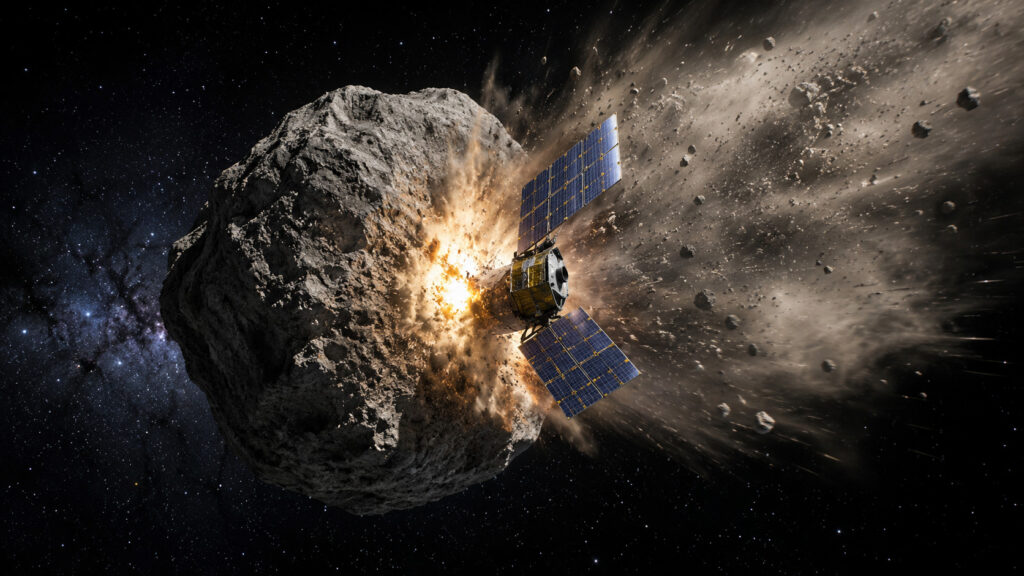

Sometime before the end of the decade, a Chinese spacecraft could race toward a small asteroid at roughly nine kilometres per second (about 20,000 miles per hour or 26 times faster than the speed of sound) and smack into it.
The impact should destroy the spacecraft instantly. But if everything works according to plan, the asteroid should emerge on a slightly different path.
If the mission succeeds, China would become only the second country, after the United States, to demonstrate that it can deliberately alter the motion of an asteroid, and that’s just one of several ambitious planetary defense missions the country is pursuing. They have an entire project designed to find dangerous asteroids, calculate their risk, study them at close range, hit them, and then measure whether their trajectories changed.
DART Proved That It Can Be Done
NASA demonstrated the basic idea on September 26, 2022, when its Double Asteroid Redirection Test, better known as DART, crashed into Dimorphos, a roughly 160-metre-wide moonlet orbiting the larger asteroid Didymos.
The 570-kilogram spacecraft struck at about 6.1 kilometres per second. Before the collision, Dimorphos completed one orbit of Didymos every 11 hours and 55 minutes. Afterward, the journey took 32 minutes less. It was the first time humans had intentionally changed the motion of a celestial object.
The physics of this mission was carefully planned. It’s not just the brute force alone that made the difference. The collision blasted tonnes of rock and dust from Dimorphos. As that material flew in one direction, it pushed the asteroid in the other, much like air escaping from a balloon. A study published in 2026 estimated that this debris roughly doubled the effective force of DART’s impact.
China’s mission takes a different approach. They want to hit faster, which in theory, could deliver a larger push. But the spacecraft’s mass, the angle of collision and the asteroid’s internal structure will all influence the result, and if the resulting debris behaves differently, the end result might be less spectacular.
China’s proposed mission aims to alter its target’s orbit relative to Earth and perhaps even “break up its structure,” according to the information shared by the South China Morning Post. But fragmentation would raise its own questions. Breaking one threatening asteroid into several large pieces wouldn’t necessarily make the danger disappear. In an Earth defense scenario, you’d want to deflect the asteroid off course, not break it into smaller pieces that still hit the planet.
Two Missions in One

That architecture would effectively combine two major Western missions.
DART delivered the collision, but it did not remain at Dimorphos to examine the damage. The European Space Agency launched Hera in October 2024 to perform that forensic work. Hera is expected to arrive in late 2026, map the asteroid, examine the impact site and probe beneath its surface with two small companion spacecraft.
China aims to perform the impact and the detailed investigation in a single campaign. Scientists would know what the asteroid looked like before the crash, see exactly how the collision unfolded and then measure how its structure and orbit changed.
However, the test is only a proposal for now. The latest paper describing it is still undergoing peer review, and officials have not announced a final target or launch date. But researchers led by Li Mingtao, the China National Space Administration’s chief scientist for planetary defense, are aiming for an impact during an asteroid’s close approach to Earth in 2029 or 2030. The object would pass approximately seven million kilometres, or 4.3 million miles, from the planet.
You Must Find the Asteroids First
Even a perfectly designed impactor is useless if astronomers discover a dangerous object too late.
China announced in June that it is studying a coordinated network of large ground-based telescopes and spacecraft to search for near-Earth asteroids around the clock. The system would automatically calculate newly discovered objects’ orbits and estimate their chances of hitting Earth.
More than 40,000 near-Earth asteroids have already been catalogued. Scientists believe they have found more than 95% of those measuring at least one kilometre across, which could cause global devastation. But only around 45% of the roughly 140-metre objects capable of devastating a country or large region have been identified, according to Li.
One of the greatest gaps lies in the direction of the Sun. Earth’s atmosphere scatters sunlight, blinding ground-based telescopes to objects approaching through the glare. The meteor that exploded over Chelyabinsk, Russia, in 2013 arrived broadly from that direction and went undetected until it entered the atmosphere.
China is therefore considering spacecraft positioned where they could watch portions of the sky inaccessible to terrestrial observatories. Options described by researchers include a satellite between Earth and the Sun, as well as spacecraft following or leading Earth around its orbit.
Better Safe than Sorry
“No asteroid has so far been identified that will definitely collide with Earth in the foreseeable future, but concerns over impact risks are not unfounded,” Li told the state-run Xinhua news agency. “Many near-Earth asteroids remain undetected.”
China’s plans are emerging as planetary defense becomes an increasingly global effort. More than 60 observatories and space institutions now participate in the United Nations-backed International Asteroid Warning Network, sharing observations so that astronomers can refine an object’s orbit and determine whether it poses a genuine threat.
A major new contributor has just come online: the Vera C. Rubin Observatory in Chile officially began its 10-year Legacy Survey of Space and Time on June 30, 2026. Rubin will photograph the southern sky every few nights, repeatedly catching moving objects that might otherwise escape notice. Even before the main survey began, preliminary observations uncovered more than 11,000 previously unknown asteroids, including 33 near-Earth objects, none of which threatened Earth.
NASA is also building NEO Surveyor, an infrared space telescope scheduled to launch no earlier than September 2027, which will search for dark asteroids and objects hidden in the Sun’s glare. Together, these projects underline the central lesson of planetary defense: no impactor can save Earth from an asteroid that humanity never sees coming.