China is building a so-called “mothership” to deploy underwater drones at scale, satellite images appear to show, as Beijing continues to bolster its military capabilities to aggressively back its claims in the Indo-Pacific.
The vessel, which experts described as the world’s first, was seen at the Hudong-Zhonghua shipyard in Shanghai where China previously built large amphibious assault warships.
It appears to be a purpose-built amphibious mothership capable of carrying at least four of Beijing’s top-secret extra-extra-large uncrewed underwater vehicles, two of which are known, one as long as 115ft, more than twice the size of the US navy’s Orca, and the other 148ft.
“By far the most plausible explanation is that it’s a special drone submarine mothership,” wrote the naval historian and analyst H I Sutton in Naval News, adding that multiple satellite images had been reviewed to assess its likely role.
The hull of the amphibious ship appears to be about 670ft long and 88.5ft wide and its stern contains a wet well deck and a cradle that can be lowered into the water using 12 vertical jack-up arms, according to media reports.
Given the ship’s size, Naval News estimated, it could carry four of the top-secret drones in the internal hangar, making a “civilian or research explanation unconvincing”.
Defence experts said the evidence from satellite images was compelling but not conclusive. “The satellite imagery doesn’t prove that China is building a dedicated mothership for large uncrewed undersea vehicles,” said Alessandro Arduino, an associate fellow at the Royal United Services Institute. “But it makes the possibility increasingly difficult to dismiss.”
He told The Independent that the new ship fit a pattern of China’s investment in autonomous systems designed not only to supplement traditional naval power but to change how the power was generated, distributed, and sustained.
China has rapidly expanded its naval capabilities amid growing tensions in the disputed South China Sea, where confrontations with rivals, especially the Philippines, have turned violent in recent years.
The Chinese uncrewed submarine is likely capable of carrying a payload over 10,000 nautical miles, compared to 6,500 nautical miles for the Orca.
The UK has developed its own version, known as XV Excalibur, which measures only 39ft long.
“It is a novel type of platform,” said Aditya Ramanathan, a research fellow at India’s Takshashila Institution, referring to the Chinese vessel. “I’m not aware of any other country that has a purpose-built sort of submarine carrier.”
It may still be two to three years before the new vessel is deployed after undergoing sea trials.

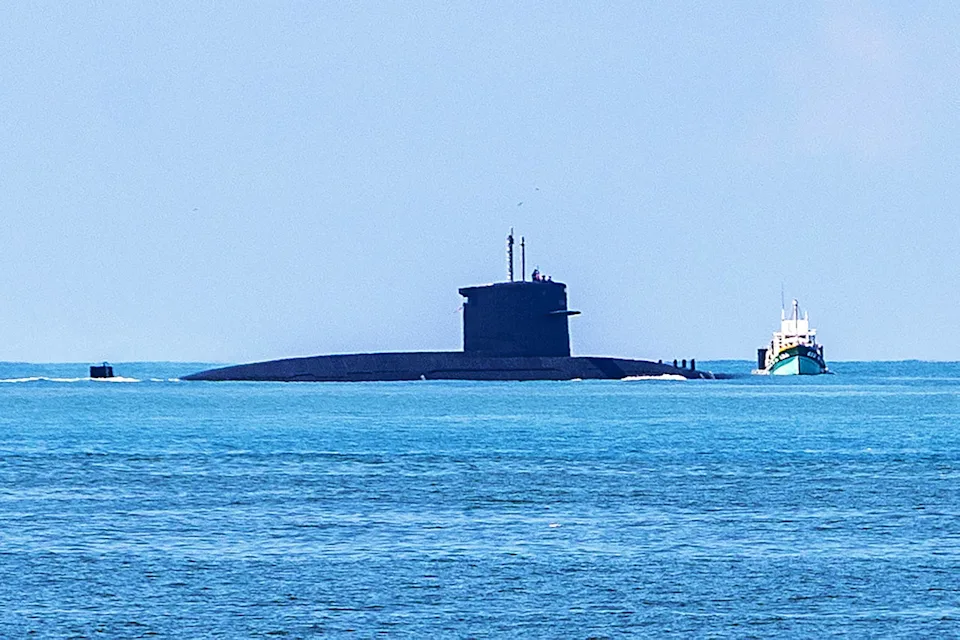
A Taiwanese submarine takes part in the Han Kuang military exercise in Kaohsiung on 5 August 2026 (AFP/Getty)
Mr Arduino noted that China had been exploring a larger autonomous underwater platform capable of carrying more sensors, payloads, and energy so that it could remain at sea longer and perform missions at a lower cost.
The Chinese military has neither confirmed nor denied the construction of such a vessel.
Although unmanned submarines are limited in many ways because of their much smaller sizes, they can perform tasks that bigger vessels can’t, like go in shallower waters. They can “quietly collect data on the noises, the acoustic signatures of other ships and submarines, and basically create large libraries”, so that in the future when they detect these acoustic signatures, they can immediately tell what they’re encountering, said Mr Ramanathan.
“And it will become harder for countries like India to detect them,” he added.
The mothership could expand the reach of these underwater drones and contribute to denying freedom of navigation to its adversaries, he added.
China claims sovereignty over almost all islands and reefs in the South China Sea, where it faces opposing claims from the Philippines, Vietnam, Brunei, and Taiwan.
A tribunal established at The Hague under the UN Convention on the Law of the Sea ruled in 2016 that China’s claims were illegal. Beijing rejected the ruling.
The contested waters are also a flashpoint with the US, which denies Beijing’s sovereignty claims in the region.
In this context, Mr Ramanathan explained, unmanned vessels increased China’s ability to dominate the underwater domain.
“For these countries, the military imbalance is so large that this simply adds more to it. And it’ll make it certainly harder for them, just like with India, to detect these submarines,” he said, referring to China’s rivals.
China and the US are locked in an escalating naval race, with Beijing building the world’s largest fleet and Washington pouring billions into high-tech dominance. China’s shipbuilding capacity is currently estimated to be at least 200 times greater than America’s.
“In the Indo-Pacific, the US is already exploring concepts built around large numbers of distributed autonomous systems, including the ‘Hellscape’. China is unlikely to respond symmetrically, meaning future maritime combat could resemble today’s drone-heavy land warfare more than traditional naval operations,” Mr Arduino said.
Mr Ramanathan said that uncrewed ships could be deployed just to collect data on adversary forces, temperature, salinity, and other oceanic details. “But,” he added, “they would also be capable of being used in combat in some way.”
Noting that the Chinese army had not fought a major war since 1979, Mr Arduino said that while “autonomous systems cannot simply compensate for the absence of combat experience, they can reduce dependence on some of the human factors by shifting more sensor fusion, and machine-speed decision support”.