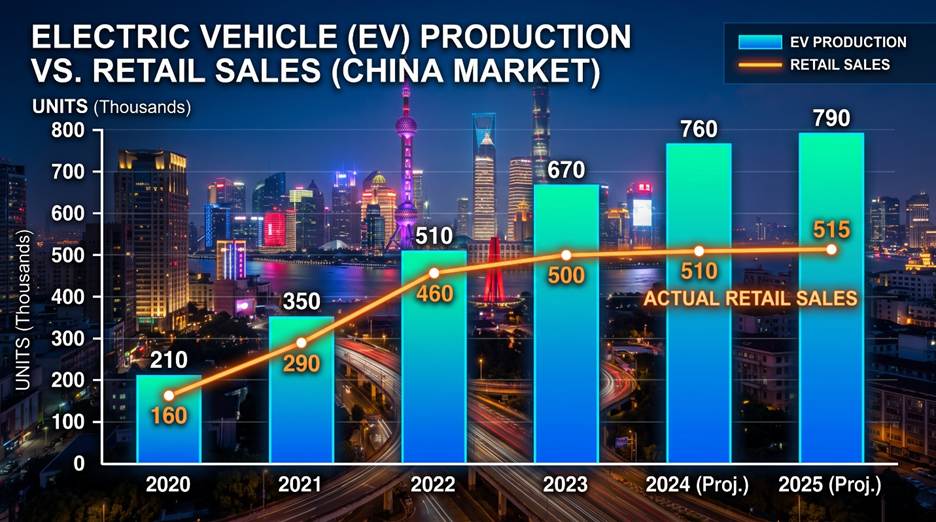
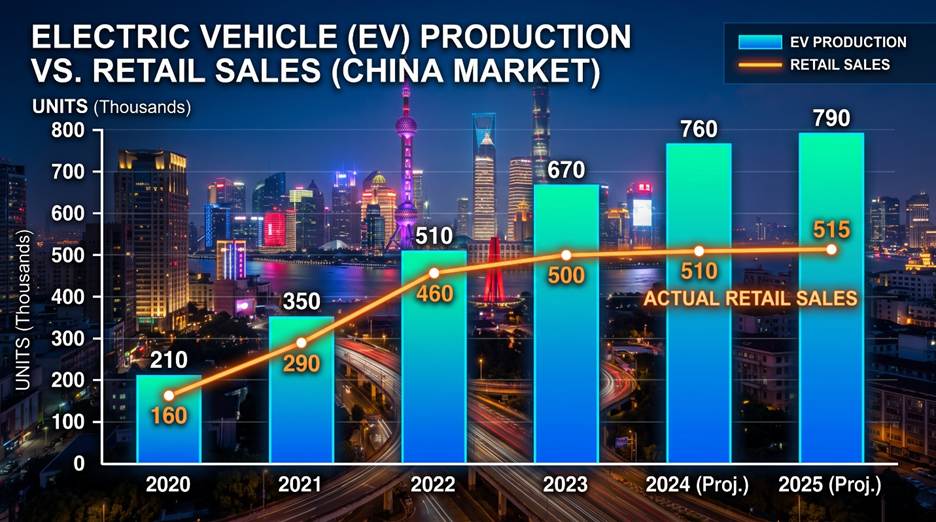
As an industry watcher, there are certain numbers that flash across the screen and immediately make the hair on the back of your neck stand up. We are currently looking at one of those numbers in the global automotive sector, and it is emanating directly from the East.
By the end of July 2026, passenger car inventory in China’s New Energy Vehicle (NEV) industry has swollen to a staggering 3.43 million units, translating to roughly 62 days of inventory on hand. For an industry that built its modern reputation on just-in-time manufacturing and lean supply chains, a 62-day glut of depreciating, battery-powered assets is not just an operational hiccup—it is a glaring, four-alarm bubble warning.
When you parse the latest retail figures, the disconnect between what factories are pumping out and what consumers are actually absorbing becomes painfully clear. According to recent data analyzing the first three weeks of July NEV retail sales, consumer uptake is fundamentally failing to keep pace with the relentless wholesale production quotas mandated by regional governments and optimistic corporate boards.
Let’s dive into the mechanics of this oversupply, analyze whether this market is heading for a soft landing or a spectacular crash, and examine what this all means for the validity of China’s much-touted global EV dominance.
The Roots of the 62-Day Swell
To understand how a market ends up with nearly three and a half million unsold vehicles sitting in lots, you have to look at the intersection of government policy, intense market competition, and macroeconomic headwinds.
First and foremost is the issue of local government subsidies and the desperate need to maintain factory utilization rates. In China, auto manufacturing is a massive driver of local GDP and employment. When demand softens, the typical Western response is to scale back shifts or idle plants. However, in the Chinese ecosystem, municipal governments often provide backdoor incentives to keep production lines rolling to avoid unemployment and maintain the illusion of economic growth. Factories are producing for the lot, not for the customer.
Secondly, we are witnessing the destructive side of price wars. Over the last two years, major players have relentlessly slashed prices to capture market share. Ironically, this has induced a phenomenon known as buyer hesitation. When consumers believe a car will be 10% cheaper in three months, they delay their purchase. This creates a vicious cycle: automakers cut prices to spur demand, which causes consumers to wait for further cuts, which in turn leads to cars piling up at dealerships and distribution centers.
Lastly, there is the undeniable reality of China’s broader economic slowdown. With youth unemployment high and a real estate sector still reeling from massive defaults, the Chinese middle class is pulling back on discretionary spending. A new EV is a significant capital outlay, and in a climate of economic uncertainty, families are simply choosing to drive their current internal combustion engine (ICE) vehicles longer.
Echoes of Bubbles Past
We have seen this movie before, and it rarely ends well for the latecomers. This current inventory expansion shares a chilling resemblance to the Chinese ICE vehicle overstock crisis of 2018. During that period, aggressive manufacturing targets combined with a sudden retraction in tax incentives left dealers choking on millions of unsold gas-powered cars. The result was a brutal wave of dealership bankruptcies and a painful two-year period of heavy discounting that eroded brand equity across the board.
Even further back, the dynamics mirror the American housing bubble of 2008 or the dot-com crash of 2000. In all these historical precedents, the core issue was a fundamental detachment of supply from organic demand, driven by systemic financial incentives to simply “keep building.” When you incentivize production rather than consumption, you inevitably build a mountain of product that the market cannot digest. The difference here is that EVs are essentially rolling computers with massive battery packs; they degrade. A car sitting in a field for six months loses battery health, suffers from software obsolescence, and physically deteriorates, making this inventory particularly toxic.
Will the Bottleneck Clear or Catastrophically Burst?
The immediate question for investors, global competitors, and policymakers is whether there are signs this situation will improve. Unfortunately, the leading indicators suggest things will likely get worse before they get better.
For the inventory situation to organically improve, consumer confidence in China would need a massive, sudden injection of optimism, driving a surge in retail buying. There are currently no macroeconomic indicators pointing to such a revival. Alternatively, automakers could drastically slash production. Yet, as noted, the political pressure to maintain employment makes severe production cuts a weapon of last resort.
Furthermore, China’s traditional safety valve—exporting its way out of domestic overcapacity—is being rapidly shut down. The European Union has recently imposed significant provisional tariffs on Chinese EVs, and the United States has erected a near-impenetrable 100% tariff wall. Without the ability to easily dump these 3.43 million excess vehicles on foreign shores, this massive inventory is largely trapped within China’s borders. Therefore, the pressure inside the domestic pressure cooker is rising, not falling.
Fixing the Glut Demands Drastic Measures
If China hopes to take this inventory down to more reasonable, healthy levels—say, 30 to 45 days of supply—it will require a highly orchestrated, and likely painful, market intervention.
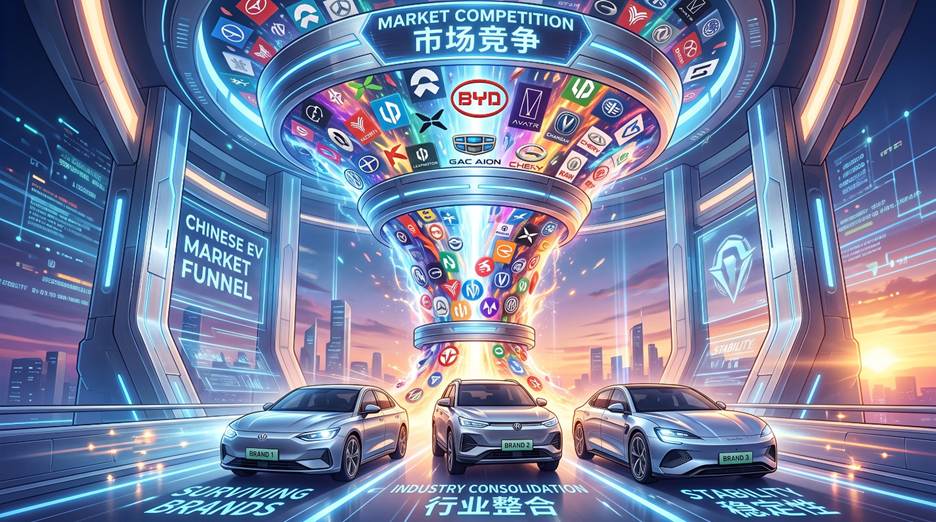
First, Beijing will have to force a brutal consolidation of the market. There are simply too many EV brands operating in China today. By turning off the financial taps to underperforming “zombie” automakers, the government can halt the overproduction at the source. This will mean bankruptcies, job losses, and a painful restructuring of the sector, but it is a necessary surgical strike to save the broader industry.
Second, we may see the implementation of a massive, government-funded domestic stimulus program. Think of it as a supercharged “Cash for Clunkers.” The government would essentially have to pay its citizens heavily to absorb this inventory, trading in older, polluting vehicles for these stockpiled NEVs.
Finally, the state might resort to fleet dumping—forcing state-owned enterprises, taxi networks, and government agencies to upgrade their fleets immediately using the overstock. While this temporarily clears the lots, it pulls forward future demand, essentially cannibalizing tomorrow’s sales to solve today’s crisis.
Smoke, Mirrors, and the Validity of China’s EV Market Share
Perhaps the most profound impact of this 62-day inventory is what it reveals about the validity of China’s reported EV sales numbers and its perceived global market share. For years, Western automakers have watched in awe and terror as Chinese EV makers reported astronomical, triple-digit growth figures.
However, in the automotive industry, there is a distinct and critical difference between a “wholesale” and a “retail” sale. A wholesale occurs when the factory sells the car to a dealership or a distribution partner. A retail sale occurs when a consumer actually registers and drives that car home.
When you have 3.43 million units of inventory clogging the system, it suggests that a vast portion of China’s historic EV growth was nothing more than channel stuffing. Factories were reporting spectacular production and wholesale numbers to secure government subsidies and boost stock valuations, but the end-consumer demand was largely an illusion.
This inventory growth casts a heavy shadow of doubt on China’s true EV market share. If millions of the vehicles counted as “sold” by the manufacturers are actually sitting in open-air lots gathering dust, then the narrative of an unstoppable Chinese EV juggernaut is deeply flawed. It means Western automakers, while certainly behind in cost-structuring, might not be as far behind in actual consumer traction as the headline numbers suggest. The true measure of a company is not how many units it can build with state funding, but how many units real people are willing to buy with their own money.

The Existential Threat to the Broader Automotive Economy
The sheer size of this inventory represents a systemic risk that extends far beyond the automotive sector, threatening the very fabric of China’s industrial economy. An inventory of 3.43 million vehicles, assuming a conservative average price of $25,000 per unit, represents roughly $85 billion in tied-up, depreciating capital.
For the smaller and mid-tier EV startups, this level of capital lockup is an existential threat. They operate on razor-thin margins and rely on continuous cash flow to fund R&D and pay suppliers. If dealers cannot sell cars, they stop ordering from the factories. If factories stop receiving orders, they stop paying parts suppliers. This cascading effect can trigger a wave of defaults down the supply chain, impacting everything from raw material mining to microchip procurement.
Moreover, there is a severe banking sector risk. Much of this production was financed through heavily leveraged loans from state-owned banks. If a wave of automakers and large dealership networks go bankrupt because they are choking on inventory, the banks will be left holding billions in non-performing loans, backed only by rapidly depreciating, obsolete electric vehicles.
In a country already grappling with a fragile real estate market, a collapse in the automotive manufacturing sector—China’s modern industrial crown jewel—could trigger a broader economic recession. It is a house of cards built on battery packs, and the wind is beginning to blow.
Wrapping Up
The swelling of China’s passenger car inventory to 3.43 million units is not merely a statistical anomaly; it is the inevitable consequence of prioritizing production over organic market demand. Fueled by government subsidies, relentless price wars, and a cooling domestic economy, this 62-day glut exposes the fragility of China’s hyper-aggressive EV strategy.
As historical precedents have shown, manufacturing bubbles cannot be sustained indefinitely. With export avenues narrowing due to Western tariffs, China faces a painful reckoning. To right the ship, Beijing must embrace necessary, albeit painful, market consolidation and resist the urge to artificially inflate wholesale numbers. Ultimately, this crisis proves that true market leadership is not defined by how many cars you can build and park in a field, but by how many you can profitably put in the driveways of willing consumers. The global automotive industry must take heed: the Chinese EV juggernaut is entirely capable of stalling out.
Disclosure: Images rendered by Artlist.io
Rob Enderle is a technology analyst at Torque News who covers automotive technology and battery developments. You can learn more about Rob on Wikipedia and follow his articles on TechNewsWord, TGDaily, and TechSpective.
Follow us today…